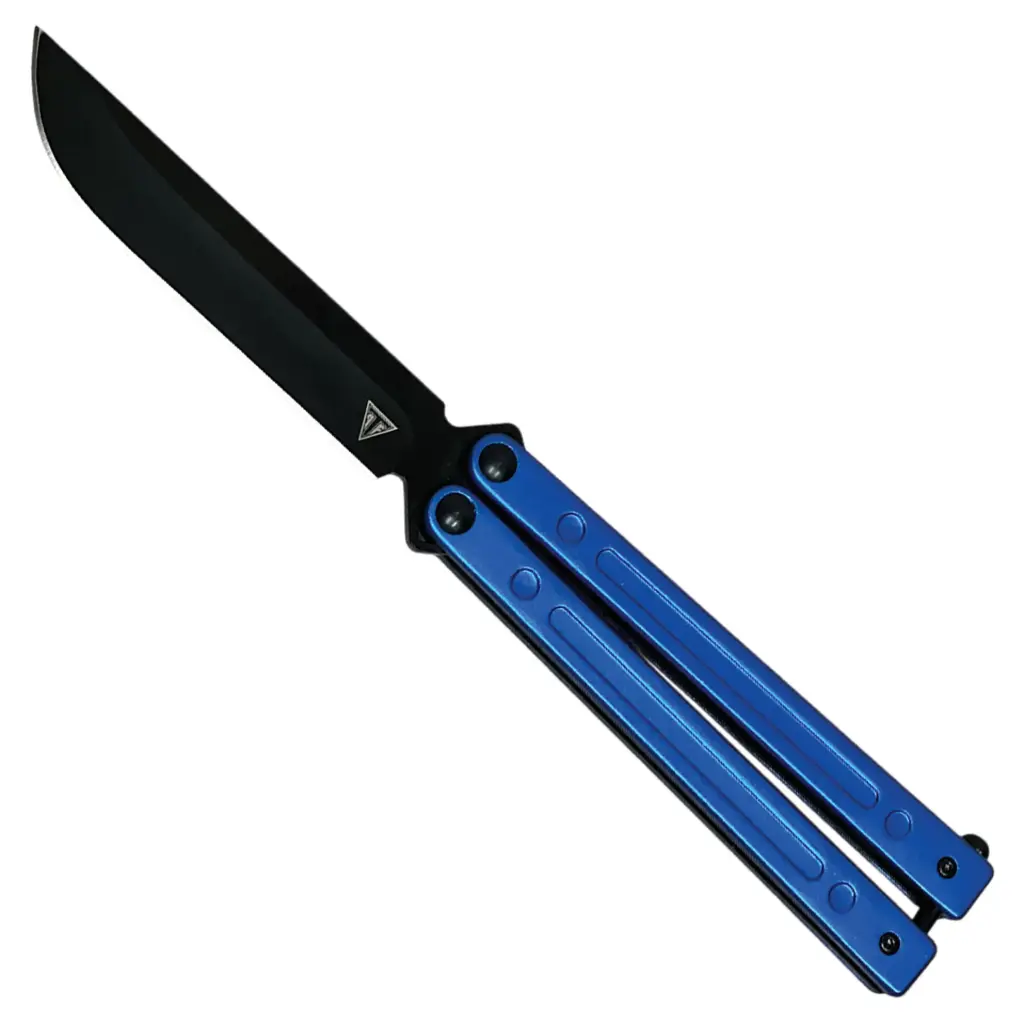
Azure Glide Bearing-Balanced Butterfly Knife - Blue Aluminum
You know that moment when the butterfly knife doesn’t fight you—it just moves? That’s where this butterfly knife lives. Ball-bearing pivots turn flips into muscle memory, while the blue aluminum handles stay locked in your grip and the matte black drop-point blade tracks exactly where you send it. You feel the balance in the first rotation, the control in the first cut, and the quiet shift from “trying tricks” to owning the motion every time you pick it up.
| Blade Length (inches) | 4.125 |
| Overall Length (inches) | 9.25 |
| Closed Length (inches) | 5 |
| Weight (oz.) | 4.31 |
| Blade Color | Black |
| Blade Finish | Matte |
| Blade Style | Drop Point |
| Blade Edge | Plain |
| Handle Finish | Anodized |
| Handle Material | Aluminum |
| Theme | None |
| Latch Type | T-latch |
| Is Trainer | No |
The first time you flip it open, you notice something missing: tension. No grit, no stutter, no half-commit that ruins your rhythm. The butterfly knife just moves—clean, glassy, obedient to your hands instead of your nerves. A streak of matte black, a flash of blue aluminum, and suddenly you’re not thinking about the mechanics. You’re just in the flow.
When a butterfly knife finally feels as smooth as you wanted
If you’ve ever fought a stiff hinge or a sticky latch, you already know how much a good butterfly knife changes everything. Here, the ball-bearing pivots are the quiet advantage. Each handle rides on a ring of steel bearings, so the rotation isn’t just smoother—it’s predictable. Your opening stroke feels the same on flip one as it does on flip one hundred, and that consistency is what lets your confidence catch up to your curiosity.
The drop-point blade stays centered through the arc, so you don’t feel that weird off-balance twist some butterfly knives give you mid-spin. At 4.125 inches, the blade gives you room to work for utility cuts, but the real story is how it travels: tip tracks true, handles circle like they’re on rails, and your fingers learn the timing without punishment for every tiny mistake.
Why this butterfly knife makes motion feel easy in your hand
The first time you pick it up, the blue anodized aluminum handles tell you what kind of tool this is. They’re slender without feeling fragile, grooved just enough that your fingers naturally find their place. Those long milled channels aren’t decoration—they’re quiet anchors for sweaty hands, nervous hands, or hands that are still learning. You don’t have to squeeze; the knife meets you halfway.
The matte black blade keeps glare out of your eyes and attention on your line. You’re not babying a polished showpiece—you’re using a butterfly knife that’s meant to be flipped, carried, and cut with. Torx hardware holds everything tight through drops, desk sessions, and pocket carry, and when you want to tune it, a standard bit is all you need. The T-latch snaps with a clear, decisive feel: open is open, closed is closed, and you don’t have to fight it to get moving.
Feeling the bearing-driven flip
You’ll notice the difference the moment gravity takes over. Instead of a clunky swing, the handles fall and recover like they’re riding on air. That’s the ball-bearing pivot system doing its job—translating your input into motion without stealing energy through friction.
Blue aluminum that looks sharp and works harder
The blue anodized aluminum isn’t just there to catch your eye in a photo. It hits that balance of stiffness and lightness that lets a butterfly knife feel alive but under control. You see brightness, you feel stability, and over time the color becomes a visual cue for that familiar, reliable flip.
The butterfly knife that turns practice into rhythm
Maybe you’re running repeated basic openings at your desk. Maybe you’re outside, working on cleaner rollovers, chasing that one sequence you keep dropping halfway through. The right butterfly knife doesn’t magically give you skill, but it removes the excuses. This one sits in that sweet spot at 9.25 inches overall and 4.31 ounces—enough length and weight to feel substantial, not so much that it punishes you for missed catches.
Closed, it compacts to 5 inches, which means it slips into a pocket, bag, or case without demanding its own space. You can live with it—pull it out between tasks, run a few flips, slide it away again. Over time, those micro-sessions stack, and you realize the knife has quietly become an extension of your hands. The butterfly knife didn’t make you good; it just stopped getting in your way.
Butterfly knife vs trainers and everyday folders: where this one fits your kit
If you’ve already spent time with a balisong trainer, you know the safe side of the equation—practice without bite. A live-blade butterfly knife adds something you can’t fake: consequence. That edge sharpens your focus, forces respect, and often tightens your technique faster because your brain knows the stakes are real.
Compared to a standard folding knife, this butterfly knife is about motion first and cutting second. A regular folder disappears until you need a box opened or a rope cut. This lives in your hand more often—on the couch, at the bench, on the porch steps—becoming part of how you fidget, decompress, and train your reflexes. The two-handle design distributes weight differently, letting you treat the movement itself as the hobby, not just a way to access the blade.
And then there’s the bearings. Bushings can feel more deliberate, with a hint of resistance that some people like. But if you crave glassy, low-friction, repeatable flips, a bearing-driven butterfly knife like this one rewards light touch and clean timing. Your grip pressure becomes your “tune,” letting you speed things up or slow them down in real time.
How this butterfly knife carries, cuts, and holds up day after day
All the smooth flipping in the world doesn’t help if the knife is annoying to live with. Here, the closed 5-inch profile is pocketable and manageable in a bag or drawer. The weight gives you just enough presence that you don’t forget it’s there, but not so much that it drags or prints awkwardly.
When you actually cut with it, the plain-edge drop-point blade shows up as more than just a flipping prop. It slices tape, cord, and packaging cleanly, with enough tip strength to handle those everyday puncture-and-draw cuts without feeling fragile. The matte black finish shrugs off light wear, looking more like a tool you trust than a toy you’re afraid to scratch.
Maintenance is simple. A soft cloth for the blade, a quick check of the Torx hardware, maybe a drop of oil on the bearings if you’re that kind of person—and you’re back to flipping. No drama, no babying, just a butterfly knife that returns to center every time you ask it to.
Questions People Ask Before Buying a Butterfly Knife
Is this butterfly knife good for someone still learning to flip?
If you’re past the pure fear stage and ready to be intentional, this butterfly knife gives you a lot of support. The bearing pivots help your moves feel smoother, and the balanced handles make it easier to feel where the knife is in space as you practice—just respect the live edge and learn deliberately.
What makes a bearing-driven butterfly knife feel different?
On a bearing-driven butterfly knife, the handles rotate with very low friction, so flips feel faster and more fluid. You’ll notice cleaner openings, snappier closes, and less choppy motion compared to gritty, dry pivots. It’s especially noticeable during longer combos where momentum matters.
Can I use this butterfly knife as part of my everyday carry?
You can, as long as local laws allow you to carry a butterfly knife. With its 5-inch closed length and balanced weight, it rides well in a pocket or pack, and the drop-point blade handles normal daily cutting easily. The key is carrying responsibly and staying aware of how a balisong looks in public spaces.
Is a butterfly knife legal where I live?
Butterfly knife laws vary widely by state, country, and even city. Before you carry or flip this butterfly knife outside your home, check your local regulations—sometimes online, sometimes with local law enforcement. When in doubt, practice privately and store it securely.
In the end, this isn’t about owning “a cool knife.” It’s about that subtle shift the first time you realize the motion feels like yours. You pick up this butterfly knife, feel the blue aluminum warm to your hand, thumb the T-latch open, and let gravity start the first swing. The bearings catch, the blade arcs, the handles return, and for a split second there’s nothing in your head but timing and sound. That’s who you become with a butterfly knife that finally moves the way you always imagined—calm, controlled, and quietly sure of your own hands.