Control Arc Hooped-Grip Meat Cleaver - Brown Pakkawood
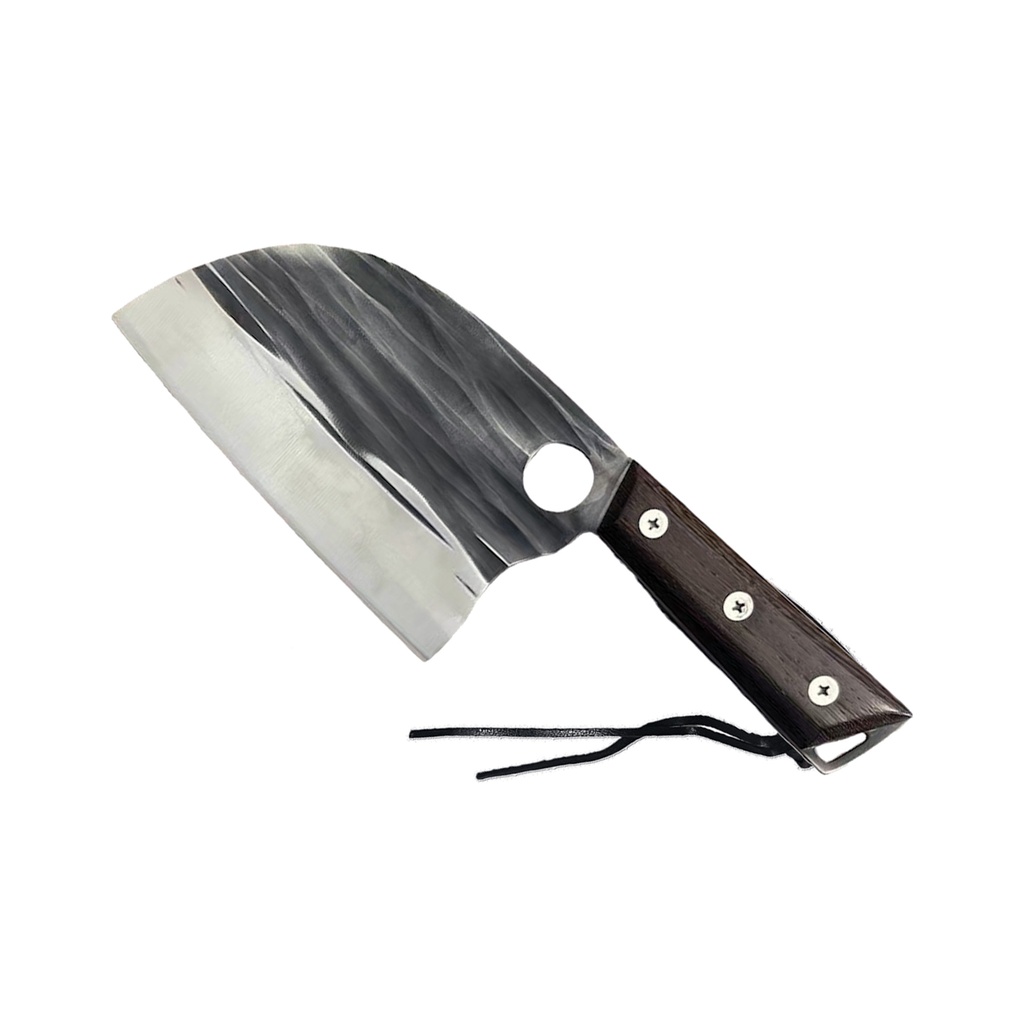
You know that moment on the cutting board when everything just clicks—the blade moves where your hand thinks, not where you push it? That’s what this meat cleaver does for you. The hooped grip drops your fingers into natural pinch control, while the 1080 high carbon steel edge bites cleanly through protein and veg. The brown pakkawood warms in your hand, the full tang steadies every swing. You don’t just prep faster—you move like someone who owns the board.
| Blade Length (inches) | 7.75 |
| Overall Length (inches) | 12.5 |
| Blade Color | Silver |
| Blade Finish | Matte |
| Blade Style | Cleaver |
| Blade Edge | Plain |
| Blade Material | 1080 high carbon steel |
| Handle Finish | Matte |
| Handle Material | Pakkawood |
| Theme | Modern |
| Handle Length (inches) | 4.75 |
| Tang Type | Full Tang |
| Pommel/Butt Cap | Lanyard Hole |
You’re halfway through prep when the rhythm falls apart. The knife you grabbed starts to slip in the garlic skins, the chicken thighs fight back, and suddenly you’re sawing instead of slicing. The board feels crowded, your hand feels tense, and you catch yourself thinking, “If I had a real meat cleaver, this would already be done.”
That’s the exact moment a well-designed meat cleaver changes who you are in the kitchen—from someone managing tasks to someone running the line.
When a Meat Cleaver Turns Prep Into a Rhythm, Not a Chore
Imagine dropping your hand onto the handle and feeling your fingers slide forward into that circular cutout in the blade. You don’t have to think about technique; the hooped grip naturally pulls you into a pinch hold. Suddenly this meat cleaver isn’t some heavy slab you wrestle with—it’s an extension of your hand.
You rock down through a pile of chicken wings. The 7.75-inch 1080 high carbon steel blade doesn’t bounce off joints; it finds the gap and goes through with a clean, confident thud. Then, without changing tools, you choke up into that hoop and mince garlic so fine it sticks to the steel. Same knife. Same board. Completely different level of control.
This is what the hooped grip really means for you: less white-knuckle power, more guided precision. Your wrist relaxes. Your knuckles stay clear of the board. You stop fighting the blade and start trusting it.
Why This Meat Cleaver Feels Like It Was Built Around Your Hand
On paper, you could call it a modern chef cleaver: full tang, 12.5 inches overall, pakkawood handle, 1080 high carbon steel. But that’s not what you feel first. What you notice is how the spine line and handle line stay straight, as if the whole tool was drawn with a ruler through the center of your grip. That straight geometry keeps the meat cleaver predictable—when you line up a cut, it tracks exactly where your eyes are.
The blade itself tells a quiet story. The upper section carries a matte, textured finish that shrugs off fingerprints and line-cook abuse. The lower edge area is smoother, honed to bite into meat and vegetables without tearing. You can actually feel the transition if you run your thumb (carefully) down the side—rough above, satin below—like the knife is split between work and finesse.
The feel of real steel and warm wood
As you start using it, the 1080 high carbon steel does what you secretly expect from a serious daily prep blade: it sharpens easily, takes a keen edge, and holds it through real work. You’re not babying it through soft tomatoes; you’re chopping, portioning, and crushing. Wipe, hone, back at it.
The brown pakkawood scales are where the warmth comes in. They’re pinned with three stainless screws along the full tang, so you never doubt the structure. But the sensation is subtle: it doesn’t feel like plastic, it doesn’t feel fragile, it just feels like a handle that’s going to be familiar every single time you pick it up, wet or dry.
How a Meat Cleaver Like This Fits Into Your Real Life, Not a TV Kitchen
In a home kitchen, this meat cleaver quietly becomes your default prep blade on nights that matter. The big roast you’ve been saving, the family barbeque, the meal you actually care about nailing. You reach for it when you want that feeling of, "I’ve got this" before the first cut.
You’ll use the broad blade to scoop diced onions from board to pan. You’ll crush garlic cloves under the flat, then pivot to fine chopping without changing tools. When you break down a pack of thighs or ribs, you stop worrying about bones dulling a delicate edge—you’ve got a daily carry kitchen workhorse in your hand, built for impact and repetition.
The quiet details that change how you move
The lanyard threaded through the butt end seems small until you’re moving quickly. In a busy outdoor cook or cramped prep space, you can hook it on a wall peg or carabiner instead of leaving it buried under packaging and vegetable trimmings. You always know where your cleaver is when the next task hits.
And then there’s the weight distribution. With a full-tang spine running through that compact 4.75-inch handle, the cleaver balances just ahead of your index finger when you’re in the hooped grip. That forward bias gives your chop authority, but the control stays in your fingertips. You feel like you’re guiding the fall of every cut, not just relying on gravity.
When a Meat Cleaver Beats Your Regular Chef Knife (And When It Doesn’t)
There’s a question every thoughtful cook asks sooner or later: "Do I really need a separate meat cleaver when I already own a chef knife?" The answer shows up the first time you force your usual blade through something it never volunteered for—frozen edges, dense bone, thick cartilage. You feel it twist, you wince, and you pretend it didn’t just hurt the edge you like.
This is where a hooped-grip cleaver earns its place. It gives you two things your regular knife usually can’t: impact confidence and fingertip precision in the same tool. For heavy work—portioning ribs, separating joints, spatchcocking poultry—you stop hesitating. For fine work on the board—shaving scallions, dicing aromatics—you choke up into the hoop and move like you’re using a smaller everyday kitchen knife.
Could you still use your chef knife for everything? Of course. But owning a dedicated, control-focused meat cleaver says something different about you: you’re not improvising your way through prep anymore. You’re equipping yourself on purpose.
Questions People Ask Before Buying a Meat Cleaver
Will this meat cleaver be too heavy or tiring to use every day?
Weight matters, but balance matters more. This meat cleaver carries its mass forward into the blade while the full-tang handle and hooped grip keep control near your fingers. That means the knife does more of the work, and your wrist steers instead of strains. Most people find it easier on the hand than forcing a lighter knife through tough cuts.
Can I use a meat cleaver for more than just chopping meat?
Absolutely. A good everyday meat cleaver like this doubles as a kitchen utility blade. You’ll crush garlic, slice vegetables, portion protein, and scoop ingredients with the broad side. The hooped pinch grip makes it feel almost like a compact chef knife when you’re doing detailed work, so it doesn’t have to live in the drawer until butchering day.
Will a high carbon steel meat cleaver rust if I use it a lot?
1080 high carbon steel rewards basic care. Rinse, wipe dry, and don’t leave it soaking in a sink full of dishes. Treat your meat cleaver like a serious everyday carry tool for the kitchen—quick clean, occasional oil on the blade if you’re storing it long-term—and it gives you reliable bite and easy sharpening in return.
At the end of a long prep session, picture this: the board is finally clear, pans are working, and your hands don’t ache. Your meat cleaver rests by the stove, blade lightly misted, pakkawood darkened from your grip. You’re not the person wrestling dull knives and praying they’ll get through bone anymore. You’re the one who chose a tool that moves with you, matches your intent, and makes every cut feel deliberate. From here on out, when it’s time to get serious at the board, you already know which knife your hand is going to close around.