Curved Guard Heritage Arming Sword - Black Leather
You don’t hang this medieval arming sword on the wall to look dangerous. You grip the black leather, feel the weight of full-tang steel, and suddenly “medieval” isn’t history anymore—it’s in your hand. The curved guard settles between your fingers and the blade tracks straight, whether you’re drilling cuts in the backyard, stepping into reenactment lines, or commanding a room from its place on the wall. This arming sword doesn’t play at being a relic—you carry it like someone who knows exactly why knights trusted steel like this.
You don’t think about the cameras when you step onto the field. You think about the way your hand finds the black leather without looking, how the steel sits in your grip like it’s been there a hundred times before. The crowd sees a costume; you feel something very different—weight, balance, that quiet moment before motion when your medieval arming sword becomes an extension of you instead of a prop.
When a Medieval Arming Sword Stops Being a Prop and Starts Being Yours
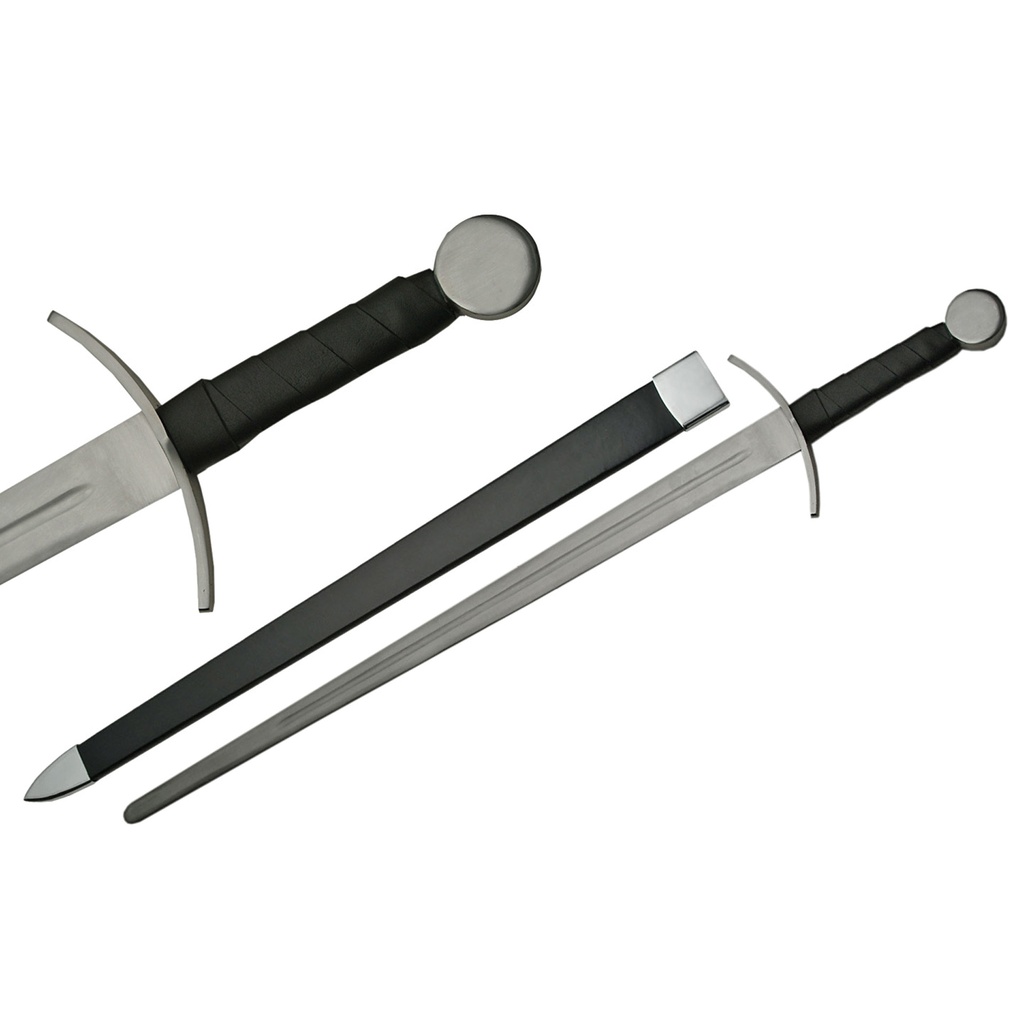
If you’ve swung enough wall-hangers, you already know the difference. They feel dead in the hand—either too light, too heavy, or just wrong. With this medieval arming sword, the first thing you notice is that it tracks where your eyes go. A straight, double-edged blade runs 33 inches from the guard, with a central fuller pulling just enough weight out of the spine to keep it lively. At 40 inches overall, it lives in that sweet spot between reach and control.
You’re not fighting the sword to make it move; you’re simply deciding where it should go next. A cut from the shoulder drops neatly into a guarded stance. A quick feint snaps back on line without drifting. Whether you’re drilling in the backyard, moving through choreographed stage combat, or locking shields in reenactment, this is the medieval arming sword that behaves like the pieces you’ve only read about.
Why This Medieval Arming Sword Feels Like Real Steel History
Design tells the truth faster than marketing ever could. You see it in the full tang disappearing into the hilt—this isn’t a decorative rod welded into mystery metal. The straight, double-edged blade in satin steel carries a single fuller, not because it looks "medieval," but because real swords used it to balance strength and agility.
Then your eye hits the guard. Not a fantasy spike, not some overly ornate flourish—just a clean, curved crossguard in brushed steel that naturally frames your grip and guides your fingers. That curve is subtle, but you feel it the moment you close your hand; it keeps your fingers from creeping forward on a hard thrust and gives your off-hand an anchor point in half-swording drills.
Follow the line back and the disc pommel finishes the story. Round, flat, and purposeful, it’s the kind of pommel you’ll recognize from museum pieces and historical texts—a counterweight that lets the medieval arming sword pivot effortlessly from the wrist. The satin finish on guard and pommel keeps everything grounded and serious. No chrome, no shine—just steel that looks like it was meant to work.
Carrying, Drawing, and Using a Medieval Arming Sword in Real Life
Owning a medieval arming sword isn’t just about what happens when the blade is out. It’s everything around that moment: how it hangs at your side, how quickly you can clear leather, how it feels to re-sheath without fumbling or fear.
The black leather-wrapped grip is where you start to realize someone thought about your actual hand. Those subtle ridges in the wrap give your fingers natural lanes to fall into, so you’re not squeezing to stay in control. Bare-handed, the leather feels secure and dry; through gloves, it still speaks clearly enough that you know exactly where the edge is.
The matching black leather scabbard completes the way you move with it. Steel fittings at the throat and tip don’t just look right next to the brushed guard and pommel—they protect the blade and reinforce the points that take the most abuse. When you draw, the scabbard gives just enough resistance to feel deliberate, then releases cleanly so the medieval arming sword is in your hand exactly when you expect it to be.
On a wall, the black-and-steel combination sends a different kind of message. Not flashy, not gaudy—just a straight-edged silhouette that says someone in this house respects real steel. You don’t need engraving or gold. The understatement is the point.
When Choosing the Right Medieval Arming Sword Actually Matters
There’s a moment in every collection or kit-building journey where you decide whether you’re playing at the past or actually living with it. That’s when the kind of medieval arming sword you carry starts to matter.
In reenactment, you’re lining up shoulder to shoulder, knowing your blade might clash, bind, or take an unexpected hit. A full-tang construction and battle-ready build give you that quiet confidence—you’re not babying it in the back of your mind. In stage combat, you’re trusting steel not to flex strangely or feel unpredictable under pressure, because your partner is depending on it as much as you are.
Even if your battlefield is a living room where friends gather around a wall display, the choice still speaks. They’ll see the disc pommel, the curved guard, the straight medieval blade and ask, “Is that real?” You’ll know the answer in the way it pulls slightly at the belt, in how the weight settles when you lift it, in the clean, honest lines that match historical arming swords instead of movie props.
Questions People Ask Before Buying a Medieval Arming Sword
Is this medieval arming sword just for display, or can I actually use it?
You’re not looking at a hollow wall-hanger. This is a full-tang, battle-ready medieval arming sword built for reenactment, stage combat, and serious solo drills. The blade, fuller, and fittings are designed to take real movement and contact, while still looking good enough to anchor a display.
How does this medieval arming sword feel in the hand for longer sessions?
If you’ve ever finished a practice session with a sore wrist, you’ll notice the difference here. The central fuller, disc pommel, and curved guard work together so the medieval arming sword pivots from your hand instead of fighting you. The black leather grip and subtle ridges help you maintain control without white-knuckling, even during extended drills.
What makes this different from cheaper medieval swords I see online?
Most budget options are built to look like swords, not move like them. This medieval arming sword is full tang, with a straight double-edged blade, brushed steel fittings, and a scabbard designed to be worn and used. You don’t have to treat it like fragile décor—you handle it like serious gear that respects the original purpose of a knight’s sword.
Will this medieval arming sword fit into my existing kit or collection?
If your kit leans historical, the proportions, disc pommel, and curved crossguard will feel right at home among other medieval blades. If your collection is mostly fantasy pieces, this medieval arming sword becomes the grounding element—the one that looks like it could have actually seen a battlefield.
Later, when the field is quiet and the gear is packed away, you’ll slide the blade back into black leather and hang it where you can see it from across the room. The curved guard will catch the light, the disc pommel will stand out in its simple, round certainty, and you’ll recognize something in that silhouette. Not just a medieval arming sword, but a tool you chose on purpose—a piece of steel that makes you feel a little more like the kind of person who doesn’t just read about history, but carries a fragment of it, ready, in their own hand.