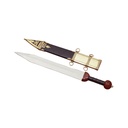
Imperial Laurel Officer’s Roman Gladius Sword - Wood Handle
You don’t hang this Roman gladius sword because you like history trivia. You hang it because command has always quietly called your name. The polished 27-inch blade, warm wood handle, and laurel-crowned black-and-gold scabbard don’t just decorate a wall—they shift the room. Suddenly your office feels like a war room, your study like a general’s quarters, and you like someone who doesn’t just read about empires—you claim one small piece for yourself.
You don’t buy a Roman gladius sword on a whim. You buy it on the day you decide your space should finally look the way your life feels—earned, focused, a little dangerous in the best way. Maybe it’s that bare wall behind your desk that’s been quietly mocking you on every video call. Maybe it’s the shelf in your den that holds stories of empires, but nothing that actually looks like one. Either way, you’re ready for something that doesn’t just sit there. It says something.
How a Roman gladius sword changes the room the moment you hang it
The first time you mount a Roman gladius sword on the wall, the air in the room shifts. The straight, double-edged blade catches the light; the spear point draws the eye like an exclamation mark. You notice visitors pause mid-sentence, their gaze locking onto the black-and-gold scabbard crowned with imperial laurel. They don’t ask where you got it first—they ask what it means to you.
This isn’t an anonymous fantasy blade. It’s a replica of the weapon that built an empire—short, efficient, made for command at close range. At about 27 inches overall, with a roughly 19.75-inch polished blade, it feels substantial when you lift it, but controlled, not unwieldy. You can actually imagine a Roman officer drawing it in a crowded street or on a dusty frontier road, and in that moment, your bland wall becomes a scene.
Why this Roman gladius sword feels like an artifact, not a prop
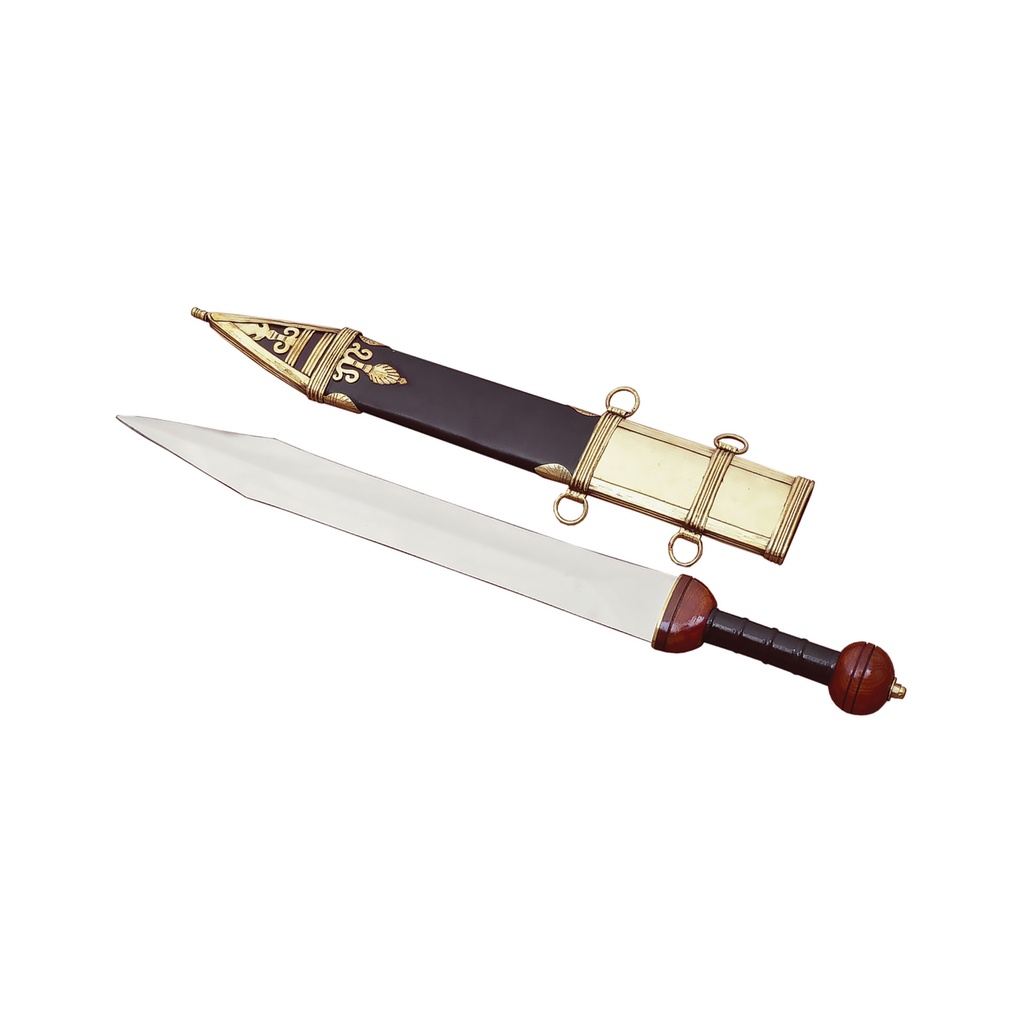
There’s a difference between something you buy as décor and something you keep because it feels like it has a story. This Roman gladius sword leans hard into the second category. The first thing your hand finds is the segmented wood handle—warm, smooth, with just enough shape to tell your fingers where to settle. No fake plastic shine, no cheap costume feel. Just real wood that picks up a little of your skin’s warmth every time you hold it.
The blade itself is polished bright, not brushed or dulled into the background. That mirror-like finish makes the edges and spear tip stand out the way a true officer’s weapon should. Gold-colored guard and pommel bookend the wood grip, echoing the scabbard’s ornate fittings so the whole piece reads like a single, deliberate design. You’re not hanging random parts—it’s one unified statement.
Then there’s the scabbard: black body, gold bands, four suspension rings, and a laurel crest at the throat. That laurel detail is where the design really clicks—Romans reserved laurels for those who earned distinction. When you see that wreath, it doesn’t feel like generic decoration. It feels like quiet recognition—of years worked, goals hit, battles fought that no one clapped for but you still won.
Living with a Roman gladius sword: from wall piece to conversation ritual
Owning a Roman gladius sword isn’t just about the day you unbox it. It’s about the dozens of small moments after. The late-night pass through your office where you catch its outline in the lamplight and remember you’ve come farther than you give yourself credit for. The way your hand absentmindedly rests on the pommel when you’re thinking through a hard decision, like you’re grounding yourself in something older and steadier than the week’s chaos.
Mounted vertically by your desk, the laurel crest sits near eye-level—almost like a seal of rank on the wall. Hung horizontally above a bookshelf, the black-and-gold scabbard frames your collection, turning a row of spines into something that looks curated, intentional. You’re not just someone who reads history; you’re someone who claims a physical link to it.
When friends come over, the ritual repeats. Their eyes flick to the Roman gladius sword, then back to you with a half-grin and a question that always sounds something like, “Okay, story time—what’s with the sword?” And you get to decide the answer. Maybe it marks a promotion, a new business, a hard reset in your life. Maybe it’s a nod to the part of you that never stopped loving legions, standards, and the clean, efficient lines of ancient steel. Whatever the story is, you now have an object worthy of it.
When a Roman gladius sword beats another random wall decoration
There’s a moment where you almost talk yourself into a framed print or another generic shelf piece. It’s safe. It’s what everyone else does. But a Roman gladius sword doesn’t feel like something you bought because it matched the couch. It feels like something you chose because it matched you.
Compared to abstract décor, this has weight you can feel. You can slide the blade from the scabbard and feel that 19.75-inch double-edged steel in your hand—solid, centered, a reminder that the world wasn’t always backlit glass and touchscreens. The wooden handle nests into your palm, the gold guard catching the light as you turn it. Even if you never swing it, never stage a reenactment, the simple act of drawing and sheathing it turns a static object into a small daily ritual of presence.
And unlike a plastic or foam replica, this Roman gladius sword doesn’t announce itself as costume. The polished blade, metal-and-leather scabbard, and realistic proportions all read as “collector’s piece,” not “party prop.” When someone steps into the room, they don’t think Halloween. They think history, authority, and a bit of daring on your part for putting something like this on display in the first place.
The small details that make it feel right in your hand
Pick it up and you notice how the shorter, straight blade keeps the weight close. This isn’t some oversized wall monster you’re afraid to touch. At around 27 inches total, it’s long enough to command attention, short enough to handle comfortably. The wood handle’s rounded segments give your fingers natural stopping points, so your grip feels secure even when you’re just turning it over to admire the lines.
The scabbard’s four mounting rings offer options: suspend it from a display hanger, lash it to a custom plaque, or even rig it to hang from a belt for costuming or events. The black leather or leather-like body absorbs shadows, while the gold bands and laurel crest catch light—so from across the room, what reads first is that gold Roman geometry framing the blade, not random clutter.
A display piece that still respects the weapon it represents
Even if you’re purely a décor buyer, there’s something satisfying about knowing your Roman gladius sword is more than a flat wall ornament. The double edges track straight from guard to tip, the spear point narrows cleanly, and the polished finish lets you see the line where light breaks along the blade. It looks like a weapon that could have seen a frontier, even if yours lives in an office.
Questions people ask before buying a Roman gladius sword
Is this Roman gladius sword just for display, or can I handle it?
You can absolutely handle it. While it’s designed as a display-grade Roman gladius sword, it’s built as a full fixed-blade short sword with a real metal blade, wood handle, and metal-and-leather scabbard. Most owners proudly hang it, then take it down now and then to feel the weight and relive the story behind it.
How big is this compared to other swords for the wall?
This Roman gladius sword sits in the sweet spot: about 27 inches overall, with a 19.75-inch blade and 7.25-inch handle. That makes it big enough to dominate a wall section without overwhelming a room. It looks right above a desk, over a bookshelf, or centered on a narrower accent wall where a full-length greatsword would feel out of place.
Will a Roman gladius sword like this actually look good in a modern office?
Yes—especially because the black-and-gold scabbard and wood handle bridge modern and classical style. Against a white or gray wall, the dark scabbard adds contrast while the gold fittings and laurel crest act like bold trim. Instead of clashing with screens and clean lines, this Roman gladius sword becomes the one intentional, storied object in a sea of modern sameness.
Is it hard to mount a Roman gladius sword securely?
Mounting is straightforward. The scabbard’s four suspension rings give you multiple anchor points for a wall rack, hooks, or a custom plaque, so you’re not depending on a single flimsy bracket. Once it’s up, you can leave the sword sheathed for a clean, imperial look or occasionally draw it to show guests the polished blade.
Eventually, there’s the night you stay up later than you meant to, work finally quiet, house finally still. You lean back, eyes drifting to the wall where your Roman gladius sword hangs—polished blade sleeping inside that laurel-crested black-and-gold scabbard, wood handle catching just a line of lamplight. In that quiet, you feel it: you’ve turned four bare feet of wall into a declaration. You’re not just passing through your days; you’re standing your ground, claiming your space, carrying a little of that Roman certainty into a world that too often forgets what real presence looks like.