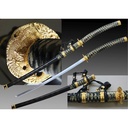
Dragon Oath Ceremonial Jintachi Sword - Black & Gold
You don’t hang this Japanese ceremonial sword to fill a blank wall—you hang it to change the whole room’s story. The first time your hand closes around that extra-long, black-and-gold wrapped handle, the polished carbon steel feels cold and real. The dragon guard catches the light and suddenly your décor, your cosplay, your collection stops looking random and starts looking intentional. This is the piece people notice, and the one that quietly says you care about the legend behind the blade as much as the look.
You don’t buy a Japanese ceremonial sword for the metal alone. You buy it for the moment when someone walks into your space, goes quiet mid-sentence, and takes three steps closer without realizing it. Their eyes go to the long, black lacquered scabbard, trace the gold fittings, and stop at the dragon guarding the hilt. Then they look at you—because this isn’t just décor anymore. It’s a statement about the stories you keep close.
When a Japanese ceremonial sword changes the room before you say a word
Picture this: the lights are low, your shelves are already lined with pieces you’ve hunted down over years—figures, art, maybe another blade or two. But when you mount this 43 1/4" Japanese ceremonial sword, the balance shifts. The extra-long handle stretches further than a standard katana, wrapped in black and gold that looks almost like it was lifted from a formal procession.
You slide the polished carbon steel from its black scabbard and hear that soft, clean whisper of steel against wood. In that second, you’re not just someone who “likes swords.” You’re the person who chose one with presence: a curved, single-edged blade that looks ceremonial but still feels honest in the hand—sharp, real, and built to be more than a toy.
Why this Japanese ceremonial sword feels like it came from another era
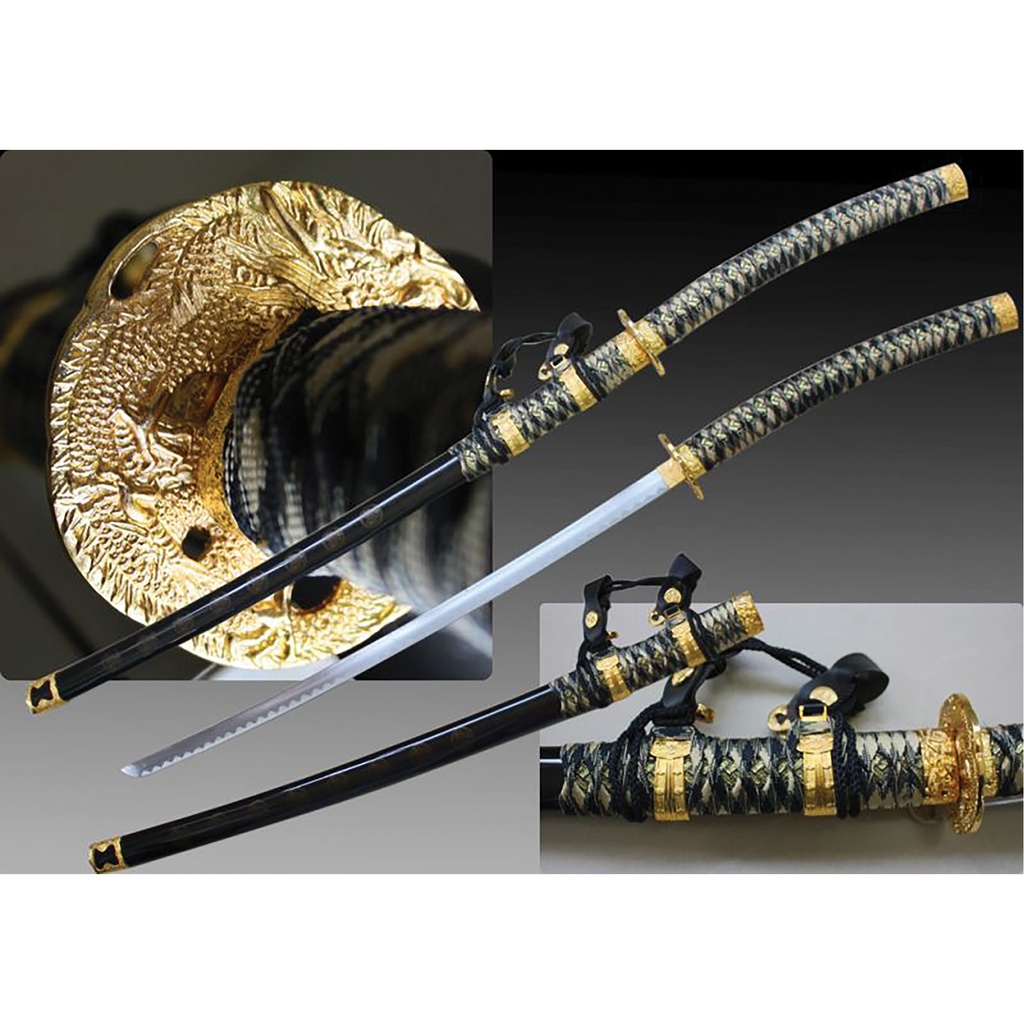
There’s a reason this doesn’t vanish into the background like a mass-market wall hanger. The design leans fully into ceremony: a long, elegant profile, a curved blade with a subtle hamon-like line near the edge, and fittings that tell a story before you ever do. The guard is a round tsuba, heavy with a raised dragon motif that feels textured under your fingers, not just printed on for show.
The black lacquered scabbard catches reflections in a way that makes it look like still water, interrupted only by gold suspension rings and end caps that echo old imperial themes. You notice how the gold pommel and collar aren’t just bright—they have a grain and depth to them that makes them feel like part of something ceremonial, not just sprayed-on color.
The moment your hand finds the extra-long handle
The first time you grip the handle, you feel what makes this different. That extra length changes your whole stance. The traditional cord wrap sits firm under your palm, and you can shift from single-hand to two-hand grip without running out of space. Even if you’re just practicing draws in front of a mirror or rehearsing for a cosplay event, the balance helps you move like you mean it.
Carrying the weight of a Japanese ceremonial sword in your story
This isn’t the kind of blade you stuff in a closet and forget. You live with it. You build a corner around it—on the wall above a console table, across a pair of hooks, or standing in a dedicated sword stand by your desk. Every time you pass it, you feel that quiet little checkmark in your head: this is exactly the kind of thing you always said you’d own someday.
For cosplay or costume, the ceremonial build is what sells the illusion. The suspension rings and black straps on the scabbard aren’t random decoration—they let you rig this Japanese ceremonial sword in a way that looks like it belongs on a uniform, not just looped through a belt on a whim. When you walk into a convention hall or onto a stage, the black-and-gold theme reads instantly as formal, intentional, and refined.
How it looks and feels in motion
Draw it slowly and the polished carbon steel throws slim, clean reflections. Turn it and you catch the line of the edge, sharp enough that you can feel the risk even if you never plan to cut a thing with it. That’s part of what makes this Japanese ceremonial sword hit differently: it’s meant to be displayed, but it never feels fake. You know, in the back of your mind, that this blade can still bite.
When a Japanese ceremonial sword is more than decoration
Maybe you’ve looked at cheaper wall swords before—the kind with loose fittings, shallow details, or blades that feel like stamped sheet metal. They fill space, but they don’t satisfy that part of you that wants something with weight and story. This Japanese ceremonial sword steps into that gap. The carbon steel blade has substance when you lift it; there’s a real spine to the steel, and a real edge you respect.
The dragon tsuba isn’t just a hint of a design—it has enough relief that you can trace the scales with a thumb. The gold fittings frame the black scabbard the way jewelry frames a suit. You don’t have to explain why you chose this one. People read it right away: this is a piece that’s meant to represent rank, ritual, or legacy—even if the ceremony is just the way you curate your space.
Questions People Ask Before Buying a Japanese ceremonial sword
Is this Japanese ceremonial sword only for display, or is the blade actually sharp?
The blade on this Japanese ceremonial sword is made from carbon steel and comes sharpened, so it’s not a toy. While it’s designed primarily for ceremonial and display use, it has real cutting potential and should be handled with the same respect you’d give any live blade.
How big is this compared to a standard katana?
This sword runs about 43 1/4" overall, with an extra-long handle that gives it a more formal, procession-style profile than a typical katana. In person, it feels slightly grander—more presence on the wall, and more room for your hands when you actually hold it.
Can I use this Japanese ceremonial sword for training or cutting practice?
It uses carbon steel and has a sharp edge, but its fittings and ornate black-and-gold design lean toward ceremonial and display. Light handling and form practice are fine if you’re careful, but if your main goal is heavy cutting or regular dojo work, you may want a blade built specifically for that abuse.
Is a Japanese ceremonial sword like this legal to own?
In most places, owning a Japanese ceremonial sword at home is legal, especially when it’s used for display or collection. Carrying it in public can be a different story. Local laws vary a lot, so it’s worth checking your area’s regulations if you plan to transport or wear it as part of a costume outside your home.
Living with a Japanese ceremonial sword as part of who you are
Imagine the first night you mount this Japanese ceremonial sword in its new spot. The room is the same, but it doesn’t feel the same. You step back, take it in—the curved blade resting silently in its glossy black scabbard, the gold dragon at the guard catching just enough light to look like it’s watching the doorway. Your hand knows exactly how that extra-long handle feels, how the wrapped cord bites gently into your grip.
From that point on, every time someone notices it, they learn something real about you: that you care about ceremony, about craft, about objects with story and weight. You’re not just collecting things—you’re building a world you want to live in. And this Japanese ceremonial sword stands there as proof.