Fieldline Guarded Profile Boot Knife - Olive Green
You pause beside the boots by the door, checking where your boot knife belongs in the day ahead. Your thumb finds the olive-green handle ribs; the black sheath’s snap closes beneath your fingers. You take a moment to check the fit instead of trusting appearances. That small habit says more about your kit than another accessory ever could. You’re choosing what earns its place, what needs checking, and what stays behind. The result feels less like dressing a part and more like knowing your own equipment.
| Blade Length (inches) | 4.875 |
| Overall Length (inches) | 9 |
| Blade Color | Black |
| Blade Finish | Matte |
| Blade Style | Dagger |
| Blade Edge | Plain |
| Handle Finish | Textured |
| Handle Material | Nylon Fiber |
| Theme | Tactical |
| Handle Length (inches) | 4.125 |
| Pommel/Butt Cap | Lanyard Hole |
| Carry Method | Sheath |
| Sheath/Holster | Nylon |
Your boots are beside the door, but you haven’t reached for them yet. You’re checking the gear laid across the bench, deciding what belongs in today’s setup. A boot knife earns its place through that pause, not through its silhouette alone. With Fieldline, you get a fixed blade, a ribbed olive-green handle, and a nylon sheath to evaluate against your routine. Your boot knife should fit the day you actually have, not an imagined emergency.
Finding Your Rhythm With a Boot Knife
You know the difference between equipment you enjoy looking at and equipment you understand. This boot knife gives you a clear starting point: a 4.875-inch blade and a 9-inch overall length. Those measurements matter when you picture where it will sit, how you will store it, and whether your boot knife belongs in your carry rotation at all.
You aren’t dealing with a folding mechanism or an opening sequence. With this fixed blade knife, you remove it from its sheath rather than unfold it. That simplicity still asks something of you: enough room, an appropriate setting, and deliberate handling. A boot knife isn’t automatically the convenient answer simply because it has fewer moving parts.
Before the door closes behind you
You make better decisions while your gear is still on the bench. Check the sheath, consider your destination, and confirm that carrying a boot knife is permitted there. Readiness can mean taking a tool along; it can also mean recognizing when your ordinary pocket tool makes more sense.
What Your Boot Knife Tells Your Hand
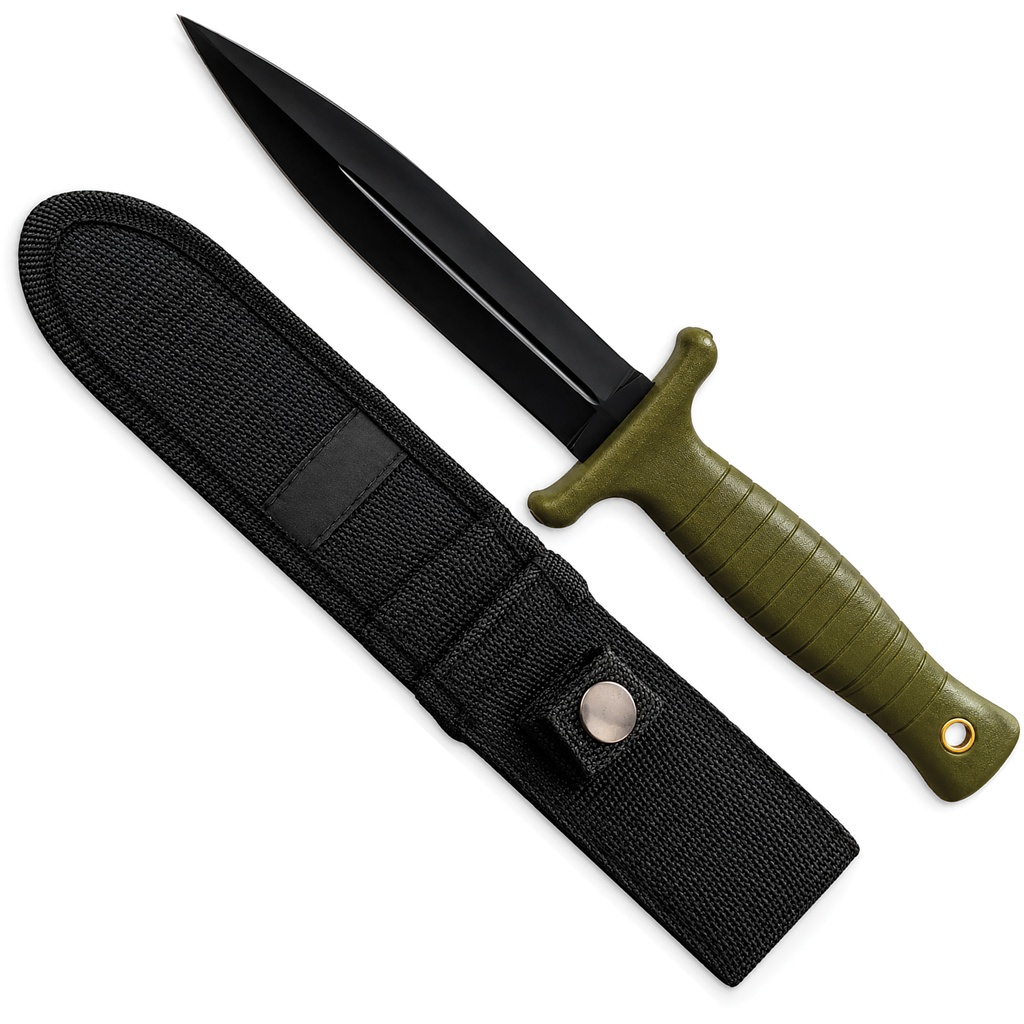
Your eye follows the repeated handle ribs toward the wide, two-sided guard, then along the blade’s central groove. That sequence is what makes the design feel coherent: texture where you hold it, a distinct boundary before the blade, and a restrained black-and-olive palette. Your boot knife looks considered without needing graphics to explain its character.
In your hand, the 4.125-inch nylon-fiber handle offers visible texture rather than a smooth surface. You can assess where your fingers settle and whether the guard suits your hand size. You should still treat that guard as a design feature, not a guarantee against slipping. Your boot knife deserves the same careful grip and attention you give any exposed blade.
You also get a matte-black blade with a dagger profile and a plain edge. The steel grade, hardness, and coating composition aren’t specified, so you shouldn’t have to build a decision around invented performance claims. If you judge a boot knife by edge retention or corrosion resistance, those missing details are worth clarifying before you commit.
Where Your Carry Setup Has to Earn Its Place
You notice carry comfort through ordinary movements: sitting down, climbing a step, or reaching to tie a lace. At 9 inches overall, this boot knife asks for more planning than a small pocket folder. Before choosing a position, you need to consider clearance, clothing, secure retention, and whether the setup interferes with movement.
Your included black woven nylon sheath has a snap retention strap. You can inspect that closure and check how securely the knife sits before moving around with it. However, the available details don’t confirm a boot clip, belt attachment, mounting orientation, or ambidextrous configuration. The boot knife name alone doesn’t establish how the sheath attaches.
The snap you check twice
You press the strap closed, then check it instead of assuming the sound settled everything. That small habit matters more than matching colors. Before carrying your boot knife, examine the sheath for damage and confirm that your chosen, supported attachment arrangement is secure; don’t improvise around an unverified mounting method.
At the handle’s end, you’ll find a metal-lined lanyard hole. If you add a cord, keep it from interfering with the sheath closure or snagging nearby equipment. Your boot knife setup should remain straightforward to inspect, without loose additions turning a simple safety check into a puzzle.
Boot Knife vs Folding Knife: Choose Around Your Actual Day
If your day mostly involves opening deliveries and trimming loose packaging, you may prefer a utility-oriented folding knife. Choosing a boot knife instead means accepting a separate sheath and an exposed blade whenever it is unsheathed. The useful comparison isn’t which looks tougher; it’s whether a boot knife suits your tasks, surroundings, and legal responsibilities.
You may simply appreciate the guarded dagger silhouette as part of a tactical-style collection. That’s a valid reason to consider this design without inventing a demanding outdoor role for it. You shouldn’t expect this boot knife to handle chopping, prying, or other heavy work when its construction and performance specifications haven’t established those capabilities.
Your ownership routine can stay practical. After handling your boot knife, inspect it, clean away residue, and dry it before storage. Don’t assume a black finish makes an unspecified steel rustproof. You’ll also want the nylon sheath dry before putting the blade away, with the entire setup stored securely away from children.
Questions People Ask Before Buying a Boot Knife
Is a boot knife legal to carry where I live?
Your answer depends on local rules covering blade length, dagger classifications, concealed carry, and restricted locations. Before carrying this boot knife, check current official guidance for every jurisdiction on your route; its name doesn’t determine its legal classification.
Can I attach this boot knife sheath directly to my boot?
You receive a nylon sheath with a snap retention strap, but the supplied information doesn’t identify its attachment hardware. Before planning boot carry with this boot knife, confirm the mounting method and compatibility rather than assuming a clip is included.
Will this boot knife hold an edge with daily use?
You can’t reliably predict edge retention without the steel grade, heat treatment, and details of your cutting tasks. This boot knife has a plain edge, but you should request those additional specifications if sharpening frequency is central to your decision.
Back at the bench, you take your boot knife from its sheath for that first careful inspection, noticing where the ribs meet your fingers and how much space the blade occupies. You check, learn, and put it away deliberately. Owning this boot knife doesn’t have to change your character; it can reflect the care you already bring to choosing your gear.