

Garand Arsenal Armorer Edition Manual - Army Yellow
You’ve cleared the bench, set the receiver in the vise, and now it’s just you, your M1, and a question: “Am I doing this right?” This M1 Garand armorer manual sits under your hand like a quiet old sergeant, walking you step by step through real Army procedures. Diagrams, checklists, and no-nonsense instructions turn guesswork into confidence. You’re not just cleaning a rifle—you’re keeping a piece of history running right, with an authentic M1 Garand technical manual backing every move.
You’re at the bench with your M1 Garand stripped farther than you’ve ever dared. Springs, pins, and wood are laid out in careful rows. That mix of gun oil, old walnut, and cold steel hits your nose, and for a second you wonder if you’ve gone too far. This isn’t just a range toy—it’s a piece of history. That’s when your hand finds the ordnance yellow booklet at your elbow—the M1 Garand technical manual that finally makes you feel like you’re not guessing anymore.
When an M1 Garand Technical Manual Turns Confusion Into Confidence
There’s a particular kind of silence that happens the first time you take an M1 down beyond basic field strip. You’re not afraid exactly, but you know one slipped step could mean a cracked stock, a lost spring, or a rifle that never quite feels right again. That’s the moment an M1 Garand technical manual stops being “something to read someday” and becomes the quiet voice over your shoulder saying, “Do this next.”
This Armorer Edition keeps you anchored. It walks you through operator and organizational maintenance the way the Army taught it—clear procedures, order of operations, and diagrams that show you exactly what “right” looks like. Instead of bouncing between forum posts and half-remembered YouTube clips, you have a single, authoritative source open flat on the bench while your hands do the work.
You start to notice the shift: less hesitation before each step, less double-checking on your phone, more trust in your own process. Owning this manual doesn’t just give you information—it gives you permission to really know your rifle.
Owning the Rifle, Not Just Shooting It: How the M1 Garand Technical Manual Was Built
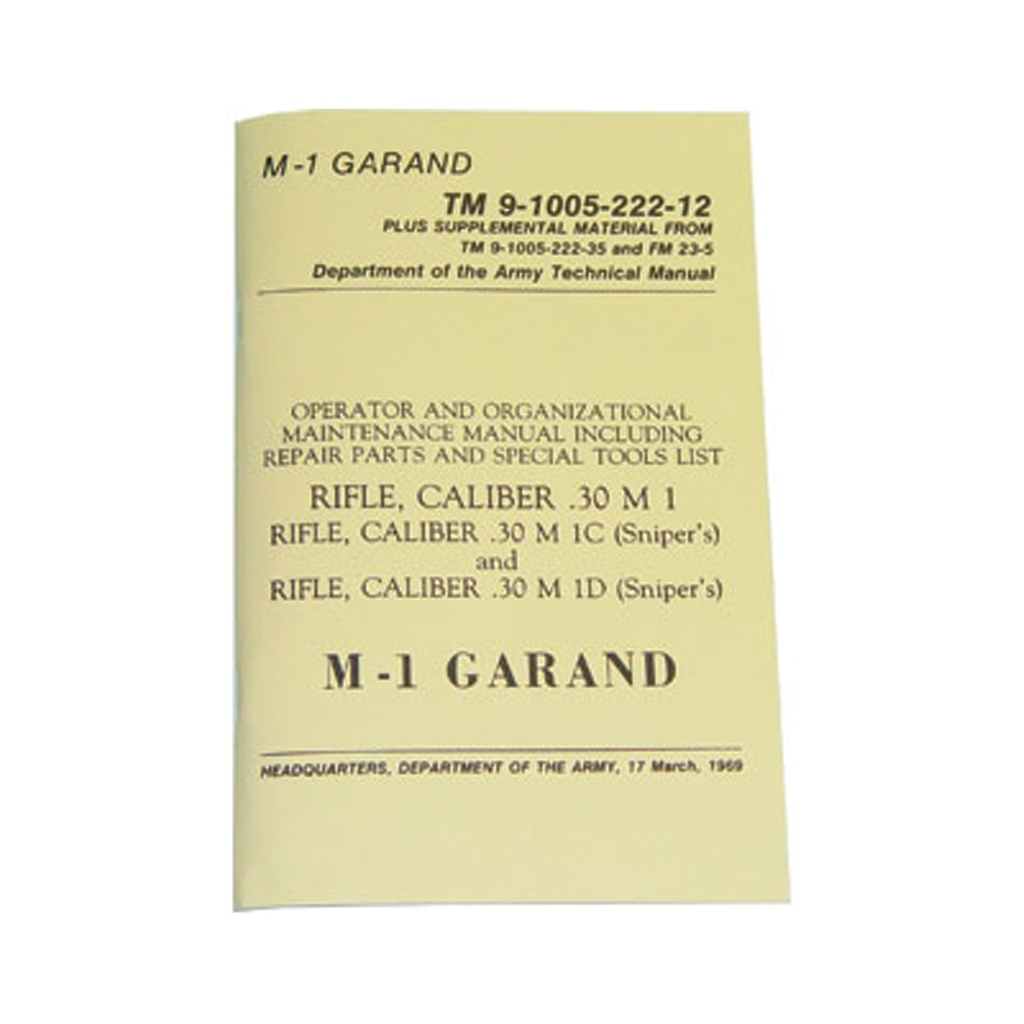
When you pick up this ordnance yellow booklet, it doesn’t feel like a glossy coffee-table history book. It feels like a tool. Softcover, Army-format, all text and diagrams—no fluff, no marketing. The M1 Garand technical manual is laid out the way military armorers needed it: procedures first, pictures where they matter, and everything else stripped away.
The original Army document this follows—TM 9-1005-222-12—was written so a soldier or armorer could do the job right even when the light was bad and the clock was worse. That’s why you get explicit operator and organizational maintenance instructions, plus material pulled from deeper-level manuals and marksmanship field manuals. The design choice is simple: every line either helps you keep an M1, M1C, or M1D running, or it doesn’t belong on the page.
That’s the detail that makes it click. You’re not flipping through decorative illustrations; you’re reading the same style of technical manual that kept service rifles battle-ready in 1969. The font, the layout, the ordnance yellow cover—they all remind you this isn’t cosplay documentation. It’s real, and it respects your time and your rifle.
The Quiet Authority of Ordnance Yellow
The first time you toss it into your range bag, that yellow stands out against black nylon and green canvas. On the bench, it’s impossible to lose under rags and parts. But more than visibility, that color carries a feeling: this is official, serious, and meant to be used. You’re not playing at being an armorer—you’re stepping into a lineage that maintained these rifles long before they were collectibles.
Living With Your M1 Garand Technical Manual at the Bench and the Range
Once this booklet becomes part of your routine, it shows up in small, practical ways. Before a match, you flip to the section that confirms your lubrication points. After a long range session, you sit down, Garand across your lap, and follow the cleaning sequence exactly as laid out. No arguments, no internet myths—just the Army’s own method.
On a slow weekend, you finally look up the procedures for the parts you’ve always left alone—the gas cylinder, the sights, the details that separate a merely functional rifle from one that feels tuned. The M1 Garand technical manual doesn’t rush you. It breaks each task into steps, so even if you’re not a professional gunsmith, you can move with the same deliberate care.
And when a friend brings over his grandfather’s rifle, nervous about a sticky action or feeding issue, that’s when this really pays off. You set the manual between you, walk through the troubleshooting together, and by the end you’re not just the person who owns an M1. You’re the one people trust to keep them running.
From Collector to Caretaker
Owning a Garand without understanding its maintenance can feel like having a classic car you’re afraid to drive. This manual closes that gap. Page by page, it nudges you from “I hope I don’t break it” to “I know exactly what to do.” You become not just a collector, but a caretaker of a service rifle with real history baked into its steel and wood.
When a Real M1 Garand Technical Manual Matters More Than Another Forum Thread
There’s always another opinion online—about grease vs. oil, about which parts to leave alone, about what “the Army really did.” But there’s a reason serious Garand owners still hunt down an M1 Garand technical manual instead of relying only on screenshots and hearsay: at some point, you want the source, not just the stories.
When you’re diagnosing a stubborn malfunction, swapping a part, or checking headspace with a more experienced friend, having a real manual on the bench changes the tone. Suddenly you’re not just debating preferences—you’re lining up what you see with clear diagrams and official procedures. It calms the noise.
For reenactors and collectors, it goes deeper. This manual completes the rifle’s story. An M1, M1C, or M1D sitting in a safe is an artifact. An M1 with its yellow Army-style manual nearby feels like a living tool, ready to be fired, maintained, and passed on with everything it needs to survive another generation.
Questions People Ask Before Buying an M1 Garand Technical Manual
Do I really need an M1 Garand technical manual if there’s so much online?
You could muddle through with videos and forum posts, but an M1 Garand technical manual gives you a single, organized reference that doesn’t change, disappear, or contradict itself. It’s laid out in logical Army order, so you always know where you are in the process instead of bouncing between half-answers.
Will this help with both standard M1 rifles and sniper variants?
Yes. This style of M1 Garand technical manual covers the standard M1 plus the M1C and M1D sniper variants. That means if your collection grows—or you already own a scoped rifle—you’re still working from procedures that match the rifles in your rack.
Is an M1 Garand technical manual useful if I’m new to military rifles?
It is, as long as you’re willing to move step by step. The language is straightforward and procedural, so even if this is your first service rifle, you can follow along. You’ll probably find yourself learning the correct part names and maintenance intervals faster than you expected.
Can I bring this manual to the range without ruining it?
It’s built as a softcover booklet, meant to live on benches and in bags. The ordnance yellow cover shrugs off a bit of oil and carbon, and if it gets worn, that just means it’s doing its job. Most people end up liking the look of a well-used M1 Garand technical manual—it tells its own story.
Sooner or later, there’s a night when the house is quiet, the TV’s off, and your M1 is laid open under a shop light. You flip to a dog-eared page in that ordnance yellow booklet, trace a diagram with a fingertip, and feel that click of understanding: this is how it’s supposed to work. In that moment, the M1 Garand technical manual in front of you is more than paper. It’s a bridge between the rifle’s past life in uniform and its future years in your hands—clean, cared for, and always ready when you close the bolt and settle into the stock.