Cold War Doctrine Special Forces Field Manual - Yellow Cover
You don’t pick up a Cold War Special Forces field manual just to skim—you pick it up because you want to see how the people who wrote history actually thought. With this guerrilla warfare book in your hands, the yellow cover feels like a warning label and an invitation. Margins beg for your notes, sections on doctrine push you to think in systems, not slogans. You’re not collecting trivia; you’re studying how real unconventional warfare was planned, argued, and executed.
You open the yellow cover on a quiet night, half out of curiosity, half because part of you has always wanted to know how real Special Forces doctrine actually reads—without the movie soundtrack, without the YouTube simplifications. Within a few pages, this guerrilla warfare book stops feeling like a relic and starts feeling like a conversation with the Cold War officers who had to get this right the first time.
When a Guerrilla Warfare Book Shows You How Professionals Think
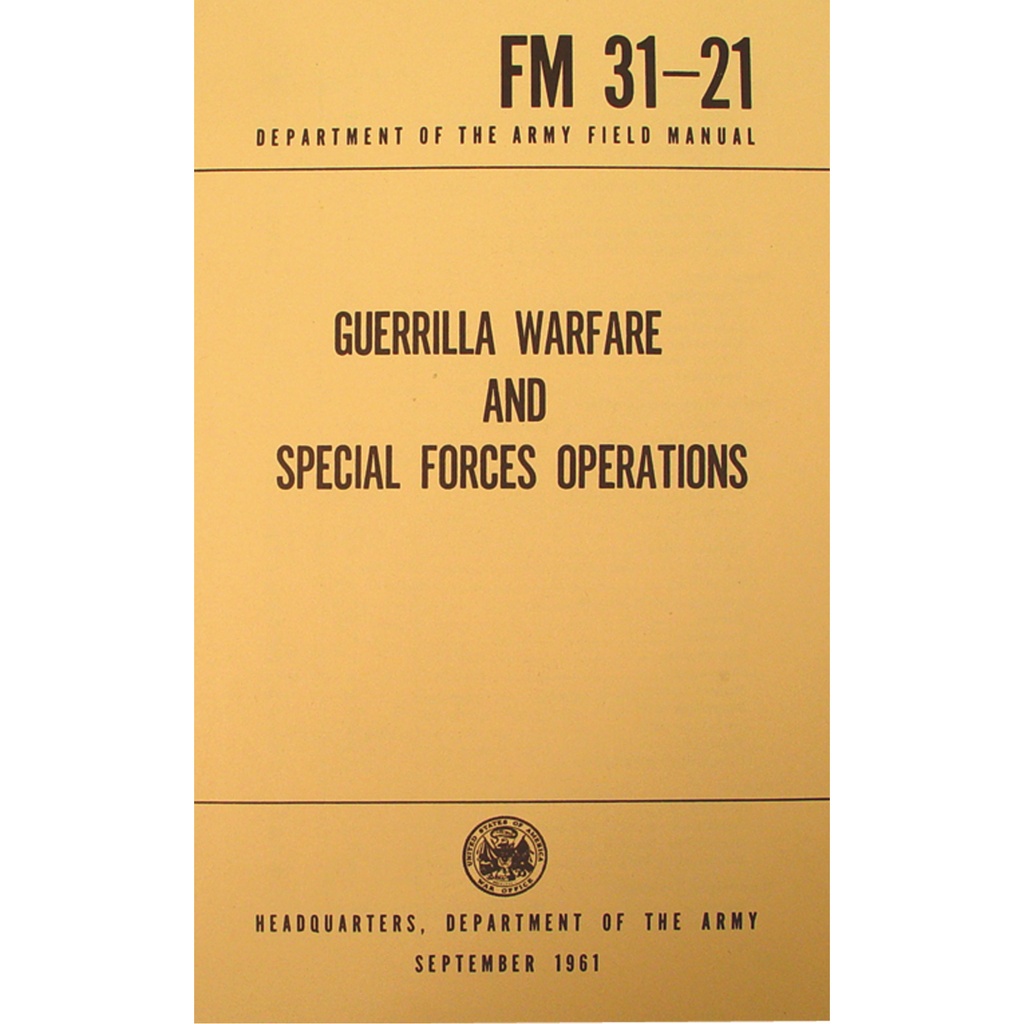
You’ve read articles, watched breakdowns, maybe sat through a briefing or two. But a lot of that feels filtered—commentary on commentary. Here, the voice is different. This is FM 31-21, a 1961 U.S. Army field manual on Guerrilla Warfare and Special Forces Operations, written for people who might actually have to use it.
As you move through it, you notice how little space is wasted. Fundamentals, control, logistics, intelligence, communications, area command—each topic is laid out with the calm, clinical tone of someone who doesn’t have time for drama. That’s the quiet power of this guerrilla warfare book: it lets you step into that mindset. You’re not just learning what they did; you’re learning how they structured their thinking when the stakes were real.
The Yellow-Cover Guerrilla Warfare Book That Feels Like an Artifact
On your shelf, it doesn’t blend in. The bold yellow cover and black text look exactly like what they are: an official Department of the Army field manual from the Cold War. No glossy action photos, no tactical skulls, no marketing language—just "DEPARTMENT OF THE ARMY FIELD MANUAL" at the top and the Army emblem anchoring the bottom.
That minimalist design is part of the experience. When you pick up this guerrilla warfare book, you feel the softcover flex slightly in your hands, like a manual meant to be folded back, marked up, carried in a ruck or a range bag. The matte finish doesn’t glare under harsh light; it just sits there, readable and serious, like it expects you to be the same.
Because this is a reprint of a 1961 manual, you’re touching the same structure of doctrine that shaped early Special Forces thinking. The codes, the headings, even the typography remind you: this wasn’t written to entertain you. It was written to prepare someone.
Reading a Guerrilla Warfare Book as Training, Not Trivia
Maybe you teach, maybe you lead, maybe you’re just the one in your circle who goes deeper than surface-level. However you come to it, this guerrilla warfare book gives you something modern summaries rarely do: a complete framework.
You see how they define guerrilla forces, how they think about organizing resistance, what they assume about intelligence and counterintelligence, and how they handle communications with people who can’t afford to make noise. The sections on control and logistics don’t just talk about moving gear; they talk about maintaining cohesion in places where everything is fragile—alliances, supply lines, even trust.
If you train others, this kind of structure is gold. You can adapt it, question it, compare it to modern doctrine, but you’re starting from an actual manual instead of someone’s interpretation. If you’re an enthusiast, this is where you connect the dots between history, tactics, and the human decisions underneath both.
How This Guerrilla Warfare Book Fits Into Your Real Life
On a desk, it becomes a reference. In a pack, it feels like a quiet backup—a way to reset your thinking when the world starts to feel too noisy. You might dog-ear the chapters that dig into area command and intelligence, or underline a dry, precise sentence that suddenly hits you as brutally honest about how conflict actually unfolds.
Because it’s a compact softcover, it doesn’t demand ceremony. You can toss this guerrilla warfare book into a range bag, slide it between training binders, or hand it across a table to a student or friend who’s finally ready for something more serious than theory videos. When someone notices the yellow spine and asks what it is, you don’t have to sell it. You just flip it open and show them the title page. The Army emblem and the 1961 date do the rest.
For gift-givers, it has that rare mix: meaningful, specific, and unexpected. It doesn’t feel like a random tactical trinket; it feels like you saw the way their mind works and chose something that matches.
When a Guerrilla Warfare Book Becomes Your Quiet Advantage
There’s a subtle shift that happens when you read doctrine instead of commentary. You stop asking only, “What happened?” and start asking, “How did they think about this before it happened?” That’s where this guerrilla warfare book earns its place in your kit or on your shelf.
If you’re comparing it to more modern tactical books, you’ll notice the difference in tone immediately. Newer titles often chase engagement; this one assumes you’re already engaged. It gives you a lens on unconventional warfare at a time when the Cold War shaped every assumption in the room. That historical context doesn’t make it outdated—it makes it honest about the world it was written for, which lets you decide how to apply it to the world you live in now.
In a stack of EDC and tactical gear, this manual is the quiet piece that says, "You don’t just carry tools—you study why they exist." That’s an identity shift as real as any new blade or piece of kit.
Questions People Ask Before Buying a Guerrilla Warfare Book
Is this guerrilla warfare book still relevant, or just historical?
It’s both. This is a reprint of a 1961 U.S. Army Special Forces field manual, so you’re getting original Cold War doctrine as it was taught. Some specifics are dated, but the way it thinks through organization, logistics, and unconventional operations is still valuable if you care about how real doctrine is built.
What makes this different from other military history or tactics books?
Most history books talk about events after they happen; this guerrilla warfare book shows you what professionals were told before they stepped into the field. It’s written as a working manual, not entertainment, so the tone is more focused on decisions, structure, and responsibilities than on storytelling.
Is the language in this guerrilla warfare book hard to follow?
The writing is formal but straightforward, the way military manuals tend to be. You’ll see some period-specific terms and a very structured layout, but that’s part of the point—it immerses you in how Special Forces doctrine was communicated in 1961, without being so technical that you need a separate guide just to understand it.
Can this guerrilla warfare book work as a teaching tool?
Yes. Instructors often use this kind of manual as a backbone for lessons on unconventional warfare, doctrine development, and Cold War history. The clear sections on fundamentals, intelligence, logistics, and command make it easy to build discussions, exercises, or comparisons to modern doctrine.
Later that week, you find yourself reaching for the yellow cover again—not because you have to, but because your brain is still chewing on a line from the section on control and logistics. You flip through, feel the familiar give of the softcover, and slide a pen into the crease. In that moment, this guerrilla warfare book isn’t just a Cold War manual anymore. It’s part of how you think now: slower, more deliberate, more aware of the quiet planning that sits behind every headline and every piece of gear you choose to carry.