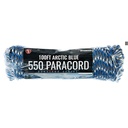
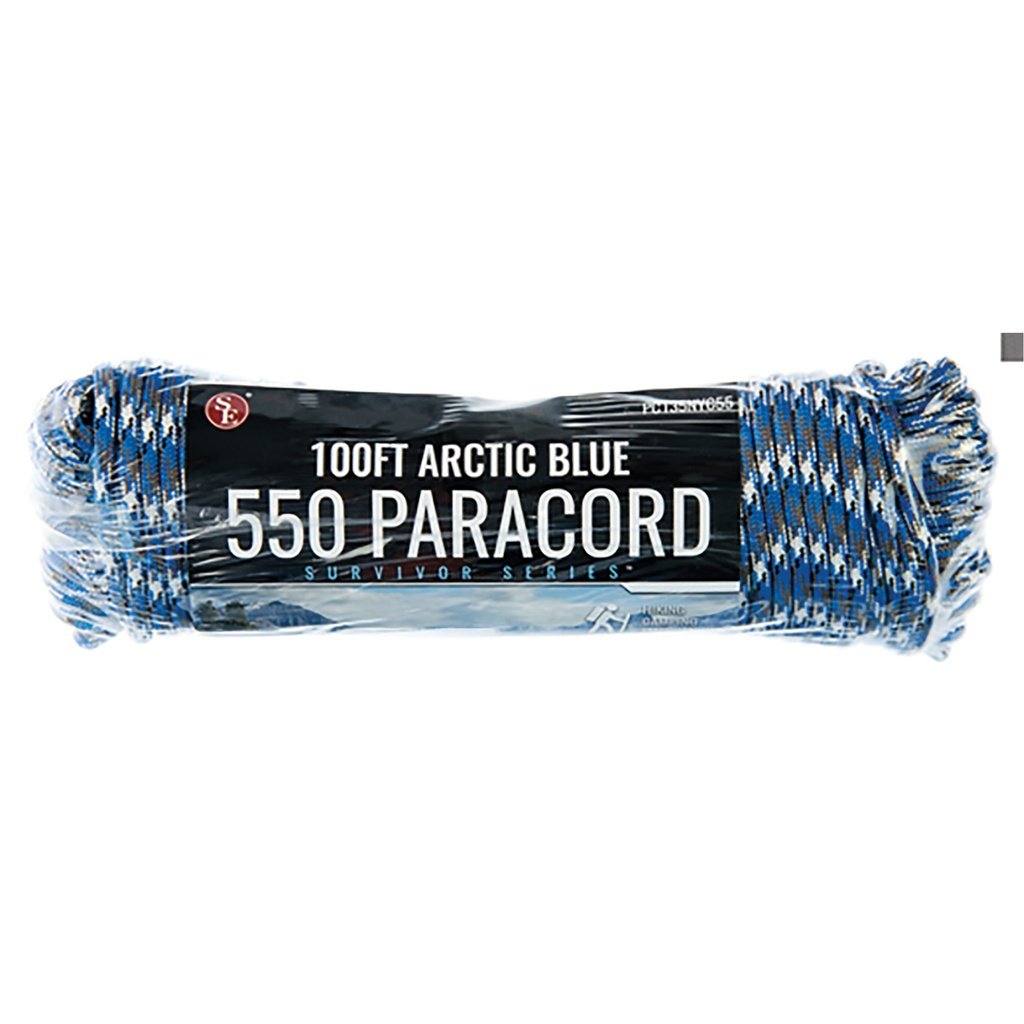
Glacier Weave Cold-Weather Survival Paracord - Arctic Blue Camo
Picture camp dropping below freezing and the wind starting to climb. Your 550 survival paracord is already in place—guy lines tight, tarp singing, everything exactly where you want it. This Arctic Blue Camo line bites when you cinch it, knots clean, and holds steady overnight. You stop fussing with gear and start watching the sky, because your setup feels dialed and you know you’ve got 100 feet of quiet backup coiled and ready in your pack.
The temperature drops faster than the forecast said it would. One minute the snow is soft and friendly, the next it’s blowing sideways, needling your cheeks and finding every gap in your clothing. You feel the gust hit your shelter hard—this is the moment you find out if the line you trusted is real or just camping decor.
You run your gloved hand along the Arctic Blue Camo cord, feel the tight weave bite into the fabric, and the shelter doesn’t even flinch. That’s when it lands: you didn’t just pack rope. You packed margin for error.
Why a 550 survival paracord quietly decides how your night goes
When you reach for 550 survival paracord, you’re usually not thinking about numbers. You’re thinking: Will this hold when it actually matters? Out here, 220 pounds of working load and 550 pounds of break strength don’t feel like specs—they feel like permission to relax. You can trust that ridgeline, that gear lash, that improvised fix without hovering over it all night.
This 7-strand nylon core is the quiet backbone of your camp. Each inner strand is its own tool—strong enough for fishing line, gear repairs, or improvised stitching—while the outer sheath gives you that smooth, controlled pull when you cinch a knot down. At 5/32" thick, it’s that sweet spot: thin enough to pack and weave, thick enough to grip with cold fingers.
And the reason the Arctic Blue Camo matters isn’t just looks. Against snow, ice, and pale rock, you can still see your 550 survival paracord at a glance—no tripping over invisible guy lines. But it’s not screaming neon either. It feels like it belongs in winter: calm, controlled, a little bit ruthless about staying put.
How this 550 survival paracord changes the way you set up camp
You know the difference between camping and managing a slow-motion gear failure. One is about being out there; the other is about chasing problems. With a full 100 feet of line, you stop rationing every scrap of cordage. You run a solid ridgeline, stake out your tarp with generous anchors, hang a bear bag, maybe even rig a quick clothesline to dry gloves overnight—because you aren’t counting inches, you’re planning moves.
The first thing you notice about this 550 survival paracord when you uncoil it is the way it falls into your hands: not too stiff, not gummy. The Survivor Series nylon braid has enough structure that it doesn’t turn into a tangled mess, but enough flexibility that you can tie a taut-line hitch in the dark and trust it to stay where you set it. You feel the sheath bite and lock when you cinch down on a carabiner or stake.
In cold weather, cheap cord gets slick, weird, and unreliable. This line stays predictable. Knots dress clean. When you need to untie them with numb fingers, they give—no welded lumps that have to be cut away. The result is simple: more reuse, less waste, and a daily carry of rope in your kit that earns its space on every trip.
From everyday carry to emergency: where your 550 survival paracord actually shows up
Most days, your 550 survival paracord isn’t saving your life. It’s doing small, unglamorous jobs that keep everything running smoothly. You cut off a few feet to fix a busted backpack zipper pull. You lash a foam pad to the outside of your pack. You tie down a load in the truck bed that would otherwise rattle or shift.
Then there are the days when it matters more than you expected. The weather turns on a day hike and you decide to stay put instead of push on. Suddenly that 100-foot hank is a shelter frame, a windbreak, and a gear line. Or someone rolls an ankle and you’re improvising a splint and a drag handle. In those hours, having real 7-strand 550 rope—not decorative cord that only looks the part—feels like a different kind of decision maker.
Because you’ve cut this stuff, tied it, loaded it, you already know how it behaves. Your knots are muscle memory. The way it stretches just a touch under load and then settles feels familiar. You’re not guessing whether your survival paracord will do its job—you’re planning what you’ll do next once it does.
When choosing the right 550 survival paracord makes the difference
If you’ve ever bought “paracord” that flattened, frayed, or snapped under a load it should have handled, you already know why specs alone aren’t enough. Real 550 survival paracord has a 7-strand inner core, each strand made of multiple nylon fibers, all wrapped in a tight outer sheath. Anything less is decoration pretending to be gear.
Here, you can actually feel that structure. Strip the sheath and you’ll find seven clean inner strands, ready for finer work. Use the full cord and that 5/32" diameter sits just right in most hardware—buckles, cord locks, tarp grommets—without bunching or slipping. The 220 lb working load gives you a safety margin for most camping, hiking, and emergency tasks without flirting with failure.
And that Arctic Blue Camo? It’s not just an aesthetic flex. It’s a visual language. On your pack, it becomes part of your kit’s story: calm under pressure, tuned for cold, easy to spot when the sky goes white. It’s the kind of detail other gear people notice—the moment someone says, “Nice cord. Where’d you get that pattern?” and you know they see it too.
Questions people ask before buying a 550 survival paracord
Is 550 survival paracord strong enough for real outdoor use?
For most camping, hiking, and emergency tasks, yes. This 550 survival paracord has a 220 lb working load and 550 lb break strength, which is more than enough for shelter ridgelines, guy lines, lashing gear, and basic field fixes. It’s not for climbing, but it’s built for serious everyday outdoor use.
What can I actually do with 100 feet of 550 cord?
More than you think. A 100-foot hank of 550 survival paracord can become multiple guy lines, a ridgeline, a gear-hanging system, bootlace replacements, emergency tie-downs, and inner strands for finer repairs. Once you start cutting and using it, you’ll find it quietly solves problems on almost every trip.
Will this 550 paracord handle cold, wet, or snowy conditions?
Yes. The nylon construction of this 550 survival paracord shrugs off moisture and cold far better than cheap cotton or bargain synthetics. The tight Glacier Weave sheath stays flexible enough to knot with gloves, and the Arctic Blue Camo pattern stays visible against snow and ice without looking loud or out of place.
Is this real 7-strand 550 paracord or just decorative cord?
This is genuine 7-strand 550 survival paracord with a nylon core and sheath, not hollow or “craft” cord. When you strip it, you’ll see seven inner strands you can use individually, backed by the full 550 lb break rating when the cord is intact. It’s meant to be worked hard, not just braided into keychains.
Later, when the wind has calmed and the snow is just drifting instead of stinging, you’ll look at your setup—the ridgeline holding, the tarp humming, the extra length of 550 survival paracord coiled neatly in your pack—and you’ll feel that quiet satisfaction. You made a choice back in the warmth of your home that showed up out here in the cold. You’re the person whose gear doesn’t quit when the forecast is wrong, whose kit has depth, not just style. And every strand of that Arctic Blue Camo line is a reminder: you don’t wait for things to go bad before you get ready. You were ready when you packed it.