Jungle Guard Sawback Survival Machete - Two-Tone Black
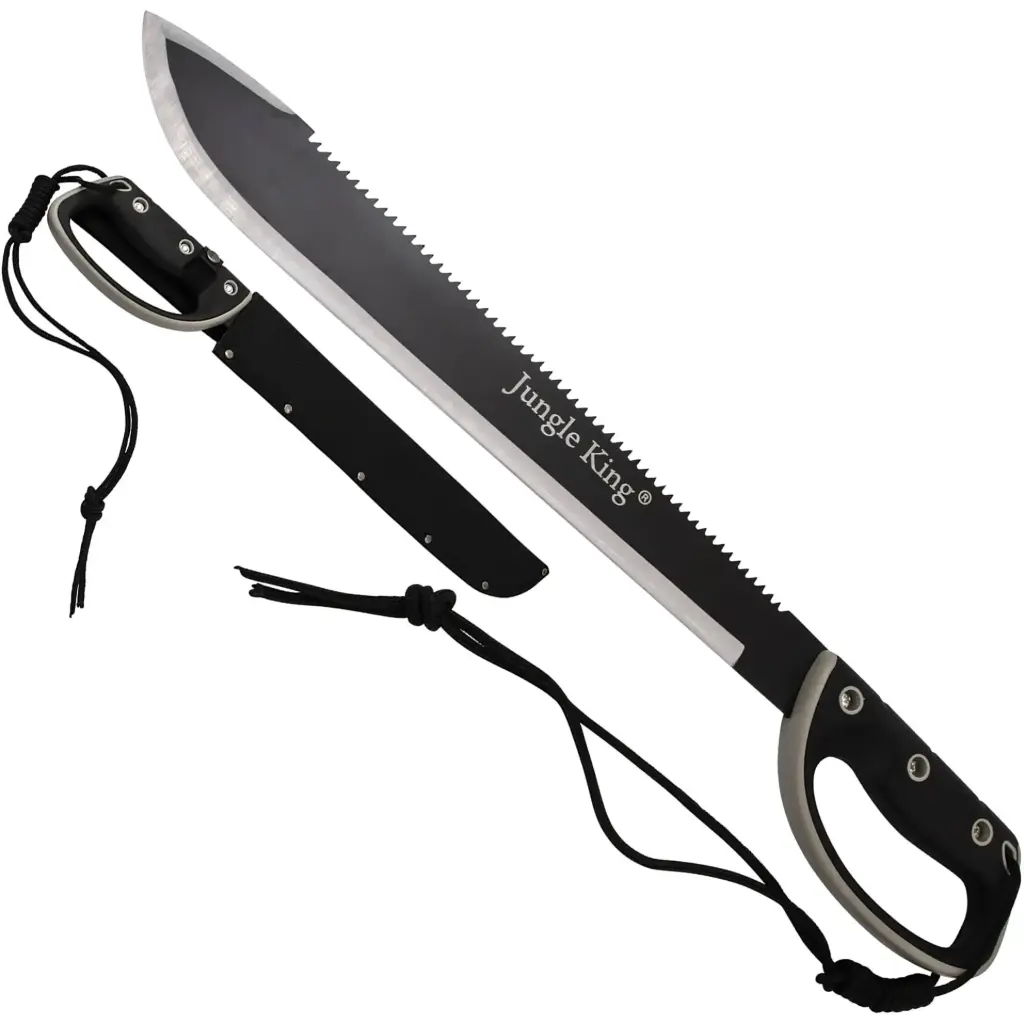
Branches whip your arms, the light is fading, and the trail you thought existed…doesn’t. This is where a survival machete stops being gear and becomes the reason you stay in control. The long, two-tone German steel blade bites through brush while the sawback chews at stubborn limbs. Your hand locks behind the knuckle guard, rubber grip tacky with sweat, paracord lanyard brushing your wrist. You’re not fighting the jungle anymore—you’re shaping it to your will with every swing.
| Blade Length (inches) | 15.5 |
| Overall Length (inches) | 21 |
| Weight (oz.) | 20.26 |
| Blade Color | Black |
| Blade Finish | Two Tone |
| Blade Style | Clip Point |
| Blade Edge | Plain |
| Blade Material | German steel |
| Handle Finish | Matte |
| Handle Material | Rubber |
| Theme | Survival |
| Handle Length (inches) | 6.25 |
| Tang Type | Full Tang |
| Pommel/Butt Cap | Lanyard Hole |
| Carry Method | Sheath |
| Sheath/Holster | Nylon Sheath |
You don’t really notice how deep you’ve gone until the trail disappears. One second you’re following a narrow line of crushed leaves, and the next it’s you, a wall of green, and that quiet voice asking, “Now what?” That’s the moment a survival machete stops being something you own and starts being the tool that decides whether you push through—or backtrack.
When a Survival Machete Turns Panic Into a Plan
Picture this: shoulder-high brush, branches grabbing at your pack, the sun dropping just low enough to turn depth perception into a lie. If all you have is a small camp knife, every step forward feels like it costs too much time, too much energy, too much of your nerves. With a survival machete in your hand, the equation flips.
That 15.5-inch, two-tone German steel blade doesn’t just cut; it clears. One swing, you feel the weight carry through saplings. Another, and that stubborn vine you’ve ducked under three times is simply gone. The sawback spine earns its place the first time you turn the blade over and start ripping into a dead limb for firewood, teeth biting and pulling fibers apart when a clean slice just won’t do it.
What this means for you is simple: your route stops being dictated by the terrain. You stop asking, “Can I get through this?” and start choosing where you want the path to go.
Why a Survival Machete With a Knuckle Guard Changes How You Swing
If you’ve ever swung something heavy in thick brush, you know the real fear isn’t missing—it’s what happens when you don’t. Hidden branches, glancing blows, thorny vines snapping back toward your fingers. A survival machete with an enclosed knuckle-guard handle changes that mental math instantly.
Your hand wraps around the rubber grip, each finger settling into grooves that feel like someone thought through the way a real hand gets tired. The full tang steel runs from tip to pommel, so when you connect with something tougher than you expected, the shock doesn’t feel sketchy or brittle—it feels solid, like the blade and the handle are one piece because they are.
The knuckle guard does more than look aggressive. It lets you commit to a swing without flinching at the idea of your hand smashing into bark or thorn. When branches ricochet, they hit steel instead of skin. You keep your fingers, you keep your grip, and your confidence doesn’t drip away with every close call.
Feeling the Tool Settle Into Your Rhythm
There’s a moment, a few minutes into clearing, when the weight of the survival machete stops feeling heavy and starts feeling inevitable. Twenty ounces sounds like a lot on paper; in your hand, with momentum, it feels like follow-through. You raise, swing, recover. The paracord lanyard taps your wrist, a small, reassuring reminder that even if things get slick with sweat or rain, this blade is staying with you.
How This Survival Machete Lives on Your Belt, Not in Your Pack
You know how some big blades end up riding in the pack, “just in case,” and somehow never actually make it out when you need them? That’s dead weight. A survival machete only matters if it’s where your hand goes first when things thicken up.
The nylon sheath on this one doesn’t try to dress itself up as anything else—it’s made to ride easy and take abuse. You feel it against your hip or strapped to your pack, riveted and ready, not some loose fabric waiting to tear when you drop it on gravel. The retention strap snaps open with that quiet, satisfying pop you only get from gear that’s been dialed in just enough.
Pulling the survival machete free, you’re not fighting with it. The profile slides out clean, the two-tone blade flashing once in the light before the black finish eats the glare. When you’re done and your arms are buzzing, you don’t have to negotiate with the sheath. You guide the blade home by feel, hear the soft brush of nylon, and it’s back on your side, not dragging you down or demanding attention.
From Backyard Brush to Backcountry Stories
Maybe you’re not hacking your way through a jungle—at least not yet. You might start with the stuff close to home: clearing a trail behind the house, cleaning up storm-felled limbs, chopping back that overgrown corner of the property that’s been bugging you for months.
That’s where you really learn a survival machete. You feel how the balance favors forward power but still lets you choke up closer to the guard when you want to baton or carve. You learn that this isn’t some wall-hanger fantasy blade; it’s a working tool that shrugs off the ugly work—dirt, sap, grit—and keeps asking what’s next.
When a Survival Machete Is the Difference Between Camping and Surviving
There’s camping where you stick to the established sites, and then there’s the night you push a little farther, stay a little later, and realize the spot you chose isn’t going to work as-is. The ground is uneven, branches hang low over where you want the fire, and dry wood is there—but it’s not exactly stacked and waiting.
This is where a survival machete quietly decides what kind of person you are. With that long German steel blade, you take down the low branches shaping your space into something livable. The sawback gets flipped into action to score and rip thicker limbs so they break clean. You split down kindling with the clipped tip biting in where you place it, full tang taking the hits when you baton with another piece of wood.
Instead of cursing the site and wishing you’d stopped earlier, you build the camp you want. You carve tent stakes instead of hunting for them. You clear the ring for the fire you’re going to remember. You don’t “make do”—you make it yours.
Questions People Ask Before Buying a Survival Machete
“Is a survival machete actually better than a big fixed blade knife?”
It depends on how you move through the world. If most of what you do is fine carving and precision work, a smaller fixed blade knife is easier. But when your problems look like thick brush, green saplings, and firewood that needs to be broken down fast, the reach and weight of a survival machete give you range and efficiency a regular knife can’t.
“Will this survival machete hold up to real abuse, not just light yard work?”
That’s where the full-tang German steel and knuckle-guard build matter. You’re not dealing with a rat-tail tang or decorative handle. The steel runs the full 21 inches, wrapped in rubber scales for grip. It’s built for clearing, chopping, and sawing in the kind of conditions that leave cheaper blades rattling loose in their handles.
“Can I actually carry a survival machete legally where I live?”
Laws around machetes and large fixed blades vary a lot by state and country. Many places treat a survival machete as a tool if you’re camping, working, or on private land—but the same blade might not be legal to carry concealed or in urban areas. It’s worth checking your local knife and weapons laws before you treat it like everyday carry. Think of this more as trail, camp, and property gear than a city carry knife.
“Is a sawback on a survival machete useful or just for looks?”
On this design, the sawback earns its place when you’re cutting across grain—branches, poles, and thicker limbs that don’t respond well to trying to chop straight through. It’s not a fine carpentry saw, but it bites and tears through wood that would otherwise force you to waste energy swinging harder and more often.
Who You Become With a Survival Machete Hanging at Your Side
Think about the moment right before you really need it. The sky’s gone that deep, smoky blue. The wind has picked up just enough to remind you that weather doesn’t care about your plans. There’s more work to do—space to clear, wood to cut, a way out to carve—and not a lot of light left to hide mistakes.
Your hand drops to your side and finds the handle without searching. Nylon gives way; the survival machete slides free with that soft scrape that always sounds like potential. You feel the knuckle guard wrap your hand, the rubber grip settle under your fingers, the familiar forward pull of the blade asking, “Where are we cutting first?”
From that point on, you’re not the person hoping the trail gets easier or the campsite turns out to be good enough. You’re the one who makes space where there wasn’t any, who shapes the environment instead of tiptoeing through it. You don’t carry a survival machete because it looks intense—you carry it because you like knowing that when the world gets thicker, rougher, less polite, you have something in your hand that’s already had that conversation and come out on top.