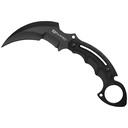
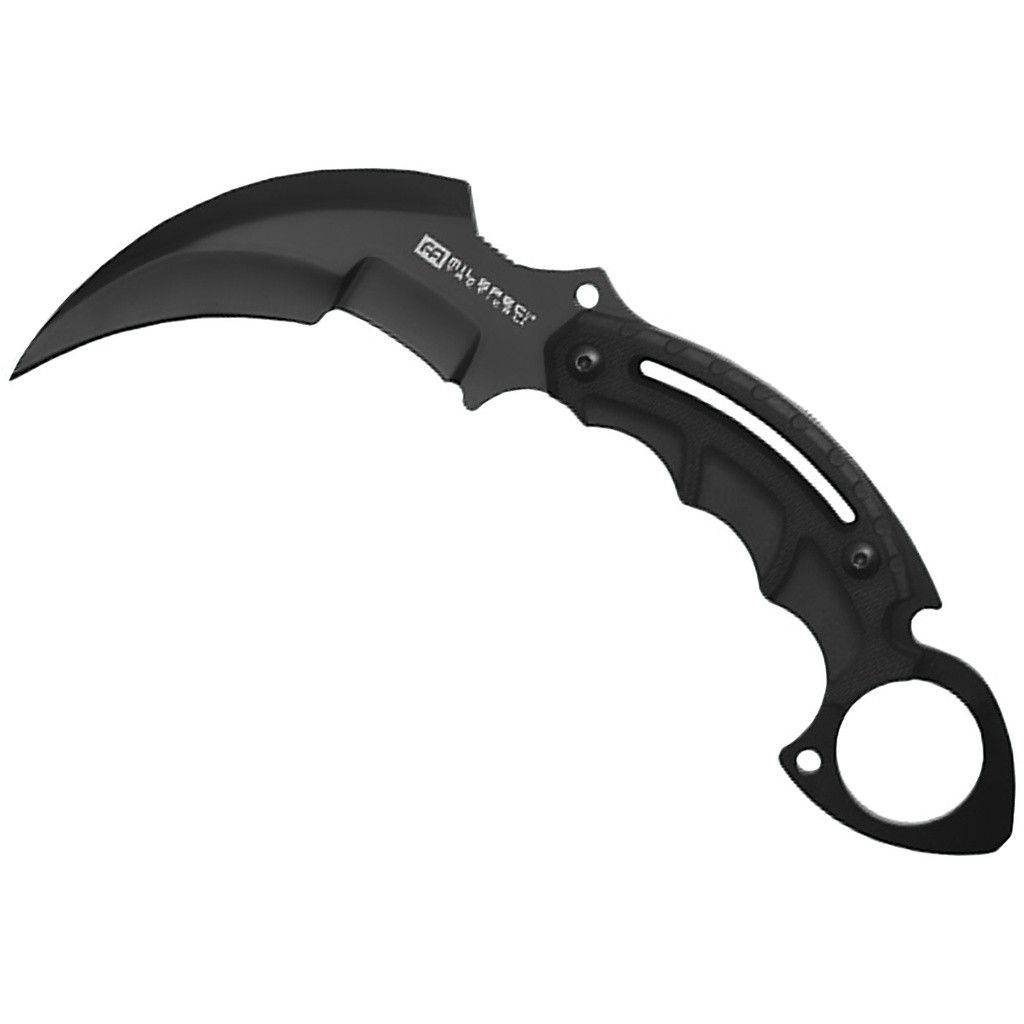
Night Claw Predator-Control Karambit Knife - Matte Black
You notice it most when things feel off—a noise outside, a late walk to the car, that prickle on the back of your neck. A tactical karambit knife like the Night Claw doesn’t make you paranoid; it makes you prepared. The matte black talon blade, the finger ring that locks your grip, the way it rides in its sheath—you feel it and instantly know which way the edge is facing. You’re not hoping for control anymore. You’re carrying it.
| Blade Length (inches) | 4.5 |
| Overall Length (inches) | 10 |
| Blade Color | Black |
| Blade Finish | Matte |
| Blade Style | Talon |
| Blade Edge | Plain |
| Blade Material | Steel |
| Theme | Karambit |
| Sheath/Holster | Hard Sheath |
You don’t plan on needing it. You just like knowing that if something shifts—footsteps where there shouldn’t be, voices escalating too fast, a shape in the dark moving wrong—you’re not standing there empty-handed. Your hand goes where it always does, to the same place on your belt or pack, and you feel that solid lock of steel and curve. In that instant, you’re not wondering what you’d do. You already know. The tactical karambit knife in your hand was built for exactly this kind of moment.
How a Tactical Karambit Knife Changes What You Do in Close
If you’ve ever held a straight blade and felt like it wanted to slip or twist when things got fast, you already understand why a tactical karambit knife exists. The ring around your finger, the hooked talon shape, the way the spine curves into your grip—everything about it is designed for control in close quarters, not show-and-tell on a shelf.
Here, that curve runs through a 4.5-inch matte black talon blade that feels less like a tool and more like an extension of the bone and tendon in your hand. At 10 inches overall, you get enough reach to matter but not so much that you lose speed or get tangled in your own gear. You can cut, hook, pull, or redirect with small movements instead of wild swings. In a hallway, in a doorway, beside a vehicle—places where distance disappears—this kind of control is the difference between reacting and responding.
What you’ll notice first is how natural the locked-in grip feels with the finger ring. Once your finger is through, you’re not thinking about dropping it or having it stripped away. You’re free to move, to push, to stabilize, to shield, knowing the blade tracks wherever your hand goes.
Why This Matte Black Karambit Wants to Live on Your Belt
There’s a big difference between a knife that photographs well and a tactical karambit knife you’re willing to carry every day. The blackout finish here isn’t just about looking mean; it’s about not flashing when you don’t want attention. Matte black steel on blade and handle cuts glare, stays low-profile, and doesn’t announce itself every time a streetlight hits it.
The steel construction gives you a reassuring weight without turning it into an anchor. The handle runs 5.5 inches with finger grooves that tell your hand exactly where to land, even when you’re not looking. A skeletonized cutout in the handle takes some of the weight off and gives you a tactile index point—a small, specific detail you’ll start to rely on in low light. Thumb here, finger there, ring locked in place: you can tell your blade orientation before you even clear the sheath.
And that hard sheath? It quietly does one of the most important jobs for any fixed blade: consistent retention and consistent draw. You’re not fighting soft nylon or wondering if the knife shifted. You’ll learn the sound and feel of it seating, then the decisive snap as you pull. Over time, that becomes muscle memory, not a conscious thought.
Carrying a Tactical Karambit Knife in Your Real Life
A lot of people imagine a tactical karambit knife living only in a training gym or a movie scene. You know better. You start to see all the in-between moments where having it just makes quiet sense: walking the dog when the neighborhood is darker than the real estate flyer suggested, crossing the parking lot after a late shift, camping near a trailhead that gets more traffic than you’d like.
The hard sheath lets you decide where this blade lives: on a belt, on a chest rig, lashed to a pack strap. Once you pick a spot, you build a habit. Your hand reaches, finds that ring, and you draw along the same path every time. That repetition is what turns a knife from an accessory into a trusted part of your everyday readiness.
Because the blade is a fixed karambit, there’s no hinge to fail, no lock mechanism to guess at in the dark. It’s simply there: 4.5 inches of talon-style steel ready the moment it clears the sheath. You don’t have to hope the blade deploys. It already is. Whether you’re cutting cord, clearing brush away from a campsite, or—if it ever comes to it—putting a barrier between you and another human being, that certainty is a quiet kind of comfort.
The Feel in Hand When It’s Go-Time
Slide your finger through the ring and close your fist. The matte steel under your palm feels cool at first, then starts to warm to your skin. The finger grooves lock your hand into one repeatable position. That curved edge sits right where your instincts want it, aligned with the natural arc of your arm. You could spin, reverse, hook, or drive with the blade and never feel like it’s trying to jump away from you.
Sound, Sight, and the Quiet Confidence of Control
You learn three things quickly: the muted scrape as the tactical karambit knife leaves its sheath, the way the blackout finish keeps reflections off the blade, and how the ring gives you instant orientation even in pitch dark. Each small sensory detail adds up to something bigger than "owning a knife." It’s owning your response when things stop going to plan.
When a Tactical Karambit Knife Becomes the Right Answer
You might already own a straight EDC blade or even a larger fixed knife. So where does a tactical karambit knife like this actually fit into your lineup? It steps in where retention and close-quarters control matter more than long reach or general utility.
Think about tight stairwells, narrow hallways, or the space between parked cars. Think about training scenarios where you’ve practiced weapon retention, off-hand support, or clearing someone off your centerline. The finger ring and hooked blade are built around those exact problems. You can keep your grip even if someone grabs or you’re wearing gloves. You can maintain orientation when your adrenaline spikes and fine motor skills drop.
And there’s another layer: identity. You’re not carrying this karambit because it looks aggressive. You’re carrying it because you’ve thought through the kind of situations you might realistically face—and you’ve chosen a blade that respects that reality.
Questions People Ask Before Buying a Tactical Karambit Knife
Is a tactical karambit knife legal to carry where I live?
Laws around any tactical karambit knife vary a lot by state, city, and even how you carry it. Some places limit blade length, others restrict fixed blades, and some don’t mention karambits at all. The safest move is to check your local statutes or talk to a knowledgeable local shop before you decide on daily carry. You want confidence, not questions, when you gear up.
Can I use this as my main everyday carry blade?
You can carry a tactical karambit knife as your primary blade, but it shines in defensive and close-control roles. Many people keep a straight-edge EDC knife for general cutting and reserve the karambit for when retention and directional control matter. If you already train with curved blades, you’ll find this feels like a natural upgrade to your daily carry options.
How hard is it to learn to use a karambit safely?
A tactical karambit knife rewards respect. The hooked blade and retention ring feel intuitive once you’ve put in some reps, but there’s a learning curve. Starting with dry practice, drills with a trainer, or formal instruction is smart. The payoff is a blade that tracks with your body mechanics in a way straight knives rarely do.
Will the matte black finish hold up to real use?
The matte black finish on this tactical karambit knife is designed to take real-world wear—draws from the sheath, contact with clothing, and regular cutting tasks. Over time, a bit of honest wear just makes it look like what it is: a tool you actually rely on, not a prop that never leaves a drawer.
Picture one specific night. You’re locking up, last car in the lot, wind pushing trash across the pavement. That old, familiar twinge of unease shows up in your chest—but this time, your hand is already resting on something solid. The tactical karambit knife sits quiet in its sheath, ring exactly where your fingers expect it. You walk to your car a little straighter, not because you’re looking for a fight, but because you know you’re not empty-handed if one finds you. That’s the real story here: not the steel, not the curve—the person you become when control is no longer a theory. It’s already in your hand.