Not For The Weak Pocket Ranger Handbook - Black Cover
You don’t carry a pocket ranger handbook to look tactical. You carry it because you know plans fall apart, people freeze, and leadership gets real in the dark and the cold. This pocket 2011 ranger handbook rides in your cargo pocket, pages already begging to be dog‑eared and underlined. You feel the thin paper, see the black‑and‑white doctrine, and know you’re holding hard‑won lessons. You’re not play‑acting soldier; you’re the one who quietly studies while everyone else just talks tough.
You’re out where cell service dies and confidence gets tested for real. Someone asks, “What’s the move?” and all the noise in your head goes quiet. You reach past the tangled gear and feel thin, worn paper under your fingers. That little pocket ranger handbook isn’t there to impress anyone. It’s there so you never have to guess.
How a Pocket Ranger Handbook Changes What You Do Under Pressure
Owning a pocket ranger handbook isn’t about collecting military stuff; it’s about never being the person who shrugs and hopes things work out. This compact 2011 edition lives where real decisions happen—in a cargo pocket, a ruck lid, the side pocket of a truck door—close enough that you can flip straight to what you need when your brain feels overloaded.
When you crack it open, you’re not reading theory. You’re stepping into hard lessons paid for in sweat and time by the Ranger Training Brigade. Leadership under stress, movement, fieldcraft, planning—it’s all laid out in blunt, efficient language. You can feel the difference between this and some glossy “tactical tips” book the moment your eyes hit the all‑caps headings and black‑and‑white diagrams. This pocket ranger handbook was clearly built for people who don’t have time to be confused.
Why This Pocket Ranger Handbook Looks and Feels Like the Real Thing
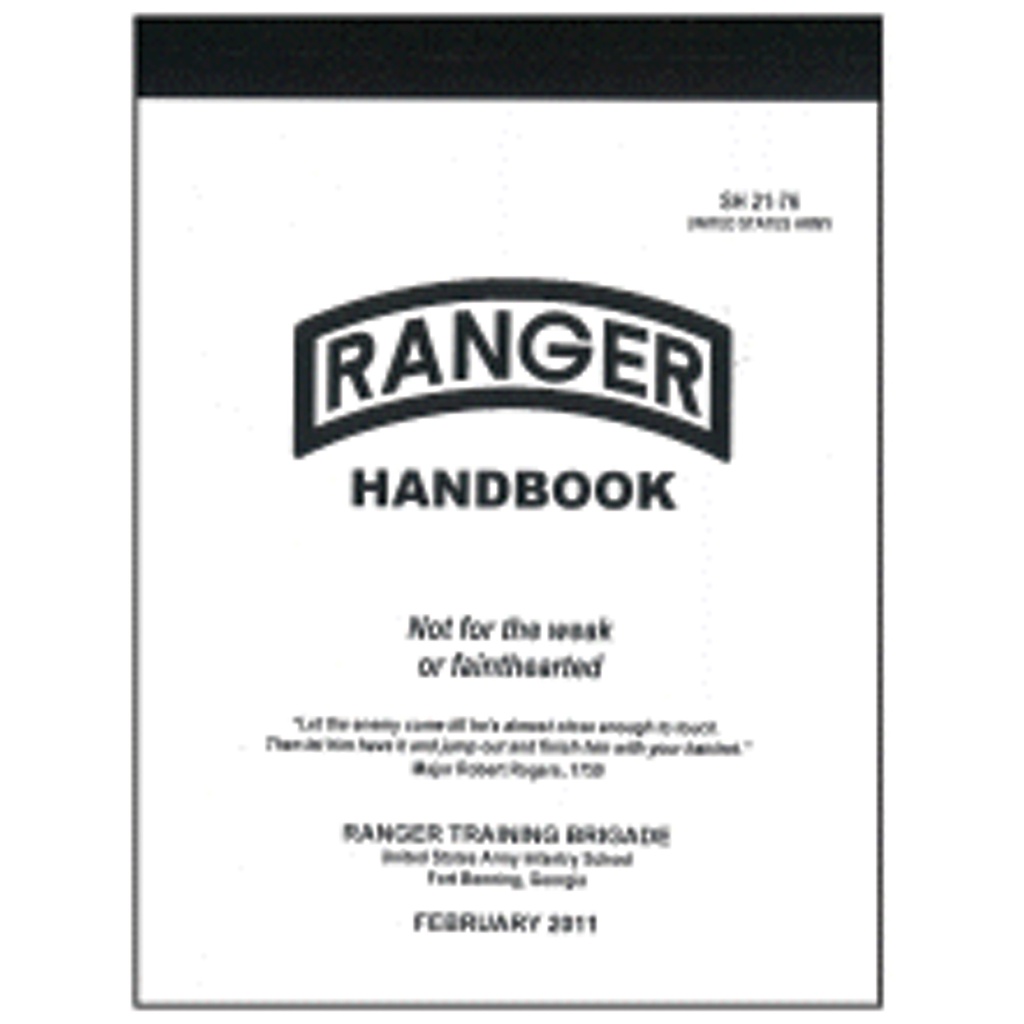
There’s a reason this doesn’t look like a coffee‑table book. The black cover strip, the arched RANGER title, the plain black border and monochrome layout—they’re not design flourishes, they’re a signal. This is formatted like an official military field manual, straight out of Ranger Training Brigade and the United States Army Infantry School at Fort Benning, February 2011.
In your hand, the softcover flexes just enough to ride in a pocket without cracking. The pages are thin, ink‑dense, and unapologetically practical. There’s no color, no distraction, only information. That minimal look does something subtle to you: it reminds you this isn’t entertainment. It’s doctrine. You treat it differently because it doesn’t ask to be admired—it asks to be used.
As you flip through, you see margin space begging for pencil notes, dog‑ears already forming at the corners of the sections you keep coming back to. That tactile, slightly fragile feel is what makes a pocket ranger handbook powerful: it’s small enough to live with you, tough enough to survive the abuse of real carry, and simple enough that you don’t hesitate to mark it up with your own experience.
Carrying a Pocket Ranger Handbook in Real Life
The first time you slide this pocket ranger handbook into a cargo pocket, you notice the size immediately. It disappears against your leg, riding flat instead of bunching up. You forget it’s there—right up until you need it. On the range, in the woods, in the back of a dusty truck, you can pull it out, thumb the edge, and drop straight into a checklist or diagram without scrolling through a phone or worrying about battery life.
In training, it becomes your quiet ritual. Five minutes before lights out, you crack it open to a dog‑eared page on small‑unit leadership or planning. During a long movement, you pull it out on a break and review hand signals or patrol formations. Even if you’re not in the military, this pocket ranger handbook plugs directly into your love of preparedness and structure. It turns vague “I should learn this stuff someday” intentions into actual, on‑paper knowledge you can revisit whenever you want.
And because it looks like what it is—a stripped‑down, no‑nonsense field manual—you never feel like you’re play‑acting. You’re just the person who quietly chooses to know, rather than hope. That identity shift is the real value of carrying a pocket ranger handbook day after day.
When a Pocket Ranger Handbook Becomes More Than a Book
There’s a line on the cover that hits harder the longer you carry it: “Not for the weak or fainthearted.” You don’t have to be a Ranger, or even in the military, for that to land. You just have to be the kind of person who refuses to rely on someone else’s competence when things go sideways.
In that way, this pocket ranger handbook becomes less of an object and more of a quiet standard you hold yourself to. Maybe you’re a vet who wants a piece of the doctrine you trained under, in a size you can keep on you. Maybe you’re a civilian who takes preparedness seriously and respects where this material comes from. Maybe you’re buying it as a gift for someone stepping into uniformed service, knowing they’ll understand what it represents before they even open it.
However it lands in your hands, the effect is the same: you start to see yourself as the one who actually knows. The one who studies. The one who can crack open a pocket ranger handbook at a tailgate, a campsite, or a dimly lit garage and say, “Here’s how this is done,” without pretending.
The feel of doctrine in your hand
There’s a specific feeling when you first flip through: the subtle resistance of tight binding, the rustle of thin paper, the dense blocks of text and diagrams. It feels like a tool, not a book—like a map or a checklist, something meant to be handled with dirty hands under a red lens, not kept pristine on a shelf.
A small object that carries a big history
The February 2011 date stamp, the Ranger Training Brigade imprint, the Fort Benning reference—each piece quietly ties you back to real people who carried similar pages into training areas and onto long movements. You’re not just reading about tactics and leadership; you’re holding a tiny slice of that lineage in your palm.
Questions People Ask Before Buying a Pocket Ranger Handbook
Is a pocket ranger handbook useful if I’m not in the military?
Yes. A pocket ranger handbook is packed with leadership principles, planning methods, fieldcraft, and problem‑solving approaches that translate far beyond uniformed service. If you care about readiness, structure, and making solid decisions under stress, you’ll find a lot to work with here.
What makes this different from a digital ranger manual PDF?
A pocket ranger handbook you can actually carry changes how you use the information. Instead of scrolling on a bright screen with low battery, you’ve got a physical field manual you can mark up, dog‑ear, and flip through anywhere—on the range, in the woods, or during training—without worrying about tech failing when you need it.
Is this pocket ranger handbook the same style as official Army manuals?
It follows the same stripped‑down, black‑and‑white, no‑frills style you’d expect from an official military field manual, complete with the Ranger Training Brigade imprint and a 2011 Fort Benning date line. It’s built to be used, not decorated.
Will this pocket ranger handbook fit in actual cargo pockets?
Yes. The pocket format is designed to ride flat and low‑profile in standard cargo pockets, rucks, and glove boxes. It’s small enough to carry every day, but packed enough with doctrine that you’ll keep finding new sections to mark up over time.
Eventually, you’ll forget the moment you bought this pocket ranger handbook—but you won’t forget the first time you really used it. Maybe it’s on a cold training night when everyone’s tired and scattered, and you quietly step aside, flip to a familiar page, and rebuild the plan from the ground up. Maybe it’s alone at your kitchen table, pen in hand, underlining a line about discipline that feels uncomfortably true. Either way, this pocket ranger handbook stops being just a book and starts becoming part of who you are: the person who doesn’t pretend to know, doesn’t bluff, doesn’t talk tough for show—you’re the one who does the work, carries the doctrine, and is ready when it’s your turn to lead.