
Field-Ready Discipline AR-15 Owner’s Manual - Camo Cover
You already know your rifle isn’t a toy. This AR-15 owner’s manual feels like the calm Marine armorer at your bench, walking you through every pin, spring, and torque value until the rifle in front of you runs the way it should. You hear the click of properly seated parts, see the carbon wiped clean, feel that quiet confidence settle in. You’re not guessing anymore. You’re the one people hand their rifles to when it matters.
You’re at the bench, rifle field-stripped, a small drift pin rolling toward the edge of the mat. Someone in your life trusts this AR-15 to work when it has to, and right now you’re realizing there’s a big difference between “can shoot it” and “can care for it.” The videos helped, but they skimmed past the part you’re stuck on. You don’t need another opinion. You need one clear, trusted voice that tells you exactly what to do next—and why.
Why an AR-15 Owner’s Manual Changes How You See Your Rifle
When you pick up a real AR-15 owner’s manual—the kind modeled after Marine field guides—you feel the shift immediately. This isn’t a glossy coffee-table book; it’s a working tool that assumes you actually use your rifle. Instead of fragments from forums and half-remembered tips, you get step-by-step maintenance, inspection, repair, and reassembly laid out like a calm checklist. Every procedure becomes repeatable. Every cleaning stops being a guess. You’re not watching someone else’s rifle on a screen; you’re working on your own with confidence.
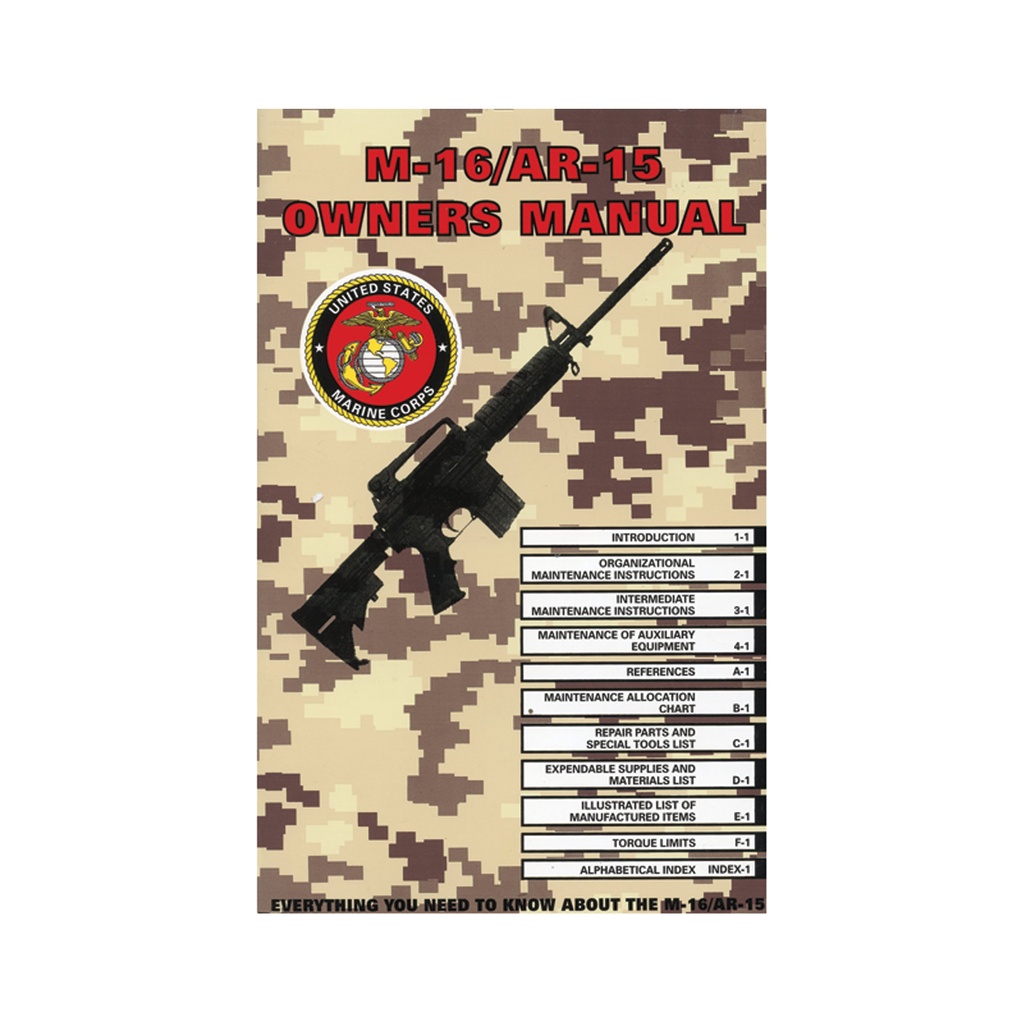
The camo-covered, Marine-style layout is a reminder: this system was built for real-world stress. The manual meets that reality head-on—carbon, wear, torque, extraction, all addressed like a disciplined routine instead of a mystery. Owning an AR-15 stops feeling like having a complicated machine and starts feeling like having a platform you truly understand.
Inside a Marine-Style AR-15 Owner’s Manual: What It Actually Gives You
A lot of books about rifles talk around the work. This one stays at the bench with you. Modeled on M16 / AR-15 technical discipline, it walks you through cleaning, lubrication points, detailed disassembly, and reassembly with the tone of a USMC armorer who has seen every way a rifle can be abused and brought back.
You see exactly how each group comes apart, what “normal” wear looks like, and when a part quietly crosses the line into “replace this now.” The AR-15 owner’s manual doesn’t just tell you what to do; it anchors every step with purpose: this torque spec, on this fastener, for this reason. That clarity is what changes your relationship with the rifle. You move from hoping it’s right to knowing it is.
Even if you never plan to be a full armorer, you feel the benefit of a complete system: crossover notes for M16 platforms, refinishing guidance, final checks, and tool references. You’re not just cleaning; you’re managing a machine that someone may one day depend on.
Why This AR-15 Owner’s Manual Feels Different in Your Hands
The design tells the truth about what it’s for. The digital desert camo cover looks like it belongs in a rucksack or on a shop counter, not hidden on a shelf. The bold red title, the US Marine Corps emblem, the black silhouette of the rifle—everything about it signals, “This is here to be used, not admired.”
That matters when you’re tired, when your hands are still faintly slick from CLP, when you’re not in the mood to baby a book. You can drop it on a tailgate, thumb through a dog-eared section on inspection, or lay it open next to a stripped bolt carrier without worrying about smudges. It’s the kind of AR-15 owner’s manual that looks right at home in a range bag or on a cluttered workbench.
The page layout mirrors that Marine mindset too—clean sections, clear headings, practical callouts. It’s not trying to impress you; it’s trying to keep you from missing a step. And when you’re working with something that can’t afford shortcuts, that restraint is a kind of respect.
How This AR-15 Owner’s Manual Fits Into Your Real Life
Think about the small, recurring moments in your routine. The night before a class when you’re stripping the rifle one more time. The friend who just bought their first AR and shows up wide-eyed, asking, “Can you look this over?” The after-action debrief where a failure to feed nags at you because you know it wasn’t the ammo.
With a worn-in AR-15 owner’s manual within arm’s reach, those moments stop being stressful. You flip to maintenance instructions and walk your friend through each group, letting them see what “good” actually looks like. You sit down after class and trace that malfunction back through the relevant section, checking gas system, magazines, extractor tension. You reference torque limits before reattaching that optic or rail, so you’re not gambling a range day—or worse—on guesswork.
If you teach, sell rifles, or run a small shop, this manual becomes part of your customer experience. You hand it across the counter to the new owner and watch their shoulders drop a little. They’re no longer walking out with just an AR-15; they’re walking out with a clear path to keeping it running. You become the person who doesn’t just move hardware—you send people home prepared.
When an AR-15 Owner’s Manual Makes the Difference
There’s a specific kind of silence when a rifle goes dead unexpectedly. No loud failure—just a click, a hesitation, that sick pause before you realize something’s wrong. In that moment, “I thought I cleaned it enough” isn’t much comfort.
The difference an AR-15 owner’s manual makes usually shows up long before that silence. It’s the inspection you perform because you know what to look for now. It’s catching a worn extractor spring during a routine strip. It’s noticing abnormal wear on a carrier key because you learned, in plain language, how it should look. Those quiet checks mean the moment of truth passes without drama—just another clean cycle, another smooth reset.
And when something does go wrong, you have a roadmap instead of a panic. You sit down with the rifle, open the manual, and start moving through causes methodically. The frustration is still there, but now it’s channeled into action. That’s what this kind of book really buys you: a way to respond instead of react.
Questions People Ask Before Buying an AR-15 Owner’s Manual
Do I really need an AR-15 owner’s manual if I watch YouTube?
Videos are great for seeing motion, but an AR-15 owner’s manual gives you a permanent, structured reference you can return to every time you clean, inspect, or repair. Instead of scrubbing through clips hoping to find the right moment, you open to the exact section you need and follow it step by step at your own pace.
Is this AR-15 owner’s manual helpful if I have an M16-style rifle?
Yes. This manual is modeled around both M16 and AR-15 platforms, with crossover details called out clearly. If you run a civilian AR patterned after the M16 system, the information on maintenance, inspection, and reassembly applies directly and helps you understand the shared lineage.
Will this AR-15 owner’s manual actually improve reliability?
By itself, a book doesn’t fix rifles—but the right AR-15 owner’s manual shows you exactly how to maintain, inspect, and correct issues before they become failures. When you follow those procedures consistently, you dramatically improve reliability because you’re no longer missing early warning signs or skipping critical steps.
Is this something I’d actually use at the bench, or just read once?
The layout and camo-covered, Marine-style design are meant for real use, not just reading. Most people end up leaving this AR-15 owner’s manual on the workbench, pages marked and corners worn, because it becomes their go-to reference every time the rifle comes apart.
Picture the next time you break your rifle down. The bolt carrier group is lined up on the mat, small parts grouped in a way that now makes sense. The camo-covered AR-15 owner’s manual lies open beside you, spine already softened from use. You don’t rush; you move methodically, wiping, inspecting, reassembling in the same order every time. When you lock the rifle back together and feel that solid, familiar weight in your hands, you’re not just hoping it will run. You know it will—because you took the time to learn it like a professional, and now you carry that quiet confidence every time you shoulder it.