Rebel Skull Grip-Lock Push Dagger - Rainbow Steel
You don’t carry a push dagger to blend in. You carry it to know, in that split-second between calm and chaos, your grip won’t slip and your nerve won’t crack. This push dagger plants your fist behind a rainbow dagger blade and a skull that doesn’t apologize. The ribbed T-handle locks into your palm, the nylon sheath keeps it close, and you walk a little straighter knowing you didn’t choose something safe—you chose something that matches the edge you already have.
When a Push Dagger Becomes the Line You Won’t Cross Alone
There’s a moment, walking to your car or cutting through a side street, when the air changes. You feel it before you see anything—your pace tightens, your senses sharpen, and you become painfully aware of how empty your hands are. A push dagger isn’t about paranoia; it’s about that exact second when you decide you’re not showing up to your own life unprepared.
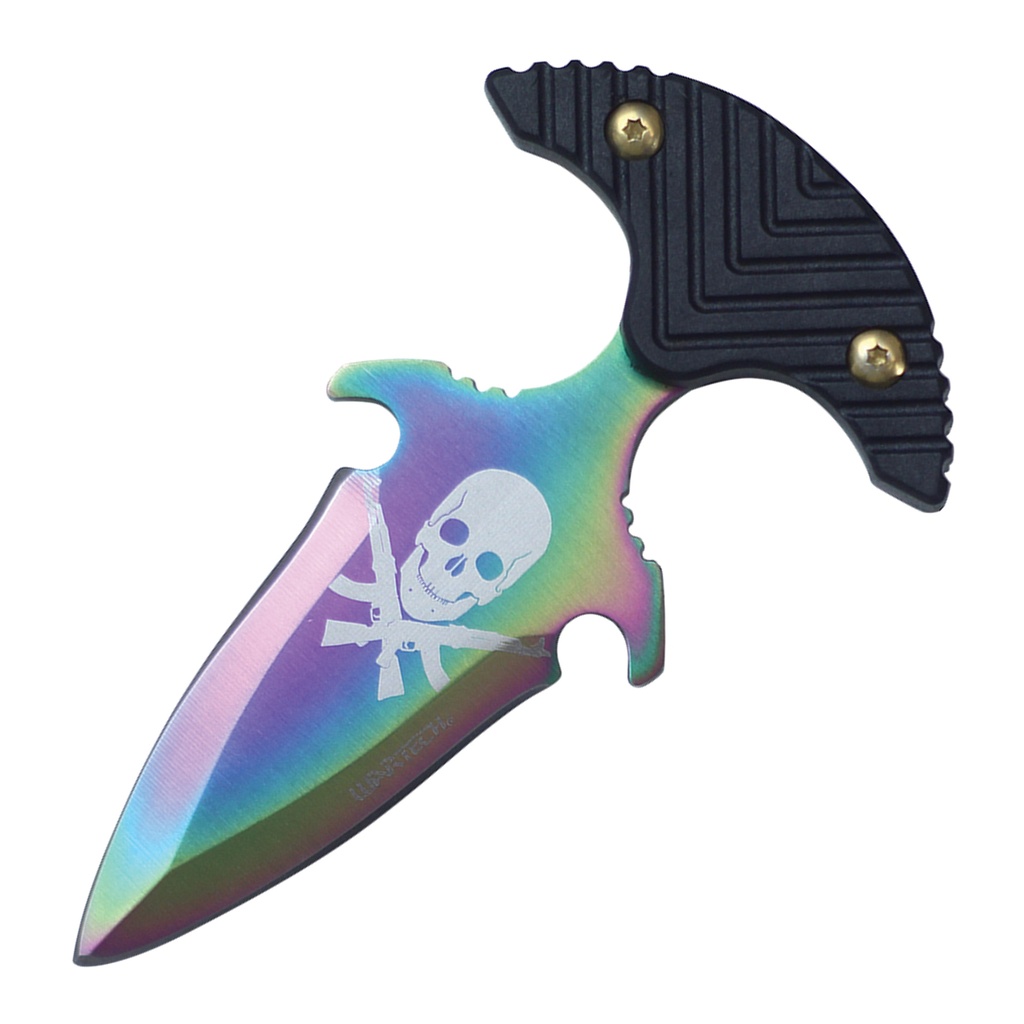
Now picture your fist behind a compact, rainbow-finished dagger blade, a white skull staring outward like it means every word you’ve never said. Your fingers lock into a ribbed T-handle, the nylon sheath snaps free, and suddenly that uneasy feeling has somewhere to go. Not as a threat. As a boundary.
How This Push Dagger Turns Your Grip Into a Statement
Most people see a knife. You feel a decision. This push dagger is built around that decision: when you decide to stand your ground, your hand needs to cooperate. That’s why the T-shaped handle is thick, synthetic, and ribbed deep enough that even sweaty or gloved hands don’t slide. Your knuckles drive straight behind the blade, so your natural punching motion becomes stable, controlled force instead of a desperate swing.
The blade itself is a fixed, dagger-style edge in stainless steel, about eight inches overall, with enough reach to matter but compact enough to stay close to your body. The rainbow finish isn’t just flash; it throws light, catches eyes, and makes the skull-and-crossed-rifles graphic impossible to ignore. You’re not hiding this tool from yourself. You’re owning the fact that you chose it.
The First Time You Draw It for Real
Imagine your hand brushing past your belt or gear, finding the familiar curve of the handle. The nylon sheath releases with a practiced pull. No fumbling for a thumb stud, no worrying if a folder will lock in time. The push dagger is simply there—already aligned with your fist, already pointing in the direction you need it to.
Why This Push Dagger Feels Built for Chaos, Not a Display Case
You’ve seen gear that looks wild but falls apart the first time you actually use it. This isn’t that. The stainless steel blade gives you real-world durability: it shrugs off light abuse, resists corrosion, and holds an edge long enough for what push daggers are meant to do—short, intense, up-close work. The skeleton of the design is simple on purpose: fixed blade, direct geometry, no moving parts to fail when adrenaline is shaking your shoulders.
The rainbow finish rides that line between showpiece and seriousness. Under harsh light it flares—greens, purples, blues flashing in the facets of the dagger grind. Under low light, it darkens, the skull graphic standing out in stark white. The gold-tone screws pinning the handle to the tang look like a custom touch, but they also quietly signal something else: this was assembled to stay together when you’re not calm, precise, or gentle.
Texture You Can Feel Without Looking
Run your thumb across the handle and you’ll catch each ribbed ridge. In a panic, that’s how you confirm orientation without taking your eyes off whatever’s in front of you. You grip down, the T-handle fills your palm, and you know immediately which way the blade is facing. That’s not an aesthetic choice. That’s design that respects what actually happens in a real confrontation.
Carrying a Push Dagger Changes How You Move Through the World
Owning a push dagger doesn’t turn you into someone who’s looking for trouble. It turns you into someone who quietly refuses to be the easy option. Slipped into its nylon sheath, this dagger rides close—on a belt, in a bag, in a console—waiting in that edge space between "probably fine" and "I need something in my hand right now."
Because it’s compact and fixed, there’s no awkward unfolding, no wondering if you can get it open one-handed. Your grip goes from empty to locked in a single, simple motion. Over time, that certainty does something subtle: your shoulders drop, your eyes stay up, your route choices come from confidence instead of fear.
And then there’s the look. That skull staring out from a rainbow blade isn’t shy. You might leave it sheathed most of the time, but when you lay out your gear or open your drawer, it grabs your attention first. You start to recognize it as part of your personal kit—the thing you chose because it matched your refusal to disappear into the background.
When a Push Dagger Is the Right Call (and When It Isn’t)
You’ve probably compared this to a folding knife, a tactical pocket blade, maybe even an OTF or automatic. Those have range, utility, everyday cutting tasks covered. A push dagger is different. This is about close, controlled, short-range defense and intimidation-by-presence. It’s not your box cutter. It’s the tool you reach for when distance is gone and there’s no time left for finesse.
Where it shines: tight spaces, quick draws, and situations where you might not have full dexterity. The T-handle lets you drive the blade forward or brace it in a defensive posture without needing complex technique. Where it’s not ideal: delicate slicing, long cutting sessions, or places where knife visibility will cause more problems than it solves.
So you don’t buy this instead of a daily carry blade. You add it as the quiet backup—the one piece of gear you hope never leaves its sheath, but you train with anyway because you know that hoping is not a plan.
Questions People Ask Before Buying a Push Dagger
Is a push dagger legal to carry where I live?
Legality for a push dagger changes from state to state and even city to city. Some places treat them like standard fixed blade knives; others restrict them specifically. Before you carry, check your local knife laws and pay attention to blade length and how you plan to conceal or display it.
Is a push dagger good for self-defense if I’m not trained?
A push dagger is often chosen because its grip feels intuitive—your natural punching motion lines up with how the blade works. That said, any defensive tool gets better with training. A short class on situational awareness and basic retention can turn this from "sharp object" into something you can deploy with real confidence.
How comfortable is it to carry a push dagger every day?
Comfort depends on how and where you mount it. This model’s nylon sheath keeps the push dagger secure and low-profile, but you’ll want to experiment—belt carry, inside a bag, or mounted to gear—until drawing feels natural and sitting, walking, or driving doesn’t remind you it’s there.
Will the rainbow blade finish wear off with use?
The rainbow coating on this push dagger is durable, but any finish will eventually show wear where it rubs the sheath or hard surfaces. Most owners end up liking that—it trades pristine flash for a broken-in, earned look that says this blade isn’t just for show.
That First Night You Lay It Beside Your Other Gear
Picture emptying your pockets or unloading your belt at the end of the day. Keys, phone, wallet—and then the nylon sheath, followed by the cool weight of your push dagger in your hand. The rainbow blade catches a stray bit of light, the skull stares up from the table, and you feel that quiet click inside: this is yours now.
You slide a thumb along the ribbed T-handle, feel how naturally your fist closes around it, and realize something has shifted. You didn’t just buy a knife. You drew a line—between who you were when you walked through dark places hoping for the best, and who you are now, walking through the same places knowing that if the moment comes, your hand won’t be empty.