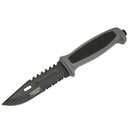
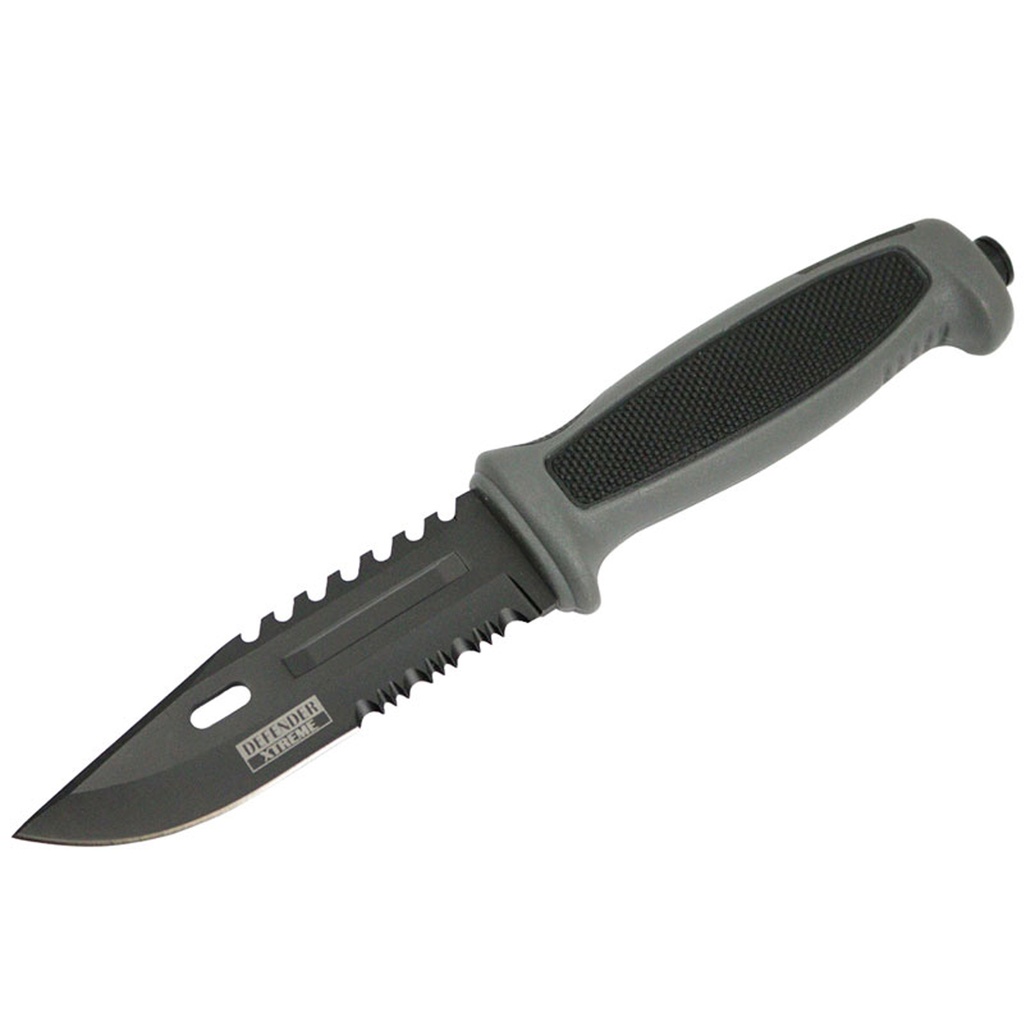
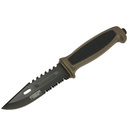
Ridgeback Survival Hunter Fixed Blade Knife - Gray Rubber
You’re halfway down the trail when the light drops faster than you expected. This is where your hunting knife stops being gear and starts being backup. With a rugged fixed blade hunting profile, sawback spine, and a gray rubber grip that actually sticks in your hand when it’s wet and cold, you’re not babying this—you're using it. The Ridgeback feels like that one dependable survival hunting knife you throw in the pack and never worry about again.
| Blade Length (inches) | 4.5 |
| Overall Length (inches) | 9.5 |
| Blade Color | Black |
| Blade Finish | Matte |
| Blade Style | Drop Point |
| Blade Edge | Partial-Serrated |
| Blade Material | Steel |
| Handle Finish | Matte |
| Handle Material | Rubber |
| Theme | Tactical |
| Handle Length (inches) | 5 |
| Pommel/Butt Cap | Flat pommel |
You’re a few miles from the truck when the weather changes for the worse. The ground is slick, your fingers are cold, and the easy part of the day is over. This is when you find out whether your hunting knife was just a good idea at checkout—or a fixed blade you can actually trust when things get uncomfortable.
That’s where a hunting knife like this steps up. Not for photos. Not for bragging rights. For the part of the trip nobody posts about: the messy work, the quick cuts, and the small problems that only a solid blade fixes.
When Your Hunting Knife Becomes Your Backup Plan
Out in the field, your hunting knife quietly becomes the tool you reach for ten times more than you thought you would. Cutting cord to rig a tarp before the rain really hits. Splitting kindling when the fire has to happen now. Clearing brush just enough to get a clean lane. None of that is glamorous—but all of it matters.
This knife’s 4.5-inch black drop point blade hits that sweet spot between compact and capable. Long enough to process game and handle camp chores, short enough to stay nimble and under control. The partial serrations on the edge chew through rope and webbing when you don’t have time to saw away with a dull spot. And that sawback spine? It’s there when you need to bite into tougher material or notch wood without babying the edge.
What this means for you is simple: you stop wondering whether your blade can handle it. You just cut, carve, slice, and move on.
Why This Fixed Blade Hunting Knife Feels Built for Real Use
Most people look at the aggressive sawback and black blade and think "tactical toy." You notice something different the first time you wrap your hand around the handle. That gray rubber isn’t there for looks—it’s there because wet hands, mud, and cold mornings don’t care how tough you think you are.
The handle runs a full 5 inches, giving your fingers actual room instead of forcing you into cramped grips. The molded guard keeps your hand from sliding forward when you’re pushing into tougher cuts. Rubber texturing and black inlays lock your palm in place, whether you’re bare-handed in summer or wearing thin gloves when the temperature drops.
The matte black steel blade cuts down on reflection—useful when you’re stalking game and don’t want a flash of sunlight giving you away. Steel at this price point isn’t delicate; it’s meant to be sharpened easily in the field on a pocket stone or improvised edge. You’re not babying a mirror finish. You’re running a working fixed blade hunting knife that looks better the more scars it picks up.
The Design Detail That Makes It Click
The flat pommel at the end of the handle looks minor until you actually use it. That squared-off end gives you a surface you can tap with a stick to drive the blade through tougher material, or use to knock tent stakes into softer ground. It’s the kind of detail you only appreciate after a weekend of real use.
How a Hunting Knife Like This Fits Into Your Everyday Gear
Not every blade in your kit is an everyday carry pocket knife. Some live in the truck, the pack, or the gear bin because that’s where they’re supposed to be. This hunting knife belongs in that second category: the reliable fixed blade that waits patiently until you need more than a small folder can give.
On a day hunt, it rides with your other essentials, ready for field dressing, cutting paracord, trimming branches for a quick blind, or breaking down camp. On a camping trip, it’s your go-to camp knife—carving tent stakes, shaving tinder, splitting small sticks, opening stubborn packaging, and handling the dirty jobs you don’t want to risk your nicer blades on.
You start to notice how comfortable it feels in different grips. Thumb on the spine when you need control for careful slicing. Choking back on the handle when you need power. Using the serrated section when everything’s wet and slippery and you just need something to bite and pull through. It’s not just a fixed blade hunting knife in your kit—it slowly becomes the one you trust for the rough work.
From Truck Knife to Trail Partner
Maybe at first it lives in the glove box or strapped inside the truck. But tools that prove themselves tend to migrate. One trip, you toss this into your pack “just in case.” A few trips later, you realize it’s been on every outing without fail. That’s how a budget-friendly fixed blade hunting knife turns into the quiet MVP of your outdoor setup.
When a Fixed Blade Hunting Knife Makes the Difference
You know the feeling of improvising with the wrong tool—trying to baton wood with a flimsy pocket knife or twist a dull blade through hide and gristle. A solid fixed blade hunting knife changes that entire experience. Instead of fighting your gear, you let it do the work.
Picture a late-season hunt. Light’s fading, the air has that sharp edge to it, and you’re racing the dark to process an animal cleanly and efficiently. A comfortable rubber grip helps when your hands are tired and slick. A strong drop point profile gives you control where you need it most, and the serrations stand ready for those tougher, stringier cuts that show up when the day’s already taken it out of you.
Or think of a stormy camp night when you realized you needed more shelter, fast. That’s when the sawback bites into branches, the serrations tear through stubborn cord, and the blade helps turn half-baked plans into actual protection. This isn’t about looking tactical. It’s about having one more edge in your favor when conditions shift.
Questions People Ask Before Buying a Hunting Knife
Is a 4.5-inch blade enough for a hunting knife?
For most people, a 4.5-inch hunting knife is a sweet spot. It’s long enough to field dress game and handle camp chores, but short enough to stay precise and controllable. You get power without feeling like you’re swinging a machete around your campsite.
Can a fixed blade hunting knife do camp chores and survival tasks too?
Yes. A solid fixed blade hunting knife like this easily crosses into camp and light survival work. The sawback spine and partial serrations add versatility for cutting cord, notching wood, and dealing with rougher material when you’re outdoors.
Is a rubber handle durable enough for hard outdoor use?
A quality rubber grip is actually an advantage in real-world conditions. It shrugs off moisture, offers better traction with wet or gloved hands, and doesn’t turn icy-cold like exposed metal. As long as you’re not abusing it with chemicals or fire, it holds up to repeated use.
How often will I need to sharpen this hunting knife?
That depends on how you use it. With regular hunting and camping tasks, a few minutes on a basic stone or pull-through sharpener after trips will keep your hunting knife ready. The steel is chosen to be easy to bring back to a working edge instead of being fussy or fragile.
Fast-forward a bit. The truck is quiet, your gear is tossed in the back, and this knife sits on the tailgate, drying in the cool air. There are a few new scuffs on the black blade, a faint mark on the flat pommel where you tapped it through a stubborn branch, maybe a bit of dried sap near the serrations you still need to wipe clean. That’s the moment you realize this isn’t just another hunting knife you tried. It’s the one that quietly did its job every time you reached for it—and the one that’ll be there, waiting, the next time you head out.