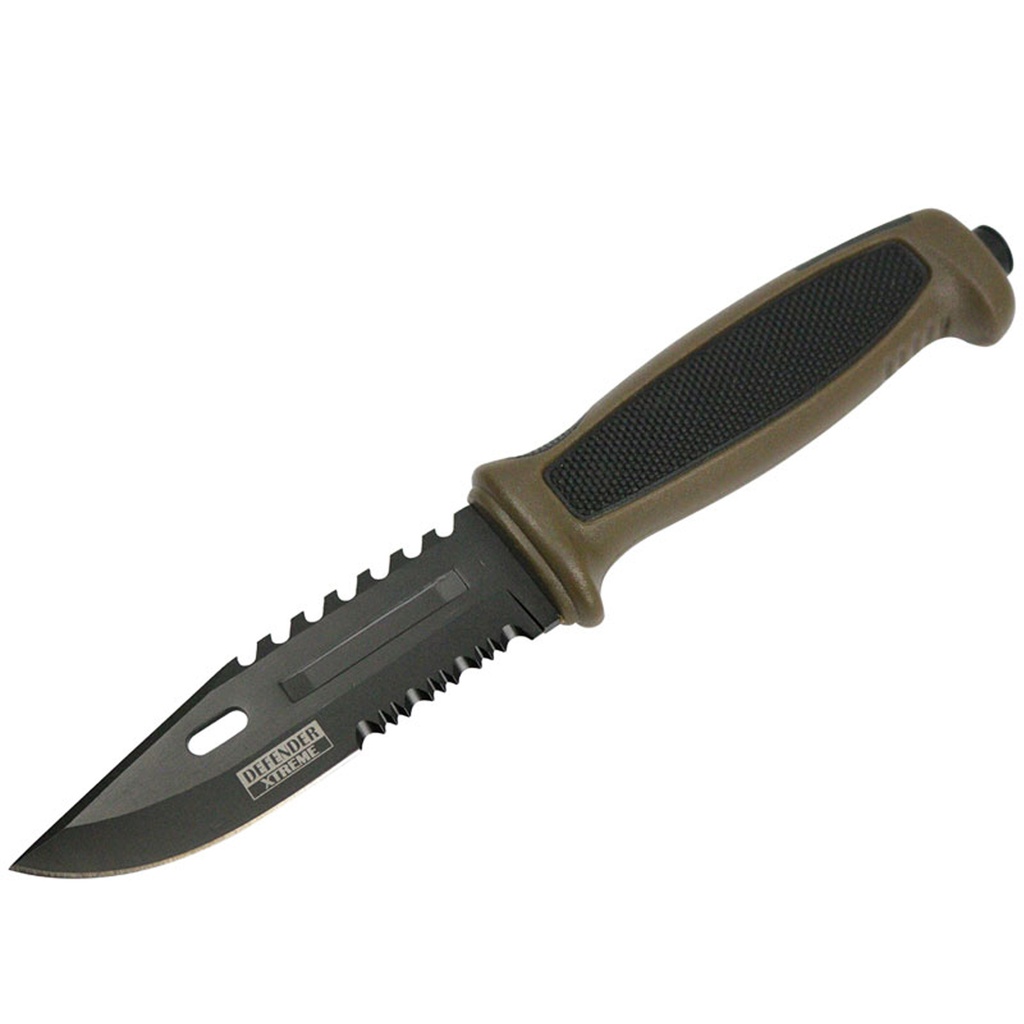
Ridgeline Hunter Sawback Fixed Blade Knife - Coyote Rubber
You’re halfway down the trail when the easy path disappears. Brush thickens, light drops, and suddenly that cheap folder you’ve been carrying doesn’t feel like much. A solid fixed blade hunting knife in your hand changes everything. The ridged sawback, the coyote rubber grip, the weight of real steel—you feel ready, not hopeful. This isn’t about looking tactical. It’s about knowing, when things get rough in the woods, you brought a knife that won’t quit before you do.
| Blade Length (inches) | 4.5 |
| Overall Length (inches) | 9.5 |
| Blade Color | Black |
| Blade Finish | Matte |
| Blade Style | Drop Point |
| Blade Edge | Partial-Serrated |
| Blade Material | Steel |
| Handle Finish | Textured |
| Handle Material | Rubber |
| Theme | Tactical |
| Handle Length (inches) | 5 |
| Pommel/Butt Cap | Exposed pommel |
The moment you step off the trail, the gear you chose an hour ago becomes either a quiet relief or a loud mistake. Out here, there’s no counter, no return policy—just you, the tree line closing in, and whatever fixed blade hunting knife you trusted enough to bring.
Brush starts grabbing at your clothes. A low branch blocks the way. You reach back automatically—not to your pack, not to something delicate—but to the solid weight on your belt. When your fingers close around a coyote rubber grip and feel that sawback spine waiting, you’re not guessing whether your blade can handle it. You already know.
Why This Fixed Blade Hunting Knife Changes How You Walk Into the Woods
You’ve probably carried something that made you nervous before—a folder that flexed a little too much, a budget blade that dulled halfway through a simple task. Owning a fixed blade hunting knife like this takes that tension out of your head and puts quiet confidence in your hand.
At 9.5 inches overall with a 4.5-inch steel drop point blade, this isn’t a wall-hanger or a toy. The sawback spine is there when you need to chew a notch into a branch or score wood for kindling. The partial serrations near the handle bite through rope, vines, or stubborn material your plain edge just skates over. And the matte black finish keeps it low-reflection and all business—no shiny ornament, just a working edge made to get dirty.
What this means for you: you stop treating your knife like something fragile. You start using it like a field tool. Clearing light brush. Breaking down camp tasks. Processing what you brought down on the hunt. One blade, no hesitation.
Built Like a Field Tool: The Story in the Steel and Coyote Rubber
There’s a reason serious outdoors people keep at least one fixed blade hunting knife in their kit: there’s no hinge to fail when things get rough. This blade is a solid piece of steel running straight through the handle, ending in an exposed pommel you can actually use to strike, tap, or persuade stubborn gear into cooperating.
The handle is where the design really clicks. That coyote rubber grip isn’t there to look tactical on a desk. It’s there for the moment your hands are wet, cold, or tired and you still need control. The rubber is textured and contoured with black inset panels so your fingers naturally lock in. Your thumb finds its spot, your index finger settles behind the guard, and the whole knife feels like it’s bracing with you.
You notice it the first time you twist your wrist to cut through something tough: the handle doesn’t roll or slip. The deep finger guard keeps your hand from sliding forward onto the blade when you’re driving down hard. That’s not just comfort—that’s safety you feel in real time, when you’re tired and not at your sharpest.
The Details You Only Appreciate After a Long Day Out
After a few hours of use, little things start to matter. The rubber doesn’t chew up your hand. The balance point lands where your fingers actually hold it. The exposed pommel gives you a solid impact point when you need to crack, tap, or anchor something without abusing the cutting edge. These details don’t show up in a spec sheet—you feel them mid-task, when you realize you’re not fighting your own knife.
How a Fixed Blade Hunting Knife Like This Fits Into Real Life Carry
Not every knife you own has to live in your pocket. A dependable fixed blade hunting knife becomes part of your routine in quieter ways. Maybe it rides in your truck kit, edge oiled, ready for those unplanned roadside moments. Maybe it lives with your camping gear, the one you always reach for first when setting up or breaking down.
The 9.5-inch size hits that sweet spot between usable and manageable. It’s long enough to feel substantial in hand and short enough that you don’t feel ridiculous carrying it. The drop point profile is familiar and versatile—you can do controlled tip work for field dressing, or lean into the belly of the blade for slicing and general camp tasks.
This isn’t just a hunting knife that comes out once a year. It becomes the tool you teach your hands to trust—cutting cord for tarps, notching branches, breaking down cardboard, trimming stakes, scraping bark for tinder. The more you use it, the more it stops being “a knife” and starts being your knife.
The Feel of Readiness, Not Just Ownership
There’s a particular comfort in knowing you don’t have to baby your gear. When you carry a fixed blade hunting knife with a sturdy spine, serrations, and a tough rubber grip, you give yourself permission to say yes to rough work. You’re not wondering “Will this break?”—you’re already rolling up your sleeves and getting on with it.
When a Fixed Blade Hunting Knife Beats a Folder Every Time
You might already have a favorite pocket knife. Most people serious about everyday carry do. But there are moments when even the best folding blade feels like the wrong choice. Heavy batoning, prying, or twisting cuts can turn a folder into a liability fast.
This is where your fixed blade hunting knife steps up. No lock to fail. No pivot to clog. No play in the joint when you’re torquing the blade sideways to free it from wood. In a wet, muddy, or cold environment, simplicity wins—steel and rubber, nothing to flip, no mechanism to baby.
If you’ve ever found yourself asking, “Which is better for real outdoor use, a fixed blade or a folder?” you already know the real answer: it’s not either-or. It’s having the right tool for the job. Your folder handles quick, small everyday carry tasks. Your fixed blade hunting knife waits for the moments that matter more—when failure isn’t just annoying, it’s dangerous.
Questions People Ask Before Buying a Fixed Blade Hunting Knife
Is a 9.5-inch fixed blade hunting knife too big to actually carry?
For most people, no. A 9.5-inch fixed blade hunting knife with a 4.5-inch blade rides comfortably on a belt or in a pack without feeling oversized. It gives you enough reach and leverage for real outdoor work, while still being manageable around camp and on the trail.
Will this type of fixed blade hold up to real survival and hunting use?
A solid steel fixed blade hunting knife with a sawback spine, partial serrations, and an exposed tang is built for hard use. You’re getting a tool that can handle cutting, notching, light batoning, and general field tasks without babying it—exactly what you want when you’re hunting or camping away from the truck.
What’s the advantage of a rubber handle on a fixed blade hunting knife?
A rubber handle on a fixed blade hunting knife gives you grip and forgiveness. When your hands are wet, cold, or muddy, the textured coyote rubber helps you hang on without needing a death grip. It also absorbs some shock when you’re chopping or prying, making longer use less fatiguing.
Is a sawback on a hunting knife actually useful or just for looks?
On a working fixed blade hunting knife, a sawback can absolutely earn its place. You can use it to score branches, cut shallow notches, or rough up wood for fire prep. It won’t replace a full saw, but in the field it gives you added utility without carrying another tool.
The Moment This Fixed Blade Hunting Knife Becomes Yours
Imagine coming back from a long day out. Boots muddy, hands scratched, the kind of tired that feels earned. You drop your pack, unclip your fixed blade hunting knife, and see it streaked with sap and dirt, edge still ready. There’s a quiet satisfaction in that—gear that looks like it shared the day with you instead of watching from the sidelines.
Next time you step off the trail, you won’t be wondering if your knife can keep up. You’ll feel the coyote rubber settle into your palm, see the black steel catch a sliver of dying light, and know that whatever the woods throw at you—brush, rope, bone, bark—you brought a fixed blade hunting knife that’s ready to take the hit right alongside you.