River Forge Field-Rite Skinner Knife - Brown Micarta
You know that moment over a cooling carcass when the talk stops and the work starts? That’s where a hunting skinner either proves itself or slows you down. With this compact Damascus skinner knife in your hand, the blade bites clean, the Micarta stays sure even when slick, and the full-tang weight tells you it won’t flinch. Slide it back into leather and you’re not carrying a showpiece—you’re carrying proof you know what you’re doing.
| Blade Length (inches) | 3.5 |
| Overall Length (inches) | 6.5 |
| Weight (oz.) | 7.5 |
| Blade Color | Silver |
| Blade Finish | Patterned |
| Blade Style | Drop Point |
| Blade Edge | Plain |
| Blade Material | Damascus |
| Handle Finish | Textured |
| Handle Material | Micarta |
| Theme | Damascus |
| Handle Length (inches) | 3 |
| Tang Type | Full Tang |
| Carry Method | Belt Loop |
| Sheath/Holster | Leather Sheath |
The first cut after a good shot always tells you the truth. Not about the animal—you already know that story—but about your gear. Either your blade glides where you want it to go, or you fight it, adjust your grip, and promise yourself you’ll upgrade before next season. A dedicated Damascus skinner knife doesn’t just make the work cleaner; it changes how confident you feel every time you step into the woods.
Why a Damascus skinner knife changes the work in your hands
Field dressing is where all the “someday” gear talk dies. It’s cold, maybe getting dark, your fingers are slick, and any mistake risks meat, hide, or your own hand. In that moment, a purpose-built Damascus skinner knife quietly earns its place on your belt.
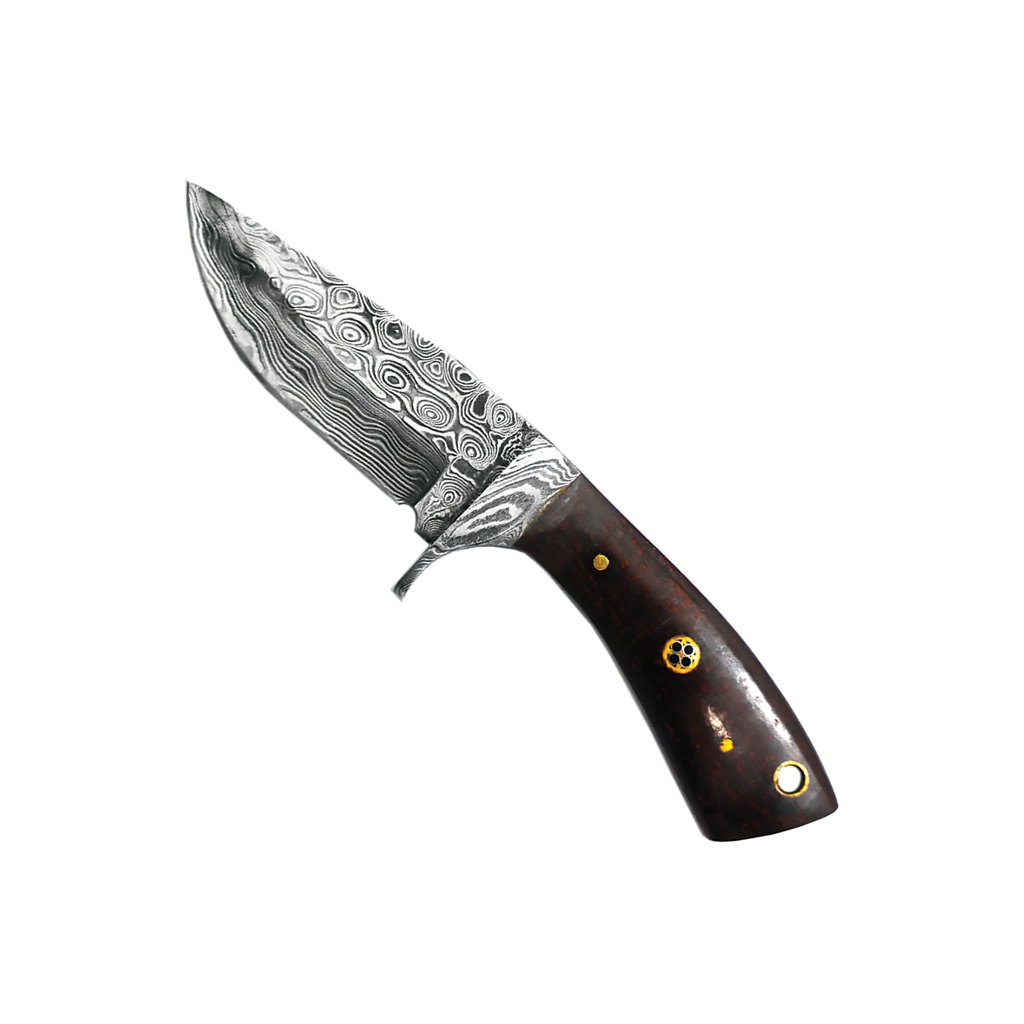
Here, the 3.5" Damascus drop point isn’t about looking fancy on a shelf. The layered steel gives you a fine, biting edge that wants to start a cut as soon as you lay it in. The compact 6.5" overall length keeps the blade close to your fingers, so you feel every contour as you trace around joints or follow the line of a hide. You’re not wrestling a big camp knife into delicate work—you’re guiding a tool that finally feels sized to what you’re doing.
Damascus will always draw the eye, but out here it does something quieter: it lets you trust that thin, keen edge as you work through fat, sinew, and gristle without feeling it go dull halfway through the job. That’s what matters when you’re elbow-deep and just want the job done clean.
How this Damascus skinner knife is built to feel like an extension of you
When you pick up a new blade, you know in the first three seconds whether it’s going to live on your belt or in a drawer. The design of this hunting skinner earns its keep the moment your fingers close around the Micarta.
The full-tang construction runs the entire length of the knife, so the 7.5 oz weight settles solidly into your hand instead of feeling hollow or handle-heavy. The brown Micarta scales are contoured smooth where your palm rests and just textured enough along the sides to stay put when they’re wet or bloody. No rubbery gimmicks, no hot spots—just a handle shape that listens to how hands actually move during skinning.
You’ll notice the subtle finger guard formed by the tang and bolster. It’s not a big, aggressive hook—just enough of a stop that if your hand slides forward in a slick moment, steel doesn’t meet skin. At the back, the lanyard hole gives you the option to add a wrist thong if you like to work over steep ground or in thick brush where dropping a knife means losing it.
The small details you notice only after a few animals
After a couple of seasons with a knife, you start to care about things you never thought about at first: how easy the spine is to pinch when you’re caping around antlers, whether the handle bites into your palm during long, shallow cuts, if the tip is easy to control in tight spots.
This Damascus skinner knife lines up those details for you. The drop point profile brings the tip in line with your knuckles, which lets you work under hide without accidentally punching through it. The curved belly gives you a long, controlled slicing section so you’re gliding, not sawing. It feels less like a generic “fixed blade” and more like something shaped around the way you already work.
Carrying a Damascus skinner knife in real life, not just on a gear shelf
A knife you actually use can’t be a chore to carry. This one was clearly meant to live on a belt, not in a display case.
The handcrafted leather sheath rides close with a simple belt loop, sitting high enough to stay out of the way while you’re walking, bending, or climbing into a stand. When you reach back, the compact length is right there—no fumbling past a long, swinging sheath. The retention is snug enough that you don’t worry about losing it when you’re pushing through brush, but it still draws cleanly when you need it fast.
Because this is a true full-tang Damascus skinner knife and not a big camp chopper, you’re more likely to bring it along on quick scouting trips, early-season hikes, or runs to check cameras. Weight and size stop being excuses. It becomes part of your everyday hunting kit, the way a good headlamp or trusted set of optics does.
From hunting season to everyday carry around the land
Once you’ve got a blade that feels like this, it doesn’t stay a “just during season” knife very long. It starts helping with quick rope cuts at the truck, trimming cord on blinds, breaking down cardboard back at the house, or cleaning fish at camp.
The same edge that shines as a hunting skinner turns into a reliable daily carry blade around your property or camp—a small, precise fixed blade that you know bites deep and sharp whenever you take it out of the sheath.
When a dedicated hunting skinner beats a bigger knife every time
You’ve probably made do before—pressing a big survival blade into skinning duty, or using a folding pocket knife because it was what you had on you. It works, technically. But you feel every compromise in your wrists, your shoulders, and in the little nicks in the hide or lost meat you wish you could take back.
A compact Damascus skinner knife quietly solves that. The 3.5" drop point is short enough to stay under control when you’re working around legs, ribs, or the neck. You can choke up, pinch the spine, and make surgical moves instead of hoping a long blade doesn’t slip too far. The belly and edge geometry are tuned for slicing more than stabbing—exactly what you want on game.
And because it’s Damascus, you’re not babying some dainty showsteel. You can cut through tough hide, work around joints, and still know the edge will take a honing stone and come back quickly. It becomes the knife you hand a buddy silently and say, “Use this instead,” once they start struggling with whatever they brought.
Questions people ask before buying a Damascus skinner knife
Is a Damascus skinner knife really better for hunting than a regular fixed blade?
“Better” comes down to how you use it. A Damascus skinner knife like this is tuned for controlled slicing—shorter blade, curved belly, and a tip that tracks close to your hand. Compared to a generic fixed blade, you’ll feel more control around joints and under hide, and the Damascus edge holds up well through a full animal without constant touching up.
Can I use this Damascus skinner knife for everyday tasks too?
Yes, and that’s where it really starts to earn its place. While it’s built as a hunting skinner, the compact size, full-tang build, and Micarta handle make it comfortable for daily chores—cutting cord, opening bags, light camp work. You’re basically carrying a small, robust fixed blade that just happens to be optimized for game when the season rolls around.
How hard is it to maintain a Damascus hunting skinner?
Caring for a Damascus skinner knife is mostly about consistency, not complexity. Wipe it clean and dry after use, especially after contact with blood or moisture, and give the blade a light coat of oil before long storage. Sharpen it with a stone or guided system the way you would any quality carbon-rich steel, and the layered Damascus will reward you with a fine, lasting edge.
Will the Micarta handle stay grippy when it’s wet or bloody?
That’s exactly where Micarta shines. This brown Micarta is textured and slightly porous, so instead of getting slick, it actually keeps some bite when your hands are wet. Combine that with the contoured shape and finger guard, and you get a hunting skinner that feels secure even in the messiest part of the job.
Picture this: the woods are quiet again, the tag is filled, and the real work is laid out in front of you. You reach back, feel the familiar shape of the leather sheath, and draw a compact Damascus skinner knife that already knows the job. The Micarta nestles into your grip, the patterned steel flashes once before it meets hide, and then everything just becomes smooth, confident motion. By the time the carcass is hanging clean and the knife is wiped down and sheathed, you’re not thinking about gear anymore. You’re thinking, quietly, “This is how it’s supposed to feel.”