Shadowbend Field-Dress Recurve Knife - G10 Black
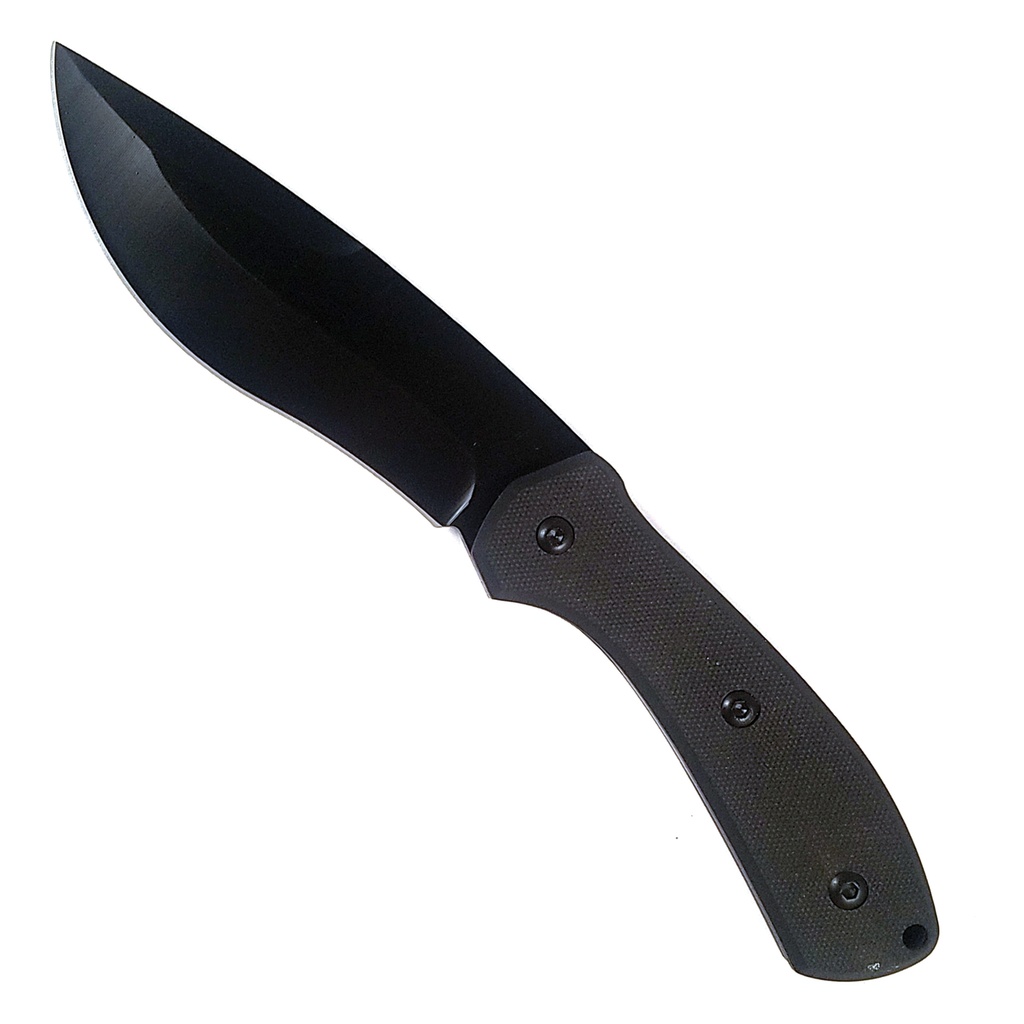
You’re kneeling over your deer, breath clouding in the cold, and this recurve hunting knife feels like an extension of your hand. The matte black blade slides through hide and tissue on the pull, no slipping, no wrestling, just clean control. The textured G10 handle locks in even when your grip is bloody and wet. On your belt it rides light and quiet. In your hand, it’s the difference between fumbling in the dark and moving like you’ve done this your whole life.
| Overall Length (inches) | 9 |
| Blade Color | Black |
| Blade Finish | Matte |
| Blade Style | Recurve |
| Blade Edge | Plain |
| Handle Material | G-10 |
| Theme | None |
| Sheath/Holster | Nylon Sheath |
You’re a few miles from the truck, light dropping faster than you planned, and the air has that sharp, metallic cold that makes every sound carry. The shot was clean. Now it’s just you, the animal, and the moment that separates someone who hunts from someone who finishes the work. Your hand drops to your belt, and the recurve hunting knife you chose on purpose—not just because it was there—slides free. The handle feels familiar. The first pull-cut bites and glides instead of tearing. That’s when you know: you brought the right blade.
Why a Recurve Hunting Knife Changes the Way You Work
If you’ve ever fought your blade more than the hide, you already know why a recurve hunting knife matters. That deep belly in the edge isn’t just a design flex; it changes how the knife behaves in your hand. On every pull, the curve pulls back into the cut, almost like it wants to stay connected. That means less pressure from you, more control where it matters—unzipping hide, tracing muscle, following bone without slipping off.
Out here, you don’t get bonus points for effort. You want a blade that turns careful cuts into muscle memory. Around 4.9 inches of matte black recurve steel gives you enough reach to open up a chest cavity cleanly, but it still feels nimble when you’re working close around joints or following that invisible line along the ribcage. You’re not thinking about the knife. You’re thinking about your next move. That’s the whole point.
Built Like a Field Tool, Not a Display Piece: The Recurve Hunting Knife in Hand
The first time you wrap your fingers around this handle, you notice something you can’t see in pictures: the way the textured G10 grips back. Not aggressively, not like sandpaper, but with that quiet friction that still holds when your hands are slick with blood, rain, or sweat. Your thumb finds its place. Your knuckles relax. You stop worrying about losing your grip and start focusing on the line of your cut.
The full-tang construction runs straight through the handle, steel from tip to lanyard hole. You feel that solidity when you twist the blade to free a joint or choke up for delicate work. This isn’t a knife you baby; it’s one you expect to ride in a nylon sheath on your belt, bang into brush, and still come out ready to slice. The matte black finish shrugs off glare so you aren’t flashing light around the treeline, and it fits that quiet, understated way you like your gear to look—serious and unbothered by attention.
The texture you notice when your hands are slick
On a clean table, every knife feels safe. In the field, with cold-numb fingers and slick palms, you learn fast which ones you can trust. That subtle G10 texturing becomes the difference between adjusting your grip every few seconds and just working straight through without a single slip.
The curve that does some of the work for you
When you pull the recurve through hide or meat, you feel the edge continue to draw itself into the cut. It’s that hooked belly doing its thing—each millimeter of edge actually engaged, not just dragging along. Less sawing, more smooth motion.
How This Recurve Hunting Knife Fits Into Your Everyday Carry and Field Kit
Most days, your life isn’t a hunt. It’s work, errands, quick trips, and the solid comfort of knowing you’re never unprepared. That’s where this recurve hunting knife slips into your routine like it’s been there for years. On your belt, the nylon sheath keeps it close without shouting for attention. Sitting in a truck seat, walking a property line, checking trail cams—it’s just there, waiting.
When you do reach for it, that 9-inch overall length feels balanced: enough knife to trust when you’re breaking down kindling, trimming cord, or cutting stray rope in the dark, but not so big you leave it behind because it’s a hassle. As a daily carry blade for your land, cabin, or hunting lease, it becomes that one fixed blade you stop overthinking and just automatically strap on.
When a Recurve Hunting Knife Quietly Makes the Difference
There are moments when the right blade turns a problem into a non-event. You’re setting up camp and realize the wood is just a little too thick for your folding knife to batoning through safely. Your recurve hunting knife, full-tang and steady, steps into that role without drama. You choke back on the handle, angle the edge, and split down kindling with controlled strikes.
Or you’re working late into the evening on a deer that ran farther than you planned. Fatigue sets in. This is when a poorly chosen knife starts to punish you—slipping off hide, requiring extra pressure, making you clench your jaw with every cut. Instead, the curve of this blade stays engaged, drawing through tissue with less effort. You finish the job cleaner and faster, and that difference shows in the meat you carry out and the way you feel about the work you did.
Questions People Ask Before Buying a Recurve Hunting Knife
Is a recurve hunting knife harder to sharpen?
Compared to a straight edge, a recurve hunting knife does ask you to be a little more deliberate with sharpening, but it’s not complicated. A rod, tapered sharpener, or a stone with patient, curved strokes keeps that belly biting. The payoff is that hooked pull-cut performance in the field you can’t get from a dead-straight edge.
Is a recurve hunting knife good for everyday use or just hunting?
You can absolutely use a recurve hunting knife for daily tasks—cutting cord, opening feed bags, slicing hose, breaking down boxes. The same curve that grips into hide also grabs into rope and plastic. If your "everyday" includes land, tools, and time outside, a fixed recurve on your belt can feel more honest than a small pocket knife riding in your jeans.
Will this kind of knife hold up to rough outdoor use?
A full-tang recurve hunting knife with a solid G10 handle and a practical nylon sheath is built with abuse in mind. It’s meant to ride on your belt, see weather, and work hard. Edge retention depends on how you sharpen and use it, but the structure—the tang, the handle scales, the hardware—is ready for real field time, not just backyard tests.
Is a recurve hunting knife overkill if I only hunt a few times a year?
Not if you want those few days to go the way you picture them. When you only get limited time in the woods, a dedicated recurve hunting knife turns every field dressing job into something smoother and less frustrating. The rest of the year, it can live as a utility blade in your truck, garage, or on your belt when you’re working outside.
Picture the next season. You’re standing over a deer in the last light of day. No crowd, no noise—just you, your breath, and the quiet weight of the moment. Your recurve hunting knife clears its sheath, the black blade catching almost no light, just a muted line. The G10 handle settles into your palm the way it always does. You make that first cut, and the edge draws through like it remembers every animal before this one. Right then, you’re not thinking about steel or specs. You’re thinking, "This is my knife." And from that night on, that’s exactly who you are: the person whose gear works as hard, and as quietly, as they do.