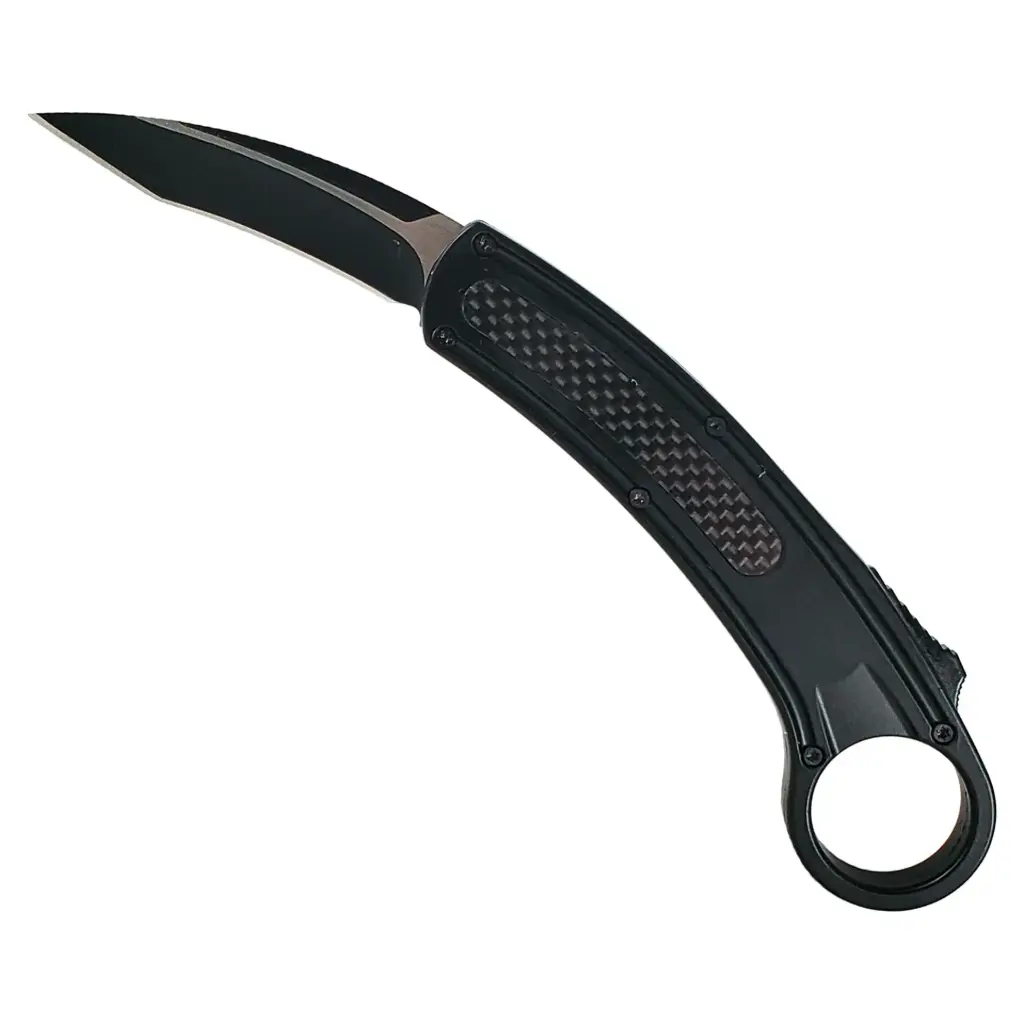
Shadow Ring Rapid-Deploy OTF Knife - Carbon Fiber Black
You don’t pull this out to show off. You reach for it when you want that quiet hit of confidence in your pocket—a shadow that moves when you do. The Shadow Ring rapid-deploy OTF knife snaps to life with a thumb push, locks solid, and disappears just as fast. Carbon fiber under your fingertips, ring anchored around your finger, you feel the control before the blade even clears the handle. This isn’t just an OTF knife. It’s the moment you stop wondering if your everyday carry can keep up—and know it does.
| Blade Color | Black |
| Blade Finish | Matte |
| Blade Style | American Tanto |
| Blade Edge | Plain |
| Blade Material | Steel |
| Handle Finish | Matte |
| Handle Material | Carbon fiber |
| Button Type | Side switch |
| Theme | Carbon Fiber |
| Double/Single Action | Double action |
| Pocket Clip | Yes |
You’re walking to your car later than you planned. One hand on your bag, the other already knows where it’s going. Not fumbling, not thinking—just a clean, practiced motion to the edge of your pocket. Your thumb finds the switch, your finger slips through the ring, and in a breath, that quiet click of an OTF knife coming to life tells you everything you need to know: you’re not just hoping you’re ready. You are.
When an OTF knife becomes the one move you don’t have to think about
There’s a reason you started searching for an OTF knife instead of another basic folder. You wanted speed without drama, control without theatrics. With this Shadow Ring build, deployment is a single, straight-line motion: thumb forward on the side switch, blade snaps out, tanto tip locked, your grip already set by the curved karambit handle and finger ring. No wrist flick. No second try. Just out, ready, done.
The double-action mechanism means the reset is just as clean—pull the switch back and the blade retracts into the handle with the same matter-of-fact click. In your pocket, it rides like any other everyday carry blade. In your hand, it feels more like a promise you made to yourself: if something goes sideways, you’re not the one caught unprepared.
Why this OTF knife feels different the second your finger hits the ring
Most OTF knives are straight, boxy, and anonymous. This one curves into your hand like it was drawn from muscle memory. The karambit-style ring gives you an anchor point before the blade even moves—your finger slides through, and suddenly the entire knife feels like an extension of your grip, not something you’re trying to hold onto.
The American tanto blade pushes that feeling further. Instead of a sweeping belly, you get strong, straight edges and an angular tip that’s built for piercing and controlled cuts. Utility tasks—opening packages, slicing cord, breaking down cardboard—feel precise instead of sloppy. In a self-defense scenario, that same geometry gives you confidence in the point and the power behind it.
What makes it click is how the OTF knife mechanism and karambit form work together. The blade rockets out in line with your forearm, while the ring locks your hand position. You’re not guessing your grip after deployment—it’s the same, every time, like a move you’ve drilled without needing to think about it.
The carbon fiber story: what you actually feel in daily carry
You notice the carbon fiber before you even notice the blade. That woven pattern under the matte clear coat isn’t just for show; it’s the first tactile cue that this isn’t another throwaway tactical toy. Your thumb brushes the inlay when you draw it from your pocket, feeling that slight texture difference between the carbon fiber and the rest of the handle.
In hand, the carbon fiber panels break up what could have been a slick surface, giving you subtle traction without aggressive, pocket-shredding texture. The matte black blade and hardware keep the whole OTF knife visually quiet—no shine, no flash—just a muted, all-business profile that disappears until you need it.
The weight you don’t have to think about
Because of the carbon fiber, the knife carries lighter than it looks. That matters when you’re clipping it to your pocket every single day. You forget it’s there when you sit, stand, drive, or walk—but the second you wrap your hand around the curved handle and feel the ring and carbon fiber under your fingers, the weight feels exactly right: present, but not a burden.
Living with an OTF knife as your everyday carry blade
This isn’t a safe-queen design. It’s built to ride with you—office, parking garage, trailhead, gas station, late-night runs. Clipped to your pocket with the integrated spine-side clip, the knife sits low and secure. You learn exactly where the switch is by touch, and because it’s side-mounted with jimping, you can find and run it even when your hands are cold or your attention is somewhere else.
Everyday tasks slowly train your muscle memory. You open a box without hunting for scissors. You cut paracord without sawing. You trim loose straps instead of letting them flap. Each time, the motion is the same: draw, deploy, use, retract. No drama, no flourish—just an OTF knife doing its job so well you stop noticing how often you reach for it.
Sound, feel, and that subtle confidence hit
The deployment sound isn’t loud, but you’ll recognize it instantly—more of a solid mechanical thunk than a cheap clack. The blade locks firm, no wobbly uncertainty. Over time, that consistency does something subtle to you: you stop wondering if your gear will cooperate and start assuming it will. That’s the real value of a reliable everyday carry knife—it changes how you move through small moments long before you ever need it for a big one.
When choosing an OTF knife over a folder actually makes the difference
There’s a quiet debate in every EDC forum: “OTF knife or traditional folding knife—what’s better to carry?” If you’ve ever hesitated with a stubborn liner lock or misjudged a thumb stud under stress, you already know the answer for yourself. With this design, the calculation is simple: one straight-line thumb motion beats any flip, flick, or flop when your attention is already stretched thin.
The karambit-style ring adds another layer. In a scramble—wet hands, gloves, adrenaline—the ring gives you a hard point of control. Slip a finger through and you can index, deploy, and retain the knife without needing a perfect grip. It’s not about looking tactical; it’s about not losing the one tool you’re relying on because your hand wasn’t textbook-perfect in the moment.
Questions people ask before buying an OTF knife like this
Is an OTF knife good for everyday carry, or is it just tactical?
An OTF knife like this works both as an everyday carry blade and as a tactical backup. The fast, one-hand deployment and solid lock make daily tasks easier, while the karambit ring and tanto blade geometry give you an edge—literally and figuratively—if you ever need it under pressure.
Is a karambit-style OTF knife legal to carry where I live?
OTF knife laws vary a lot by state, city, and even country. Before you carry this as your primary everyday carry blade, it’s smart to check your local knife regulations for automatic and out-the-front designs. Many places allow OTF knives, but some restrict blade styles, lengths, or opening mechanisms, so a quick search now can save you hassle later.
Will the OTF mechanism hold up to real-world use?
A well-built OTF knife is designed to handle repeated deployment and retraction without falling apart. The internal track and spring system in this knife are meant for regular use—opening packages, cutting cord, daily utility. Like any mechanical tool, a bit of common-sense care (keeping debris out of the mechanism and avoiding prying) keeps it running smoothly.
Picture the first night you clip this to your pocket and forget about it. Hours later, you’re in a dim parking lot fishing for your keys, and that old flicker of unease tries to creep back in. But your hand closes over carbon fiber instead. The ring catches your finger, the OTF knife jumps to life with that familiar, clean sound, and suddenly the space around you feels smaller, more defined, more under your control. You walk the rest of the way not as someone hoping nothing happens, but as someone who already decided who they’d be if it did—and chose to be ready.