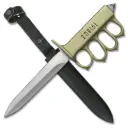
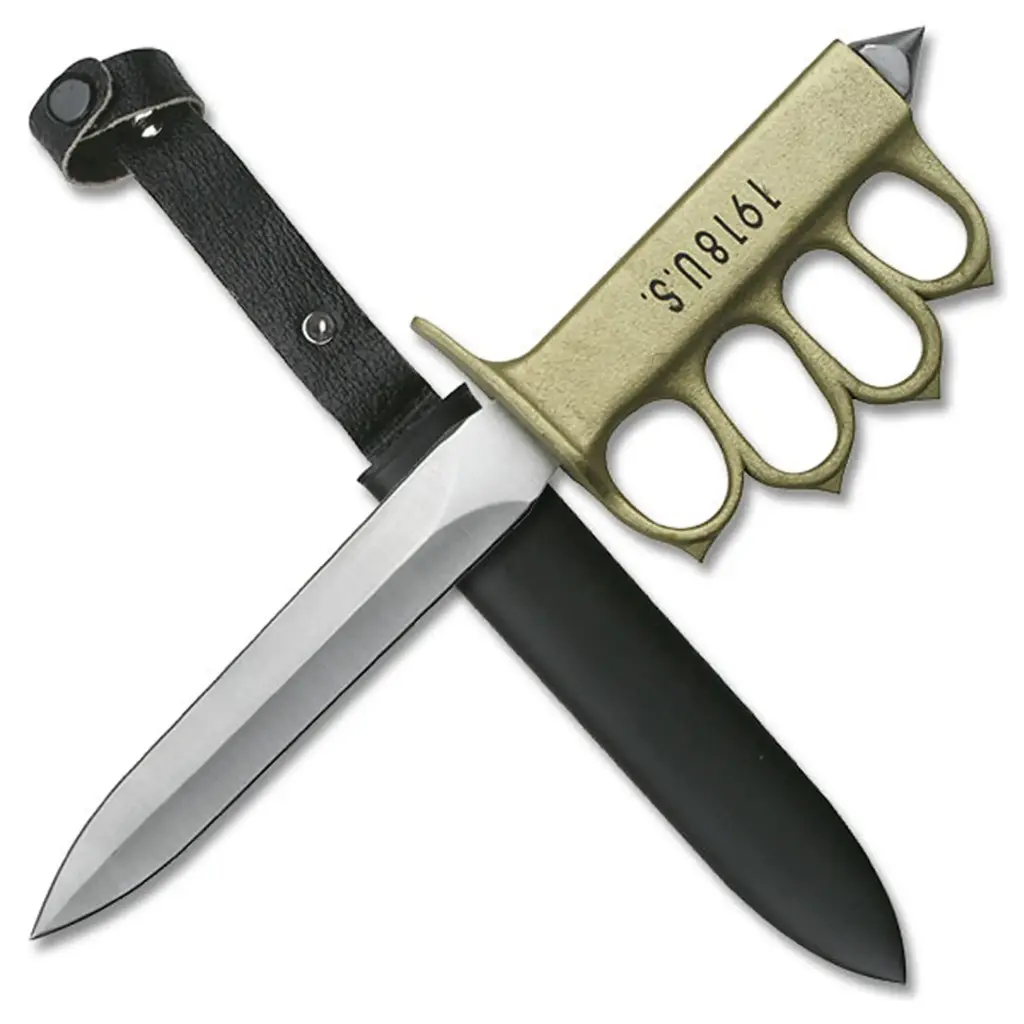
Skull-Guard Heritage Trench Knife - Brass
You don’t just add a trench knife to your gear—you inherit a story. The first time you wrap your fingers through that brass knuckle guard, this WWI-style tactical knife stops being a picture from history and becomes weight, balance, and cold intent in your hand. The double-edged dagger blade, skull-crusher pommel, and leather belt sheath turn your everyday carry into a quiet nod to the soldiers who carried the original—and a reminder that you choose tools with history, not hype. This trench knife makes you the kind of person who knows exactly why this design still exists.
| Blade Length (inches) | 6.75 |
| Overall Length (inches) | 11.4 |
| Blade Color | Silver |
| Blade Finish | Satin |
| Blade Style | Dagger |
| Blade Edge | Plain |
| Blade Material | Steel |
| Handle Finish | Matte |
| Handle Material | Brass |
| Theme | Trench Knife |
| Handle Length (inches) | 4.65 |
| Tang Type | Full Tang |
| Pommel/Butt Cap | Skull-crusher |
| Carry Method | Belt Carry |
| Sheath/Holster | Leather Sheath |
You see it before you feel it—the brass catching the light, the leather sheath worn-in just enough to hint at miles of belt carry to come. Then your hand closes around the guard, fingers sliding through the knuckles, and this stops being a replica on a screen. This is weight. This is history. This is a trench knife built the way those old photographs only ever hinted it might feel.
How a WWI Trench Knife Changes the Way You Carry a Tactical Knife
Most days, a tactical knife is just another tool in your rotation. But the moment you pick up a WWI trench knife, your relationship to that word—tactical—changes. You’re no longer thinking about box cutting or camp chores. You’re thinking about a 6.75-inch double-edged dagger meant for the worst places a human could be, carried by people who didn’t have the luxury of theory.
This fixed blade tactical knife doesn’t fold, doesn’t apologize, and doesn’t pretend to be multi-purpose in a cute, modern way. You get a long, satin-finished steel dagger, sharpened on both edges, riding a full tang that disappears into a brass knuckle guard stamped simply: “1918 U.S.” It’s the kind of trench knife that makes you pause for a second before you slide it into the leather sheath—because you feel the story that comes with it.
Why This Tactical Knife Still Feels Right in Your Hand Today
You’ve probably handled plenty of knives that looked good online but felt wrong the second you picked them up—too light, too hollow, too much marketing and not enough metal. This trench knife has the opposite problem: pictures can’t show you how the brass handle locks into your grip the moment your fingers thread through the guard.
The weight of the solid brass knuckle duster shifts the balance slightly back toward your hand, so the double-edged blade feels like an extension of your wrist instead of a separate piece of steel. That skull-crusher pommel at the base isn’t just a visual flex—it gives you a focused point of impact for hammer fists and strikes when the blade isn’t the answer. The satin silver blade catches light along its central spine, reminding you that under all the history talk, this is still a very real tactical knife designed for close-quarters control.
Run your thumb along the flat of the blade and you feel the straight, no-nonsense grinds. Grip the brass knuckles and you’ll notice how the matte finish takes the shine off just enough to feel like something that’s been carried, not polished for a display case. This isn’t cosplay metal. It’s a fighting knife that happens to look incredible on a shelf when you aren’t wearing it on your belt.
Carrying a Trench Knife: From Display Piece to Everyday Story
You might think a trench knife like this belongs in a shadowbox, not on a belt. Then you thread it through that black leather sheath for the first time and realize how quickly it becomes part of your everyday carry story. The sheath rides vertical on your belt, snug but not bulky, so you can wear this tactical knife on a hike, at the range, or at the workshop without feeling like you’re in costume.
The leather has just enough stiffness to hold the shape around the blade, with a retention strap that snaps over the brass guard. That means when you reach down, your fingers already know where the handle will be, and when you draw, the knife clears the sheath in one clean motion—no wrestling, no awkward angles. You get the drama of a WWI trench knife without sacrificing the quiet practicality you expect from a daily carry blade you actually use.
And then there’s the moment someone notices it. A friend at the range, a coworker who spots the sheath, the buddy who asks about the “brass thing” when you set it on the table. Suddenly you’re not just the person who owns a tactical knife—you’re the person who knows what a 1918 trench knife is, why the knuckle guard exists, why that skull-crusher pommel looks the way it does. You move from casual knife owner to the one who can tell a story that starts with, “So in the trenches of World War I…”
When a Tactical Knife Crosses the Line Into Living History
You can buy a dozen modern blades that slice cardboard with surgical efficiency. But how many knives in your collection make you slow down and imagine who carried the original design? A trench knife like this hits a different part of your brain. Part of you is measuring steel and edge geometry. The other part is standing in mud up to your shins, feeling the cold brass in your fist, thanking whoever designed something so brutally straightforward.
This tactical knife is a combat throwback, but that doesn’t mean it’s fragile or just decorative. The full-tang construction gives you the kind of durability you only really appreciate when a knife takes an accidental hit, a drop, or a hard impact and just shrugs it off. The double-edged dagger blade means you’re not hunting for the "right" side under stress—whichever way you orient it, there’s cutting surface ready.
If you collect, this trench knife earns space because it carries its own explanation. You don’t have to invent reasons for why you bought it. One look at the 1918 U.S. mark on the brass and people understand: this isn’t a random tactical knife. It’s a piece of battlefield design still relevant enough that you can strap it to your belt today.
The Feel of Brass, the Bite of Steel
Close your eyes with it in hand and it tells on itself: the cool, dense brass warming slowly against your skin, the smooth leather of the sheath brushing your knuckles, the faint sound of steel leaving leather when you draw. This isn’t just about having another blade—it’s about having a trench knife that turns every handling into a small ritual.
Questions People Ask Before Buying a Tactical Knife Like This
Is a WWI-style trench knife legal to carry where I live?
That depends entirely on your local laws. Double-edged blades, brass knuckles, and skull-crusher pommels each trigger different rules in different areas. Before you carry this tactical knife, check your state and city regulations—many owners treat this more as a display and collection piece and keep their everyday carry knife simpler for public use.
Can I actually use this trench knife, or is it just for display?
You can absolutely use it; it’s built as a functional fixed blade tactical knife with a full tang, steel dagger blade, and durable brass handle. That said, the double-edge and knuckle guard make it more specialized for combat and close-quarters scenarios than for routine tasks, so many people keep it as a serious showpiece that still could work if it ever had to.
How does this compare to a modern everyday carry knife?
A modern EDC knife is usually lighter, folding, and optimized for cutting tasks like boxes, cord, and camp chores. A trench knife like this is heavier, fixed, and purpose-built as a fighting and tactical knife. If you want something that tells a story and feels like carrying a piece of history, this wins. If you need discreet daily utility, you’ll likely pair it with a smaller everyday carry knife.
Is the brass knuckle guard comfortable, or does it dig into your hand?
The brass guard feels surprisingly natural once your fingers settle into it. The weight sits across your knuckles, giving a solid, confident grip. It’s not a soft, rubberized handle—this is metal on skin—but if you like knowing exactly where your fingers are and feeling locked-in control over a tactical knife, it delivers that in a very particular, satisfying way.
Will the blade hold up to real use, or is it just a wall-hanger?
The double-edged steel dagger is designed as a real blade, not a decorative prop. As with any tactical knife, edge retention depends on how hard you run it and how you maintain it, but this isn’t fragile. It’s a functional trench knife that can cut, pierce, and strike; you just get to decide how much of its life it spends on a belt versus resting in its sheath on display.
Is this too aggressive to keep as part of my regular gear?
That’s a question only you can answer. A trench knife with a knuckle guard and skull-crusher pommel is visually intense compared to a standard everyday carry blade. If your environment is tactical, collector-focused, or outdoors-oriented, it fits right in. If you’re in polite office spaces all day, you might keep this as the piece you bring out when it’s your turn to show something with weight and history.
Owning a Tactical Knife That Feels Like a Story in Your Hand
Picture the first time this trench knife arrives. You slide it from the box, unstrap the leather sheath, and the brass catches the light in your room the way it once caught light from flares over muddy trenches. Your fingers slip through the guard, the skull-crusher settles against your palm, and in that quiet moment, you’re holding more than a tactical knife—you’re holding a design that survived a century because it works.
From then on, every time you thread that sheath onto your belt or set the knife on your desk, you’re not just someone who owns a blade. You’re the person who chose a WWI trench knife on purpose, because you’d rather carry a story forged in brass and steel than another forgettable edge. And once you feel that weight in your hand, you won’t mistake it for anything else.