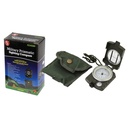
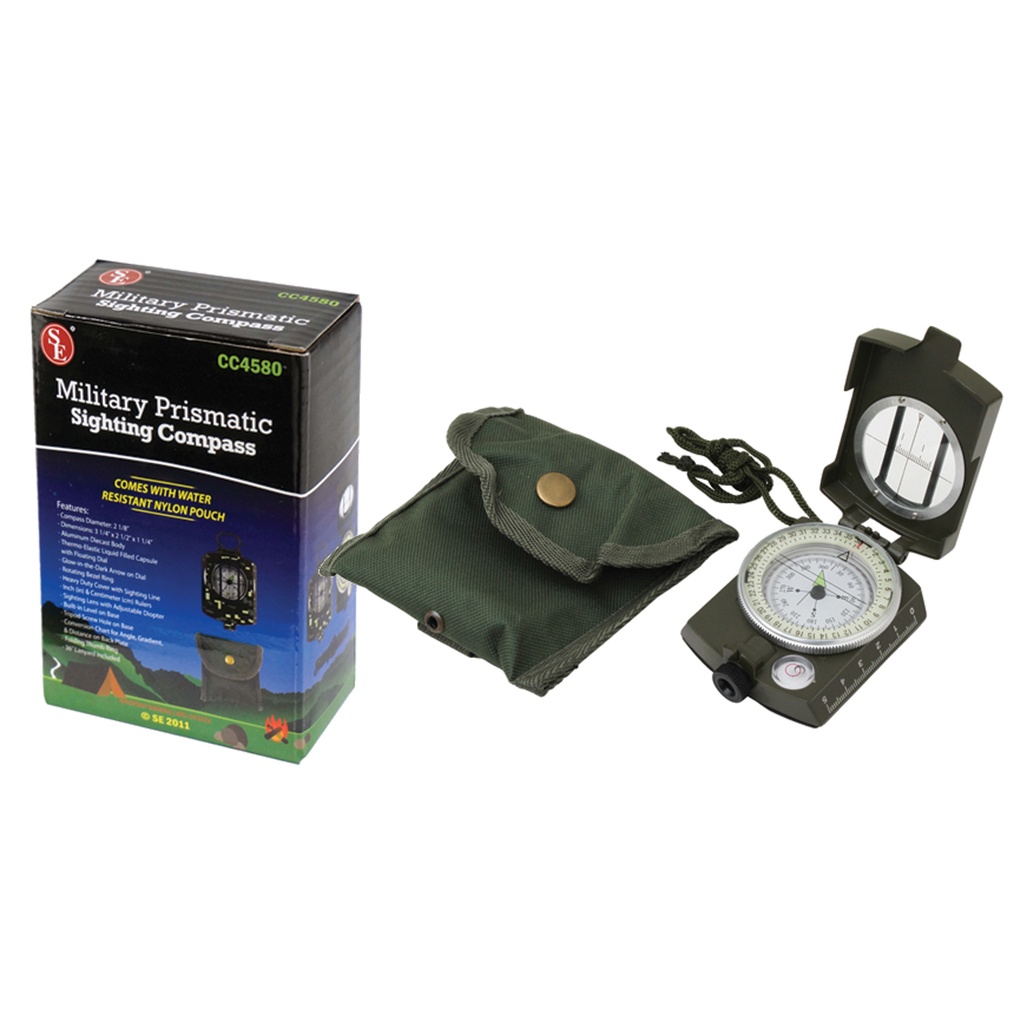
Trailline Prism Navigation Compass - OD Green Aluminum
You’re standing at an unmarked fork, the trail fading into brush, phone at 8% and no service. This is where a real lensatic compass earns its place in your kit. With a tripod-ready base, prismatic sighting, and a glow-in-the-dark dial you can read under red light, you don’t guess—you measure. You feel the base level out, watch the needle settle, and know exactly which way is home. Owning this isn’t about gear. It’s about never feeling lost on your own ground.
You realize you’re off-trail the moment the path under your boots turns from packed dirt to loose rock. The sun is sliding down behind the ridge faster than you planned, your phone shows a blank patch of map, and that familiar knot of doubt tightens in your chest. This is the moment you either pretend you “kind of know” which way camp is—or you take ten calm seconds, pull out your lensatic compass, and get a real bearing.
When a Lensatic Compass Turns Guessing into Knowing
If you’ve ever stood with a cheap baseplate compass spinning circles in your hand, you already know why a proper lensatic compass exists. This isn’t about pointing generally north; it’s about lining up a distant ridge through a prismatic sight, watching the numbers sharpen into focus through the lens, and locking in a bearing you can trust.
With this compass, you don’t just look down—you look through. The prismatic sighting lens brings the dial into crisp view while your eyes stay on the landmark you’ve chosen. Instead of glancing back and forth between terrain and scale, you’re doing both at once. Your brain quiets. The wobble of doubt settles, just like the needle floating in its liquid-filled capsule.
And because the dial glows after dark, that same confidence doesn’t fade when the light does. Under a red headlamp or fading twilight, your numbers are still there, waiting for you, clear enough to read without squinting or second-guessing.
Why This Lensatic Compass Feels Like Real Field Gear
There’s a reason this feels different in your hand the first time you open it. The body isn’t flimsy plastic; it’s die-cast aluminum in that familiar OD green that just quietly says, “I’m here to work.” The hinged cover snaps open like an instrument case, not a toy. You feel the weight, not heavy, but present—enough to remind you this lensatic compass was built for field time, not desk drawers.
Inside, the liquid-filled housing isn’t an afterthought. That fluid damping is what calms the needle instead of letting it swing wildly. When you raise the sighting line to your eye, the bubble level in the corner helps you know the base is flat, so your readings aren’t off by an unseen tilt. Those tiny details, the ones most people never talk about, are the difference between “I hope this is right” and “I know this is right.”
The built-in rulers along the base are more than decoration. Pressed against a map, they give you scale and distance without hunting for another tool. You can align grid lines, measure a leg of your route, and turn numbers on paper into a direction on the ground. That’s what real navigation feels like: you, the map, and a single instrument that does its job without drama.
Carrying a Lensatic Compass That Actually Fits Your Life
Good gear doesn’t stay in a box—it disappears into your routine. This lensatic compass was built with that in mind. It folds down into a compact, metal shell that drops into a pocket or clips onto your belt in the included OD green nylon pouch. That pouch isn’t a shiny afterthought either; it’s water-resistant, stiff enough to protect, soft enough not to dig into your hip when you sit on a rock or in a truck seat.
The woven lanyard gives you options. Hang it around your neck under a jacket during a wet hike, or loop it through your pack’s MOLLE so it’s always in reach without digging. When you’re moving from checkpoint to checkpoint, the last thing you want is to wrestle gear out of buried pockets. This rides where you can reach it, one-handed, even with gloves on.
The Quiet Confidence of Ready Gear
There’s a specific kind of calm that comes from knowing your navigation doesn’t depend on a battery icon. When friends start watching their phone percentages, you’re still reading bearings, leveling the base, and adjusting your route with a kind of quiet certainty. That confidence is subtle, but everyone around you feels it.
Tripod-Ready: When Precision Stops Being Optional
Most people never think about mounting a lensatic compass to a tripod—until they’ve tried to hold one perfectly level on a windy ridge. That threaded socket in the base is the difference between “good enough” and “I can repeat this reading within a degree.”
Imagine this: you’re working off a topo map on the hood of a truck, trying to confirm the exact direction to a distant saddle that’s going to be your pass through the mountains tomorrow. You set up a small tripod, screw the compass down, line up the sight through the prism, and let the bubble level guide you to true level. Now your bearings are repeatable. You can step away, check the map, come back, and it’s still there, steady as the metal it’s bolted to.
Small Detail, Big Difference
The first time you feel that solid click as the compass seats into the tripod, it changes how you think about navigation. You’re no longer balancing a delicate tool in midair; you’re working with a fixed reference point. For scouting routes, teaching land nav, or planning multi-day trips, that tiny socket earns its keep quickly.
When a Lensatic Compass Becomes the Backup That Comes First
Maybe you love GPS. Maybe your phone has never let you down. You still know, deep down, that any electronic device is one hard fall, one dead battery, or one cold night away from quitting on you. A lensatic compass doesn’t care about reception, charge level, or software updates. It cares about north, south, and the space in between.
This is the tool you hand to a friend when you’re teaching them how to read terrain. It’s the one you keep in the glove box for road trips that detour onto forest roads just to see where they go. It’s the one you pull out at a campsite, showing kids how the glowing dial keeps working even when the fire dies down.
Some gear becomes a story you tell later. This kind of gear becomes part of the story itself: the night the fog rolled in, the day the trail washed out, the moment you realized you weren’t actually lost—you were just one bearing away from found.
Questions People Ask Before Buying a Lensatic Compass
Is a lensatic compass actually better than a basic hiking compass?
If you just want a rough sense of north, a simple hiking compass will do. A lensatic compass matters when direction needs to mean more than “that way.” The prismatic sighting lens, bubble level, and rotating bezel give you accurate, repeatable bearings you can line up with real landmarks, not just cardinal points.
Can I use this lensatic compass for regular hiking, or is it only for military use?
You can absolutely use it for everyday hiking. The military-style build simply means it’s rugged and precise. For you, that translates to a navigation tool that works on casual day hikes, long backpacking trips, scouting, hunting, or teaching basic land navigation without babying it.
How well can I read the dial in low light or at night?
The glow-in-the-dark dial is built for exactly that. After a bit of light exposure, the markings stay visible, so under a dim headlamp or starlit sky, you can still read your lensatic compass without blasting your night vision. It’s one of those things you only appreciate fully the first time you’re finishing a route after sunset.
Is it hard to learn how to use a lensatic compass with a map?
There’s a short learning curve, but it’s not complicated. Once you understand basic bearings and how to line up the rulers on your map, the lens and sighting wire actually make it easier to be precise. Many people find that using a lensatic compass teaches them more about reading terrain than anything on a screen ever did.
Picture your next trip: the air cooling as the sun leans west, the map folded on your knee, the tripod set up beside you. You flip open your lensatic compass, feel the aluminum body settle into your palm, and watch the needle find its line like it’s done a thousand times before. In that moment, you’re not someone hoping the trail markers keep appearing. You’re the one who always knows where you are, who can point to a distant ridge and say, with quiet certainty, “We go that way.” And that’s who this compass turns you into, every time you open it.