Declassified Unconventional Ordnance Field Manual - Yellow Cover
You know that itch to go past the watered‑down summaries and see what the Army actually wrote? This authentic Army ordnance reference manual lets you sit where a 1966 soldier sat—yellow cover, TM number, no fluff. You feel the weight of real incendiary doctrine in your hands, diagrams and directives laid out like a briefing. It doesn’t entertain you; it trusts you. And once it’s on your desk, you stop guessing and start reading the source.
You don’t stumble onto a book like this. You decide you’re done with secondhand summaries, done with “inspired by” lore, and you want to see what the Army actually put down in black and white. That’s the moment this authentic Army ordnance reference manual starts to matter—when you’re ready to read incendiary doctrine the way a soldier or instructor in 1966 would have read it.
Why an authentic Army ordnance reference manual changes how you see history
Most people only ever see the cleaned-up version of unconventional warfare. A paragraph in a history book. A dramatized scene in a movie. When you open this authentic Army ordnance reference manual, you step into the blunt, unsentimental language the Department of the Army used to brief its own. You aren’t reading about incendiaries; you’re reading the instructions that shaped how incendiaries were actually understood and deployed.
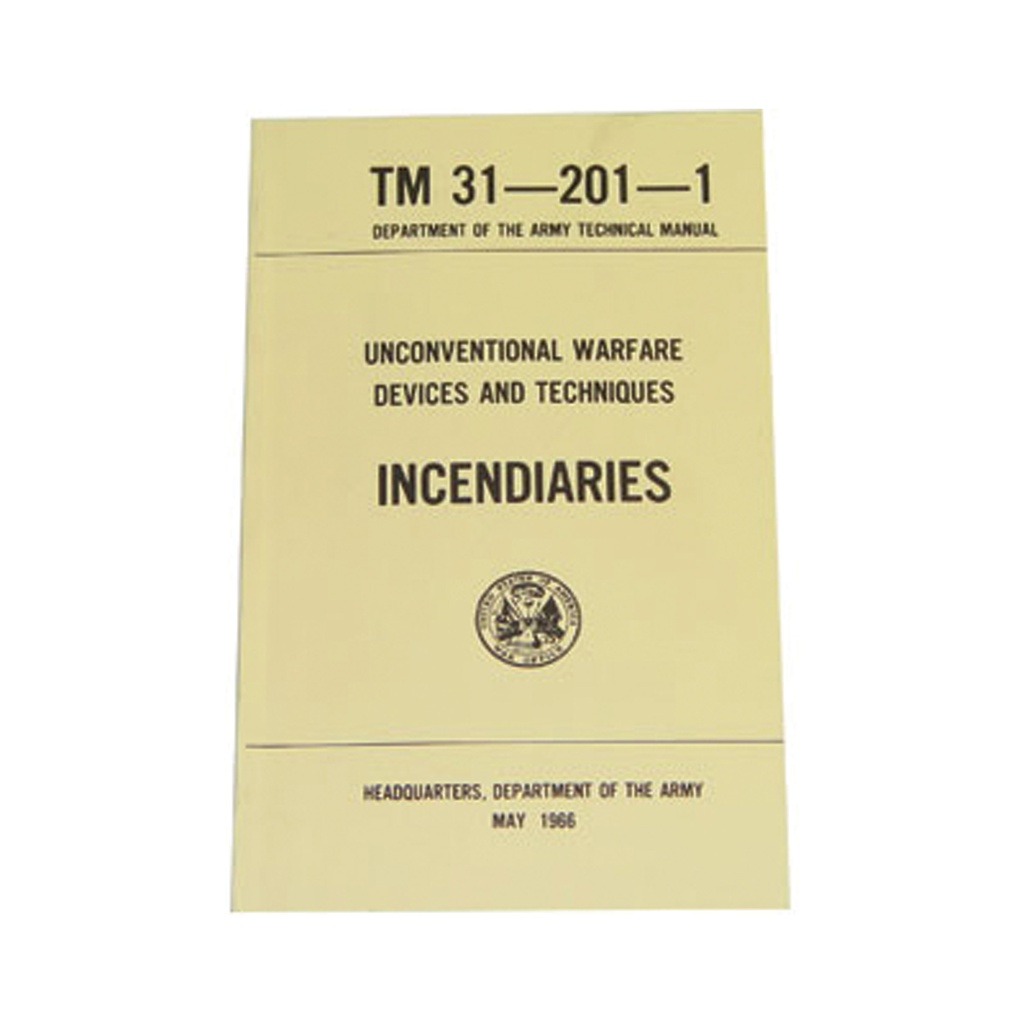
That yellow cover is more than a design choice. It’s the same institutional tone you’d see on a field-issue ordnance manual: TM 31-201-1 stamped at the top, the Army seal dead center, the word “INCENDIARIES” taking over the page. You’re not being marketed to. You’re being handed doctrine. For a collector, researcher, or tactical professional, that difference is everything.
Inside the Army ordnance reference manual: you’re reading what they read
Open the cover and the voice shifts from abstract history to direct instruction. The authentic Army ordnance reference manual talks to you the way it talked to soldiers: clean diagrams, stepwise explanations, no wasted adjectives. You see incendiaries and unconventional warfare devices stripped to their components: mechanisms, materials, techniques, effects.
If you’re a historian, this is primary-source oxygen. You can trace how 1960s doctrine framed different incendiary mixtures, delivery systems, and field improvisations. If you work around explosives, weapons design, or ordnance disposal, this manual becomes a baseline—an older doctrinal layer you can compare against everything you know now. The beauty is in its bluntness. It doesn’t try to impress you; it expects you to keep up.
Run your finger down a diagram and you can almost feel the grease pencil that might have circled that same drawing in a briefing room. The paper, the typography, even the spacing—all of it reminds you this wasn’t meant as coffee-table decor. It was meant as a working reference, a technical manual that could sit on a metal desk under fluorescent lights or in a footlocker headed into the field.
How this Army ordnance reference manual fits into your daily carry and your desk
This isn’t the kind of book you read once and file away. An authentic Army ordnance reference manual lives close: on the workbench where you tinker with gear, next to your laptop when you’re cross-checking sources, or on the same shelf that holds your favorite everyday carry blades and tactical guides. It becomes part of the ecosystem you reach for when you need clarity, not commentary.
Because it’s a softcover field manual format, you can throw it in a range bag, slide it next to a notebook in your pack, or keep it flat on your desk without worrying about babying it. The yellow cover makes it easy to spot in a stack—your eye finds that institutional shade instantly. For EDC enthusiasts who believe knowledge is as much a tool as any blade, this isn’t just a book; it’s the reference that backs up the gear you carry.
There’s something grounding about having the original Army ordnance reference on hand when you talk shop. Instead of saying, “I heard that these devices were used like this,” you can say, “According to TM 31-201-1, here’s how they defined it.” That shift—from speculation to citation—quietly upgrades your voice in every conversation.
When an authentic Army ordnance reference manual makes the difference
There’s a moment every serious learner hits: you realize Internet fragments and forum hearsay aren’t enough. That’s when an authentic Army ordnance reference manual becomes more than a curiosity. Maybe you’re writing a novel or screenplay and you want your scenes with incendiaries and unconventional warfare devices to ring true. Maybe you’re building a training module and need to show how doctrine used to frame these tools. Maybe you just want to own one piece of the paper trail that underpinned Cold War military thinking.
In each case, the manual shifts your posture. You move from guessing to verifying, from repeating stories to checking against the technical language itself. You stop wondering how the Army might have described a device and start reading exactly how they did. That authenticity changes the way you research, the way you teach, and the way you talk about ordnance.
The feel of a briefing in your hands
Flip through the pages and you can almost hear the low hum of fluorescent lights and the scrape of metal chairs. The tone is matter-of-fact, almost cold, which makes it more powerful. There’s no drama, just cause, effect, and procedure. That sensory contrast—serious content in a plain yellow wrapper—reminds you that the most consequential information often travels in the most understated form.
A yellow cover that signals you take this seriously
Leave this manual on your desk and it says something about how you approach your interests. You’re not content with replicas and rumors; you like the real thing. The yellow cover, Army seal, and dated imprint quietly signal that you’re drawing from source material. Anyone who recognizes the TM styling will clock it immediately—and they’ll know you did your homework.
Questions people ask before buying an authentic Army ordnance reference manual
Is this actually based on a real Army technical manual?
Yes. This authentic Army ordnance reference manual is a faithful reproduction of an original Department of the Army technical manual issued in May 1966. The TM number, layout, and institutional yellow cover are preserved so you’re seeing the material the way a soldier or instructor would have seen it.
What can I actually learn from this ordnance manual today?
You learn how the Army of that era defined, classified, and described incendiaries and unconventional warfare devices. For a modern reader, that means doctrinal context: terminology, conceptual frameworks, and technical descriptions you won’t get from surface-level overviews. It’s less about copying techniques and more about understanding how a major military institution thought about these tools.
Is this Army ordnance reference manual suitable as a gift?
If you’re buying for someone who lights up around military history, explosives theory, or tactical study, this manual hits a nerve. It feels more like handing them a declassified file than just another book. The yellow cover and Army seal give it that instant “you found something real” energy when they unwrap it.
How does this compare to modern ordnance references?
Modern references often add commentary, disclaimers, and broader context. This authentic Army ordnance reference manual gives you the raw doctrine: concise, unapologetic, and focused on function. Reading both side by side can deepen your understanding—one shows you where we are now; this one shows you where the doctrine came from.
Owning an authentic Army ordnance reference manual and what it says about you
The first time you set this manual down—yellow cover up, Army seal catching the light—you feel the difference between collecting and curating. This isn’t just another piece on your shelf. It’s the line in your personal library where speculation stops and source material begins. You reach for it the same way you reach for a trusted everyday carry tool: not because it’s flashy, but because it’s proven.
Owning an authentic Army ordnance reference manual quietly rewrites your role in the story. You’re no longer the person asking, “Do we know if that’s accurate?” You’re the one people turn to when they want to know how incendiaries and unconventional warfare devices were actually documented. And over time, as the cover softens and the spine develops its own history in your hands, it becomes exactly what it was in 1966—a working manual for someone who takes knowledge as seriously as any piece of gear they carry.