Signal Standard Field-Rigging Reference Manual - Signal Yellow
You know the moment: everyone’s staring at a tangled mess of wire rope, a questionable shackle, and a deadline. With this rigging manual in your hand, you’re the one who knows what’s safe, what’s not, and why. Clear diagrams, Army-tested calculations, and straightforward knot, hitch, and splice guidance turn confusion into calm. The signal-yellow cover stands out on the bench or in the truck, so the answer is never buried. You don’t guess the load anymore—you know.
You’ve seen it happen. The load is slung, the foreman is frowning, and suddenly everyone is looking at each other instead of the hook. Someone mutters, “That’ll probably hold.” Your stomach tightens, because you know “probably” has no place anywhere near a suspended load. This is the moment you either guess with the crowd—or quietly reach for the rigging manual that turns doubt into a clear yes or no.
How a Rigging Manual Turns You Into the Person Everyone Trusts
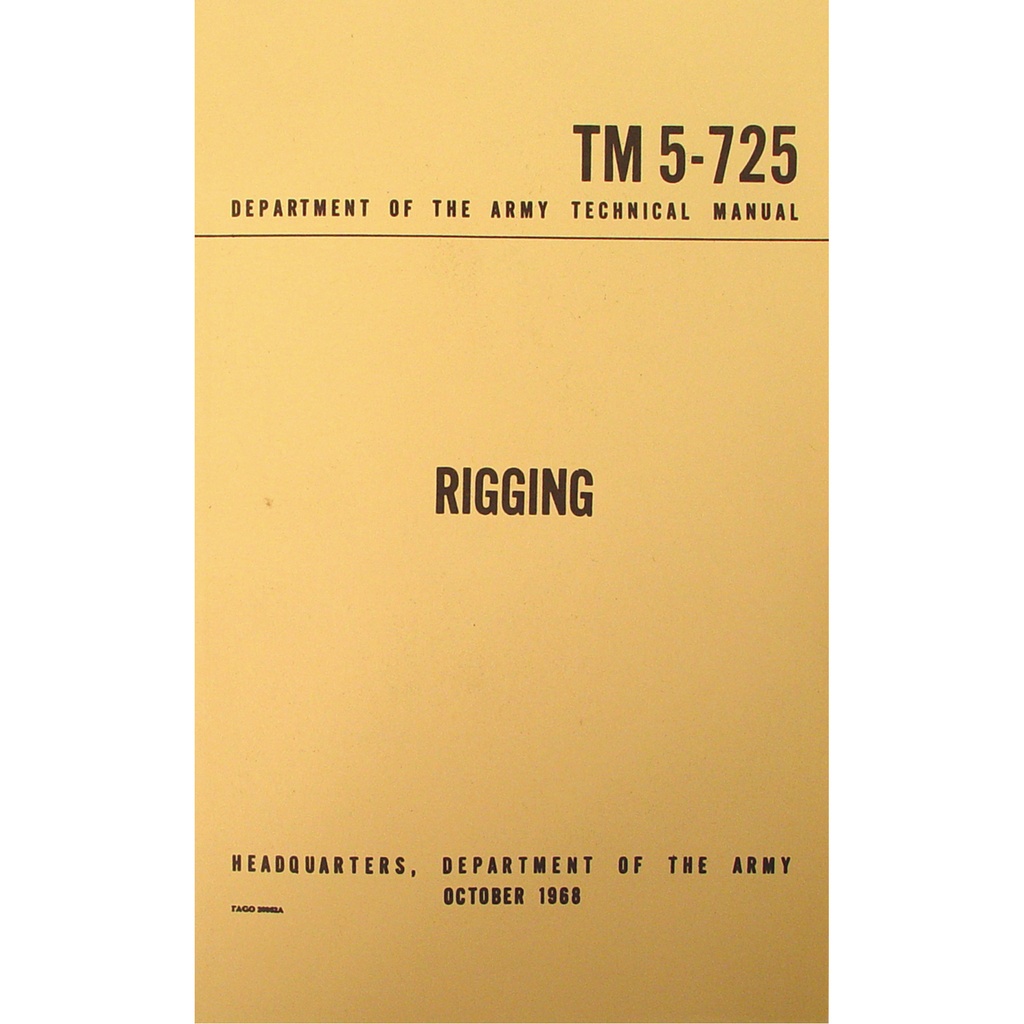
Owning a rigging manual isn’t about liking books. It’s about becoming the steady voice when the lift gets complicated and nobody wants to admit they’re unsure. This particular rigging manual comes from a 1968 Department of the Army technical standard—written for crews who didn’t have the luxury of "good enough." When you crack it open, you’re stepping into that same no-nonsense mindset: wire rope, chains, fiber rope, knots, hitches, splices, and safe-load calculations laid out so you can find what you need in seconds.
You’re not flipping for trivia. You’re flipping for an answer that might decide whether a load moves safely or not at all. The pages show you how to read wire rope, how to match working load limits to reality, how different hitch configurations actually change what your sling can take. Instead of arguing over guesses, you can put your finger on a table or diagram and say, “Here’s what we’re working with. Here’s what’s safe.”
Why This 1968 Rigging Manual Still Works on Today’s Job Sites
There’s a reason this rigging manual still shows up on shop floors and training benches decades after it was first printed. The Army wrote it to be used in the field, not admired on a shelf. That means no fluff, no marketing speak—just practical rigging guidance that assumes you’re tired, pressed for time, and maybe standing in the rain.
Inside, you’ll find the kind of structure that instantly makes sense: wire rope in one section, chains in another, fiber rope and knots grouped where your brain expects them. Safe-load calculations aren’t hidden behind formulas you need a degree to decode; they’re broken down with examples so you can run quick numbers in your head or on a scrap of cardboard. You see exactly how angle, hitch type, and sling placement change what a lift is really asking of your gear.
The 1968 date isn’t a drawback—it’s a signal. It tells you this rigging handbook was written before cut corners and “close enough” crept into everyday language. You’re borrowing standards from an era that treated procedure like life support, because sometimes that’s exactly what it is.
Signal-Yellow Certainty: Keeping Your Rigging Manual Where You Need It
The first thing you notice is the cover. That hard-to-miss signal yellow isn’t an aesthetic choice; it’s a practical one. On a cluttered bench, in a dark corner of the shop, or tossed in the back of a truck, this rigging manual stands out. You don’t waste time hunting for the one book that actually settles the argument—you spot it instantly.
The softcover build means it lays open without a fight. You can prop it against a toolbox lid or weight it with a glove, then step back and show the crew the exact knot, hitch, or sling angle you’re talking about. Finger-smudged pages and bent corners become a record of real use, not damage. This isn’t a collector’s piece; it’s a working tool that looks better the more you lean on it.
The Feel of a Field Tool, Not a Textbook
From the all-caps typography to the TM 5-725 identifier, everything about this book tells you what it is: an official field reference. You feel that the moment you hold it. It doesn’t beg to impress you; it assumes you’re here to work. Flip through, and you’ll see diagrams laid out to be understood at a glance and tables written for people who don’t have time to overthink. You get the quiet confidence that comes from tools built for crews, not for marketing photos.
Bringing Rigging Standards Into Your Everyday Carry of Knowledge
You might not carry this rigging manual in your pocket, but it still becomes part of your everyday carry in the way that matters most: the skill set in your head. Each time you grab it before a lift, or during a toolbox talk, you’re sharpening your instincts. Over time, safe-load numbers, chain grades, and sling configurations move from the page to your memory.
In the training room, it becomes your anchor. New hands can see that your expectations come from something bigger than your opinion. On the job, it backs you up when you have to say “No, that’s not safe yet” and stick to it. Off the clock, it sits on your desk or shelf as a quiet reminder of the standard you’ve chosen: you don’t wing rigging decisions. You check, then you move.
Moments You’ll Actually Use It
Picture walking into a pre-lift meeting with this signal-yellow book under your arm. You lay it down without a word. Suddenly the conversation shifts from “I’ve always done it this way” to “Let’s see what the standard says.” Or imagine a new hire asking you how to tie a particular hitch you haven’t used in years. Instead of guessing, you flip to the exact diagram and walk them through it, step by step. In both moments, you’re not just moving steel—you’re shaping culture.
When a Rigging Manual Makes the Difference Between Guessing and Knowing
There’s a quiet line between being the person who shrugs and hopes—and the person who knows exactly why a lift is safe or unsafe. This rigging manual is one of the tools that moves you over that line. You’ll reach for it when a sling angle looks wrong, when someone wants to overload a chain because “it’s just this once,” or when you’re teaching someone how to splice and you want to show them the real, field-proven way.
You’re not just avoiding accidents. You’re building habits: check the book, confirm the numbers, then move the load. Over time, crews come to expect that rhythm from you. That’s how you quietly become the reference point everyone else measures against.
Questions People Ask Before Buying a Rigging Manual
Is this rigging manual still relevant for modern work?
Yes. While it’s a 1968 Army field reprint, the core rigging principles in this rigging manual haven’t changed. Wire rope behavior, hitch angles, knots, splices, and basic safe-load calculations still follow the same physics you work with today. You’ll still follow your current codes and company policies—but this book gives you the solid foundation those rules are built on.
Can a beginner actually learn from this rigging manual?
They can—and they do. The language in this rigging manual is straightforward, written for crews in the field, not engineers at a desk. A motivated beginner can use it alongside hands-on training to really understand why certain rigs are safe and others aren’t. It turns “because I said so” into clear, visual explanations.
How does this compare to online rigging charts and videos?
Online tools are quick, but they’re scattered. This rigging manual gives you one organized, offline reference you can throw in a truck or open in a dead zone. Instead of scrolling through ads and mixed advice, you carry a single, coherent standard you can trust every time you need to double-check a lift.
Is the signal-yellow cover actually useful, or just a look?
On a busy shop floor or job site, that signal yellow is practical. It makes the rigging manual easy to spot under papers, parts, and gear. When time is tight and the crew is waiting, being able to grab the right book at a glance is more than a design choice—it’s part of staying organized and safe.
Later, when a complicated lift comes up and the chatter starts, you’ll walk over to your bench or truck, and your hand will go straight to that signal-yellow cover. You’ll flip open your rigging manual, trace a line down a table, and feel that small but solid click of certainty: this is safe, or it’s not—and now you can prove it. That’s who you become with this rigging manual in your world: the person who doesn’t guess, doesn’t bluff, and doesn’t look away. The one who knows.