Forged Legacy Field Butcher Fixed Blade Cleaver - Bone Handle
You know the moment: meat on the block, campfire low, everyone pretending they’re not watching how you handle the blade. A heritage field butcher fixed blade cleaver like this makes that moment easy. The forged-look 6-inch steel, full tang, and cool bone handle give you heavy, confident chops and clean field work, then ride quietly on your belt in leather until the next story finds you.
| Blade Length (inches) | 6 |
| Overall Length (inches) | 10.75 |
| Weight (oz.) | 32 |
| Blade Color | Silver |
| Blade Finish | Matte |
| Blade Style | Cleaver |
| Blade Edge | Plain |
| Blade Material | Steel |
| Handle Finish | Matte |
| Handle Material | Bovine Bone |
| Theme | None |
| Handle Length (inches) | 4.75 |
| Tang Type | Full |
| Carry Method | Belt Loop |
| Sheath/Holster | Leather |
You’re standing at the tailgate or a scarred-up cabin table, sleeves pushed back, something that matters in front of you—an elk quarter, a pile of bone-in beef, or just the first real camp meal of the season. Everyone else is hovering in that polite distance where curiosity lives. This is the part where your knife either makes you look like you’ve done this a hundred times… or not.
When you reach back and close your hand on a heritage field butcher fixed blade cleaver, you’re not just grabbing steel. You’re picking up a role: the one who knows what to do next.
How a Heritage Field Butcher Fixed Blade Cleaver Changes That Moment
A cheap chef knife can fake it in a kitchen. Out here—on a tailgate, a stump, a makeshift cutting board balanced on a cooler—you feel every shortcut. Thin blades chatter on bone. Handles twist when fat and rain mix on your hands. You start working around the tool instead of letting it work for you.
This is where a heritage field butcher fixed blade cleaver quietly earns its place. A 6-inch slab of matte-finished steel brings real weight—32 ounces that do the heavy part of the work for you. Instead of forcing the cut, you guide it. The authority comes from mass and balance, not from how hard you swing.
You drop the cleaver’s edge onto a joint, feel the bone, and with a short, sure motion, it parts. The full-tang construction keeps the force straight, no wobble, no twist. Fat, sinew, stubborn cartilage—everything that used to be a fight just becomes sequence: line it up, press, done.
Why This Heritage Field Butcher Fixed Blade Cleaver Feels Like It’s Already Been Yours
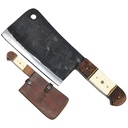
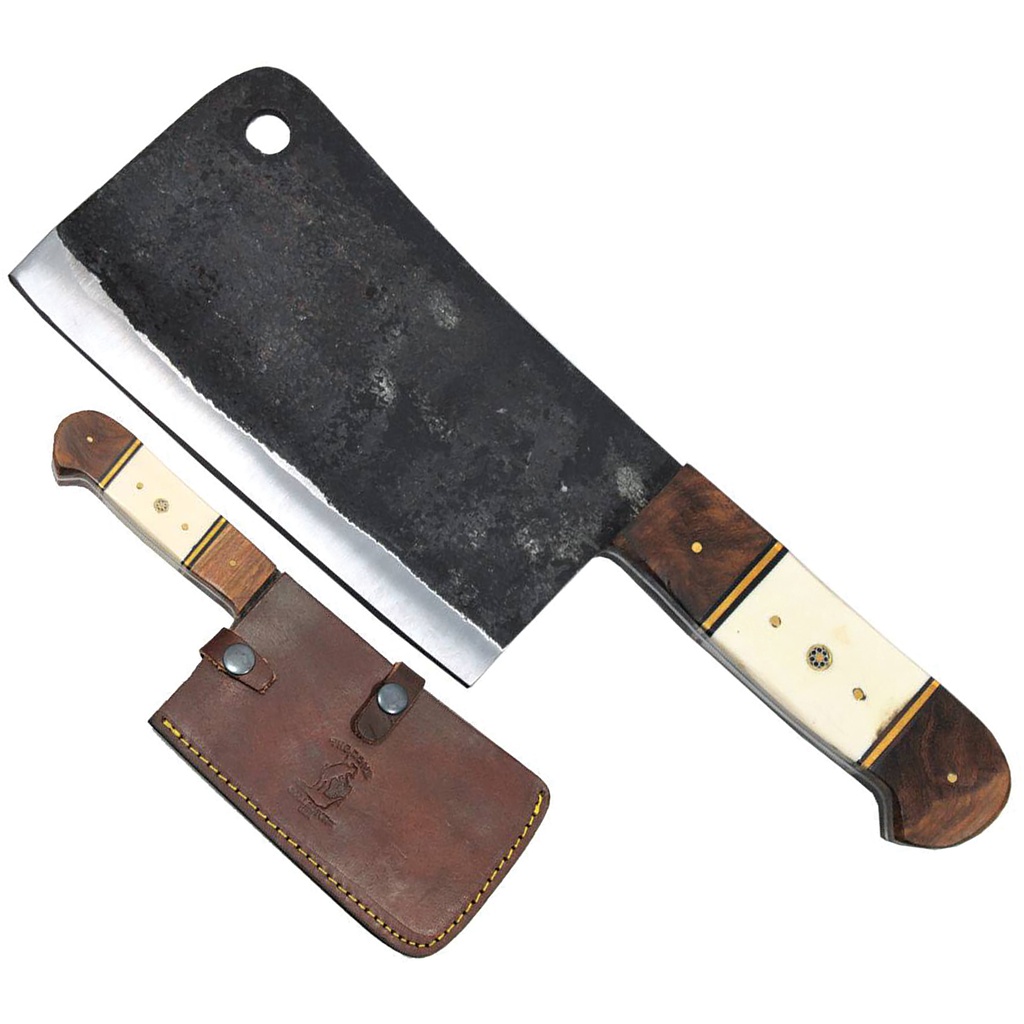
Look close and you see it: the rough-forged texture running along the upper part of the blade, the cleaner grind along the cutting edge, the bone handle framed by warm wood and dark spacers. Nothing about it looks sterile. It looks like a tool with a story, even on day one.
The full-length tang peeks out all around the handle, a solid strip of steel that tells you, without needing specs, that this thing is one piece from tip to butt. That’s why it feels unshakable when you choke up for detail work or slide back for heavy chopping. At 10.75 inches overall, it lands in that sweet spot: big enough for real butchering, compact enough to ride on your belt without feeling like a kitchen brick.
The bone scales don’t just say “heritage” on a shelf—they feel cool and dry under your palm when your hands are warm and slick. The mosaic pin is that one small, human detail that makes you want to turn the knife in your hand and just look at it before you use it. Brass pins and the grain of the wood at the front of the handle close the loop: this isn’t a prop. It’s a working tool that happens to look like something your grandfather might nod at.
The Weight You Notice—in a Good Way
Pick it up and you immediately know it’s 32 ounces, even if you never check the number. That weight means your wrist doesn’t have to carry the whole job. On tough cuts, gravity is your partner: you raise, guide, and let the cleaver fall. On finer work, you slide the edge instead of hacking. The matte finish keeps glare down when you’re working in bright sun or under harsh shop LEDs, so you see texture and grain instead of reflections.
Carrying a Heritage Field Butcher Fixed Blade Cleaver Into Real Life
In a drawer, any knife looks capable. You find out what’s real when it has to live on your belt through a weekend of weather, dust, grease, and constant reaching. The leather sheath on this cleaver wasn’t added for looks; it’s what makes a heavy worker like this something you actually bring, not just something you talk about.
The brown leather wraps the blade deep, with snap closures that stay put when you climb in and out of a truck or bend to haul gear. The yellow stitching and embossed logo aren’t there to impress anyone at a trade show; they’re the fingerprints of a piece that’s meant to be seen hanging on a nail in a shed, riding on a worn belt, or dropped on a cutting board next to a pile of fresh cut meat.
On the trail, that belt loop means your hands are free for packs, ropes, and rifles. At the homestead or backyard butchering day, it means the cleaver is always within reach without cluttering your limited horizontal space. You finish a cut, wipe the blade, sheath it, and move on. No hovering, no babying.
The Spine-Set Gut Hook You Don’t Realize You Needed
It’s easy to miss at first: a gut hook set into the spine near the handle. You really understand it the first time you’re field dressing in low light, working by headlamp or fading sunset. Instead of risking a slip with the main edge, you slide that hook under hide or along a seam and pull. It keeps the cut controlled and shallow, helping you protect meat and avoid punctures that make cleanup miserable.
That small detail turns the knife from “camp chopper” into a true field butcher fixed blade cleaver—capable of taking an animal from quarter to cooler without switching tools every ten minutes.
When a Heritage Field Butcher Fixed Blade Cleaver Beats Your Other Knives
You probably already own a pocket knife you trust, maybe a slim everyday carry blade that disappears in your jeans. Those knives are for the small, constant tasks: opening bags, cutting cord, trimming, shaping. A field butcher fixed blade cleaver steps in when the job itself has weight.
Breaking down a deer, splitting racks, portioning bone-in cuts, hacking through chicken backs for stock, prepping big vegetables on a camp block—those aren’t jobs for a delicate slicer. Here, you want a square-shouldered cleaver that lands with purpose, keeps its line through gristle and bone, and gives you a stable, wide blade to press with when you need leverage.
At home, it moves from butcher block to backyard cookout without feeling out of place. One evening it’s hanging from its belt loop on a hook in the garage, the next it’s next to a cutting board, working through racks and roasts while smoke drifts from the grill and people drift into the kitchen to see what you’re doing with “that big knife.”
Questions People Ask Before Buying a Heritage Field Butcher Fixed Blade Cleaver
Is a heavy field butcher fixed blade cleaver practical for everyday use?
If “everyday” for you means boxes and office tasks, no. This is not an everyday carry pocket knife. But if your normal includes hunting trips, processing meat, backyard butchering, or serious grilling, a heritage field butcher fixed blade cleaver becomes the tool you reach for on the big days—the ones that actually stick in memory.
Will this field butcher fixed blade cleaver hold up to bone and heavy chopping?
That’s exactly what it’s built for. The full-tang steel blade, 6 inches long and 32 ounces overall, channels force straight through the cut instead of flexing or twisting. Use a solid surface, respect the edge, and it will take repeated bone contact and hard chopping in stride.
How comfortable is the bone handle when my hands are wet or cold?
The bone handle on this heritage field butcher fixed blade cleaver stays relatively cool and provides a dry, solid feel even when your hands are warm or damp. The shape and wood bolster give you defined reference points for your grip, so you always know where the edge is pointing—even with gloves or numb fingers.
Can I carry this field butcher cleaver legally on my belt?
Laws vary a lot by state and country, especially for a substantial fixed blade knife like this. Many rural and hunting areas are friendly to carrying a field butcher fixed blade cleaver during related activities, but you should always check your local knife and hunting regulations before making it part of your everyday belt carry.
The Moment This Heritage Field Butcher Fixed Blade Cleaver Becomes Yours
Picture the first real use. The leather sheath creaks slightly as you unsnap it. You slide the heritage field butcher fixed blade cleaver free, feel the weight settle into your hand, and everything in front of you—meat, bone, board, expectation—suddenly looks manageable. The first clean chop lands, the joint parts, and the people around you stop wondering if you can handle it. They just start asking when dinner’s ready.
After that, it’s simple. This isn’t just another knife in a drawer. It’s the one you reach for when the job is big enough to remember later—when the story will include how well you handled the blade.