Operator-Ready Combatives Training Manual - Yellow
You don’t want another martial arts book; you want a straight line from doctrine to drills. This Army combatives field manual reads like an instructor who’s been there, walking you through rifle-bayonet work into hand-to-hand fighting. Pages feel like a course you can run tomorrow: clear patterns, range-based logic, and a structure that lets you build students—or yourself—without guesswork. This is where your training stops being random techniques and starts becoming a system.
You’ve got students who can throw a punch, shoot a rifle, maybe even grapple a bit—but when you stand in front of them, dry erase marker in hand, you feel the gap. What order should you teach this in? How do you connect weapon work to clinch fighting without making it up as you go? That’s the moment an Army combatives manual stops being a curiosity and becomes a tool you actually lean on.
How an Army Combatives Manual Quietly Becomes Your Backbone
The first time you flip through this Army combatives manual, it doesn’t feel like a book at all—it feels like walking into a course already in session. The sections aren’t random tricks; they’re laid out as if an instructor is talking you through how real fights collapse from distance to contact. Rifle-bayonet at range, transition, then full-on hand-to-hand combat.
Because it’s a September 1992 reprint of FM 21-150, you’re not guessing whether the material was ever pressure-tested. Every paragraph carries that clipped, no-drama tone the Army uses when it expects you to actually do the thing, not just think about it. That means you can stand in front of a room—cops, security teams, martial arts students—and know the progression you’re teaching has already been worked through by people whose margin for error was life or death.
Why This Army Combatives Manual Still Works in a Modern Fight
If you’ve spent any time around real conflict, you know the situation doesn’t care whether your techniques are Instagram-current. This Army combatives manual doesn’t sell flash. It starts with fundamentals that respect distance, posture, and intent: rifle-bayonet fighting that forces you to think about range, then hand-to-hand combat that takes you into throws, strikes, and close-in control.
The structure is what makes it quietly powerful. You don’t just get a pile of techniques; you get range-based principles, drilled into you in a sequence. You move from long weapon to mid-range to clinch in the same order fights actually collapse—reversed from how most hobby training goes. Instead of starting with fancy ground submissions and still feeling exposed standing up, you build from what happens when things go bad quickly and space disappears.
For you, that means fewer gaps. You can look at your current training and ask, “Where does my rifle transition? Where does my team learn to bridge from weapon retention to bare hands?” and then plug those holes with material written for that exact problem.
Carrying the Army Combatives Manual into Real Training Rooms
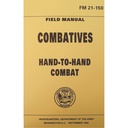
The yellow softcover feels like what it is: a government-issued field manual. No glossy photos, no marketing. Just black text, diagrams, and the U.S. Army seal quietly reminding you this wasn’t written to impress buyers; it was written to shape behavior. When you toss this Army combatives manual down on a mat or classroom desk, it changes the room. People recognize the format. They sit up a little straighter.
As an instructor, that matters. You can open to rifle-bayonet sections when you’re running force-on-force with training rifles, then flip forward into hand-to-hand progressions for your clinch or weapon-retention block. Because it’s a compact softcover, it lives easily in a range bag, on a dashboard, in a locker—always close when you’re building or revising a session plan.
Even if you’re not teaching yet, the layout gives your personal training a spine. One night you work the bayonet footwork patterns with a dummy rifle or stick. Next session you drill entries and throws drawn straight from the hand-to-hand combat chapters. The manual gives you something you can follow, adjust, revisit—so your training log stops being a random mix of YouTube ideas and starts reading like a course you’re actually progressing through.
When an Army Combatives Manual Does What YouTube Can’t
There’s a limit to how far clips and highlight reels can take you. You can learn a choke online; you can’t easily learn doctrine. This Army combatives manual gives you the boring, necessary backbone no algorithm will ever prioritize: definitions, priorities, safety framing, and a clear sense of what matters first when chaos hits.
You start to notice the difference in small ways. The next time someone in your circle talks about a "street fight technique," you find yourself asking, “Okay, but where does that fit—what range, what transition, what failure point?” That’s doctrine thinking. That’s the manual re-wiring you to see fighting as a system instead of a collection of party tricks.
And if you ever need to justify what you teach—to a department head, a school owner, a skeptical student—you’re not standing there with "some stuff I picked up." You’ve got an official field manual on the table, with a publishing line from Headquarters, Department of the Army. That doesn’t make you infallible. It does give you a foundation that’s bigger than your own experience.
The Feel of Having Doctrine in Your Hands
The paper isn’t fancy. The yellow cover is almost aggressively plain. But that’s the point. When you run your thumb along the edge and flip to COMBATIVES in big block letters, you feel like you’ve pulled something off a unit bookshelf, not a bookstore display. It smells like old-school training: ink, paper, and the unspoken expectation that you’ll put this to work on a mat, not a coffee table.
From Rifle to Hands: One Line, Not Two Worlds
If you work around firearms, you’ve probably noticed how often weapons training and empty-hand training live in different silos. This Army combatives doctrine refuses that split. One minute you’re on rifle-bayonet engagements, the next you’re in hand-to-hand transitions. You start to feel how the two belong in the same conversation—and your students feel it too.
Questions People Ask Before Buying an Army Combatives Manual
Is an Army combatives manual still useful if I already train martial arts?
Yes, because it doesn’t replace your art—it frames it. This Army combatives manual gives you range, doctrine, and sequencing. You can keep your jiu-jitsu, striking, or Krav, and use the manual as the backbone that decides what gets taught when and why.
What exactly is inside this Army combatives manual?
You get a reprint of the 1992 FM 21-150: rifle-bayonet fighting, hand-to-hand combat principles, specific techniques, and training guidance. It’s written in straightforward military language, so you can translate it into drills, lesson plans, or personal practice without wading through fluff.
Is this more of a collector’s item or a training tool?
It can sit on a shelf like a collectible, but it was born a training tool. The real value of this Army combatives manual shows up when it’s dog-eared, highlighted, and living in your range bag or gear locker, guiding how you actually train.
Can a beginner get value from this, or is it for instructors only?
A motivated beginner can absolutely use it. You may not run every drill solo, but you’ll understand how a complete combatives program is structured. Later, if you become an instructor, you’ll already think in the same organized way this manual teaches.
Owning the Moment You Open Your Army Combatives Manual
Picture your next training night. The room’s still noisy, people lacing up shoes, checking gear. You set your bag down, pull out the yellow softcover, and let it fall open on the mat. Conversations dip for a second when someone notices the seal, the big COMBATIVES title, the FM 21-150 across the top. You run a finger down a section you bookmarked earlier, nod once, and start calling people into line.
In that moment, this Army combatives manual has already done its work. You’re not winging it anymore. You’re the one in the room who can say, “Here’s where we start. Here’s where we’re going.” Doctrine in your hands, students in front of you, and a clear path from the first drill to the last rep. That’s the shift—from collecting techniques to owning a system.