Signal Doctrine Multiservice Survival Manual - Yellow Cover
You don’t carry a survival manual because you’re afraid. You carry it because you know panic scrambles memory. This multiservice survival manual rides in your pack like a calm, experienced voice: Army, Navy, Air Force, Marines on one signal yellow cover. In rain, cold, or confusion, you flip straight to shelters, signals, water, food. Your hands shake less. Your choices sharpen. You’re the person who planned ahead—and it shows.
The moment you realize the trail went quiet isn’t loud. It’s a slow, creeping awareness: no voices, no distant traffic, just your breathing and a sky that’s starting to dim faster than you expected. That’s when your brain starts to lie to you—distances feel off, directions feel wrong, and every choice suddenly feels heavier. This is exactly when having a survival manual you actually trust stops being theory and becomes the difference between wandering and acting.
When a Survival Manual Becomes Your Second Voice
You don’t pack a survival manual for the pages. You pack it for the version of you who might be cold, hungry, and tired enough to forget what you already know. In that moment, you want something that doesn’t feel like a hobbyist’s blog printed on paper—you want doctrine. You want procedures people have staked their lives on.
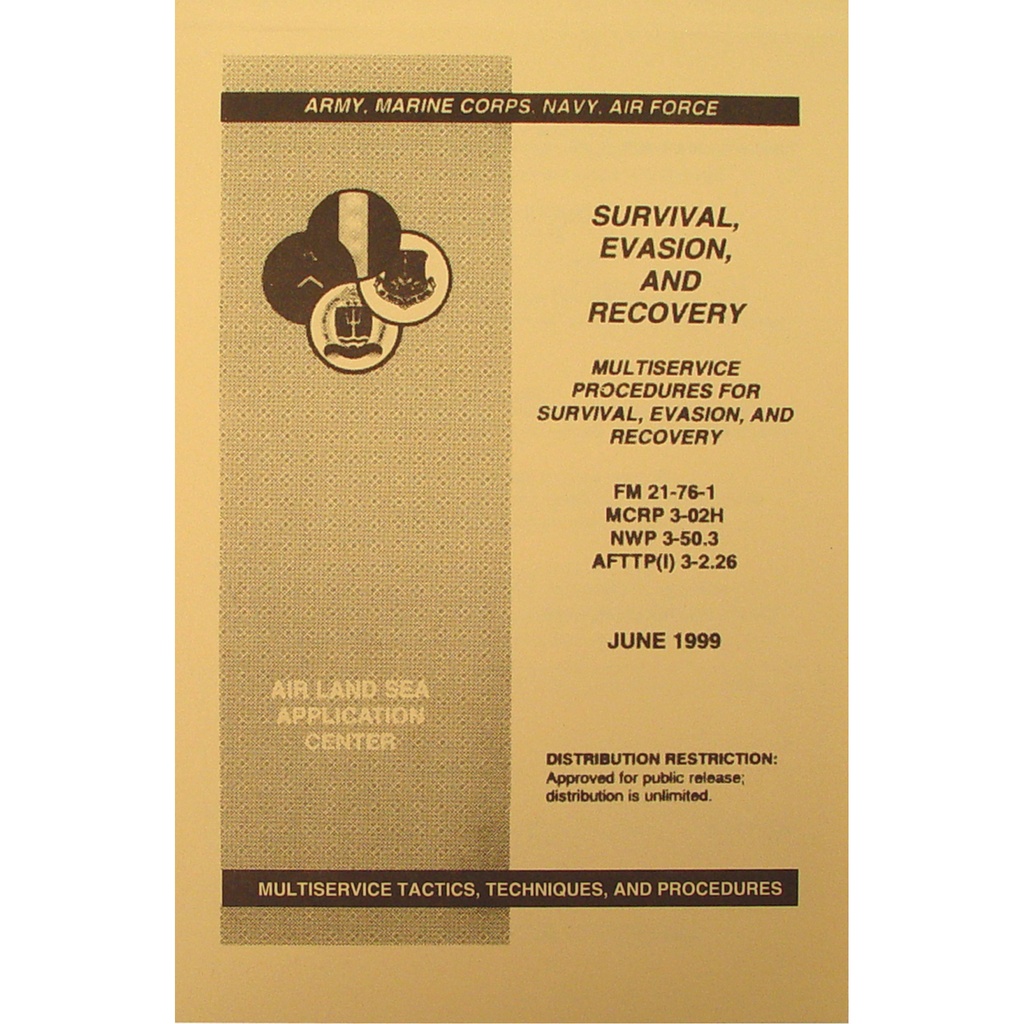
This multiservice field manual comes straight from the culture of Survival, Evasion, and Recovery—the SERE mindset—used across the Army, Marine Corps, Navy, and Air Force. The cover doesn’t shout with marketing. It stands there in signal yellow with four service emblems and a simple promise hidden in its design: when your thoughts start to spiral, you’ll have a calm, ordered way to move from panic to process.
Why This Survival Manual Looks the Way It Does
The first thing you notice is the color. That high-visibility signal yellow isn’t an accident. When your gear explodes across the ground in the dark, when your pack is open in the back of a truck, this survival manual is the thing your eyes find first. Your future self doesn’t waste seconds digging for it. It stands out on purpose.
Then you see the four circular emblems—Army, Marine Corps, Navy, Air Force—anchored against a gray vertical panel. Those marks tell you something you can’t fake: this is a multiservice field manual born from joint tactics, techniques, and procedures, not a weekend rewrite. The June 1999 date at the bottom quietly signals its era: post–Cold War, pre-digital distraction, when paper doctrine still had to do the heavy lifting in the field.
As a softcover, it bends with your kit instead of fighting it. It slides into a cargo pocket, glovebox, or side pouch without complaint. The design doesn’t ask you to treat it delicately; it expects to live with dog-eared corners, pencil notes in the margins, and mud at the edges. It’s a working survival manual, not a coffee-table prop.
Carrying a Survival Manual That’s Actually Built for Use
Think about where this survival manual will live for you. Maybe it tucks behind the med kit in your truck, rides in the hydration sleeve of your hiking pack, or slides alongside your range notebook. Wherever it lands, it’s light enough that you stop noticing the weight and start trusting the presence.
Inside, the structure mirrors how stress really works. Evasion. Shelters. Navigation. Signaling. Medical. Water. Food. Each topic is broken into practical, sequential steps—enough detail to act, not so much that you drown in theory. You’re not reading long essays; you’re reading field-proven ways to stay alive when you don’t get to hit “undo.”
Ink, Paper, and the Feel of Real Reference
There’s something grounding about real pages when you’re off-grid. No batteries to conserve, no screen glare, no notifications. Just black text on matte paper, readable under a red headlamp or a weak flashlight. You flip, you skim the bolded lines, you dog-ear what matters to you. Your hands remember where critical sections live, even when your mind is tired.
How This Survival Manual Steadies You Under Stress
Picture yourself after an unexpected night out—rain came in sideways, the temperature dropped harder than the forecast, and your phone is now a dead rectangle in your pocket. With this survival manual in your hand, the next moves stop being guesswork.
You open to shelters and it doesn’t just show pretty diagrams; it walks you through what to prioritize with the materials you actually have. You jump to signaling and see clear, direct guidance on using improvised mirrors, fire, sound, and ground-to-air symbols so a flyover doesn’t miss you. Navigation? It talks to you like someone who knows you might not have a compass, might have only the sun, shadows, and terrain lines to work with.
Water and food sections don’t pretend you’re in a survival show. They give you criteria to decide what’s safe, how to purify with minimal gear, and when conserving energy matters more than chasing calories. You’re no longer guessing; you’re following a path carved by people who planned for worst-case, not just for a weekend hike.
The Quiet Confidence of Doctrine in Your Pack
There’s a specific kind of calm that comes from knowing you’ve already answered tomorrow’s hard questions. Carrying this kind of survival manual is like carrying a checklist you didn’t have to write yourself—developed in the background by people who study what goes wrong so you don’t have to improvise everything in real time.
When a Survival Manual Outperforms Apps and Gear
You might be wondering how this compares to relying on your phone, downloaded PDFs, or that one big glossy wilderness book on your shelf. The difference shows up the first time conditions are bad enough that convenience dies.
A phone runs out of battery. A tablet cracks. A hardcover brick stays home because it’s heavy and precious. This slim survival manual is the thing you actually bring. It weighs little, holds a lot, and doesn’t care if it gets rained on, creased, or stuffed between other gear. When electronics fail—or when you deliberately leave them behind—it still opens, still reads, still works.
And because it’s a multiservice military reprint, the mindset inside isn’t entertainment. It’s operational: evade, survive, recover. That perspective quietly shifts how you see your own outings. Even on casual trips, you start noticing routes, landmarks, water sources, shelter options. The book you carry begins to rewire the way you move through the world.
Questions People Ask Before Buying a Survival Manual
Is this survival manual useful if I’m not military?
Yes. While it’s drawn from multiservice doctrine, the language and steps are built for real humans under stress, not just operators. If you hike, camp, hunt, overland, or just want a reliable emergency reference at home, this survival manual gives you clear, actionable guidance without assuming a uniform or special training.
How big and durable is the manual for everyday carry?
It’s a softcover field-style survival manual designed to ride in a pack, glovebox, or range bag without fuss. The flexible cover and practical size mean you can toss it in with your other everyday carry gear, fold pages, and mark sections without feeling like you’re damaging something fragile or collectible.
Why carry a paper survival manual when I have a phone?
Because batteries die, screens break, and signal drops exactly when you wish it wouldn’t. A physical survival manual doesn’t depend on power or connectivity, and it’s faster to flip to a dog-eared shelter or signaling page than to scroll through files while your hands are cold and shaking.
Is this survival manual good for teaching or training others?
It works well as a shared reference. The structured sections on evasion, navigation, signaling, medical, water, and food give you a backbone for classes, family drills, or group outings. Everyone can use the same terminology and steps, so when stress hits, your team isn’t arguing over methods—they’re following a common playbook.
Fast-forward to the next time you zip up a pack before heading out—forest trail, dusty back road, or storm-bound highway. Your knife is where it always is. Your light works. Your med kit’s topped off. And wedged beside it, that signal yellow survival manual you barely notice anymore—until you need it. When someone asks why you carry it, you don’t give a speech. You just tap the cover and say, “Because when things go sideways, I’d rather have a plan than a story.” And that’s who you are now: the person whose readiness doesn’t stop at gear—it extends all the way to what you know and what you can do when it counts.