Rivetline Board-Balanced Kitchen Meat Cleaver - Wood Grain
You know the moment: board crowded, pan hot, clock ticking—and you’re still calm. That’s where a board-balanced kitchen meat cleaver steps in. The satin steel hits the board with a clean, confident thud, the warm wood grain nestles into your palm, and suddenly bone, gristle, and veg all move to your rhythm. You’re not just hacking; you’re directing traffic. One knife, one motion, and your station looks like someone who’s done this a thousand times.
| Blade Length (inches) | 5.75 |
| Overall Length (inches) | 10.5 |
| Blade Color | Silver |
| Blade Finish | Satin |
| Blade Style | Cleaver |
| Blade Edge | Plain |
| Blade Material | Steel |
| Handle Finish | Matte |
| Handle Material | Wood |
| Theme | None |
| Handle Length (inches) | 4.75 |
| Tang Type | Full Tang |
| Pommel/Butt Cap | None |
When a Kitchen Meat Cleaver Turns Chaos into Rhythm
The board is crowded again. A slab of pork shoulder waiting to be broken down, carrots rolling toward the edge, onions half-diced, and a pan already heating behind you. In that moment, you don’t want options—you want one move that settles everything. Your hand closes around warm wood, you lift a compact kitchen meat cleaver, and the first chop lands with a clean, confident thud that quiets the noise in your head.
That’s the whole point of a board-balanced design. Not a wall-hanging showpiece. Not a lumbering butcher’s axe. A meat cleaver that feels dialed-in from the first swing, so your prep line finally moves at the pace you think in.
How a Kitchen Meat Cleaver Changes the Way You Prep
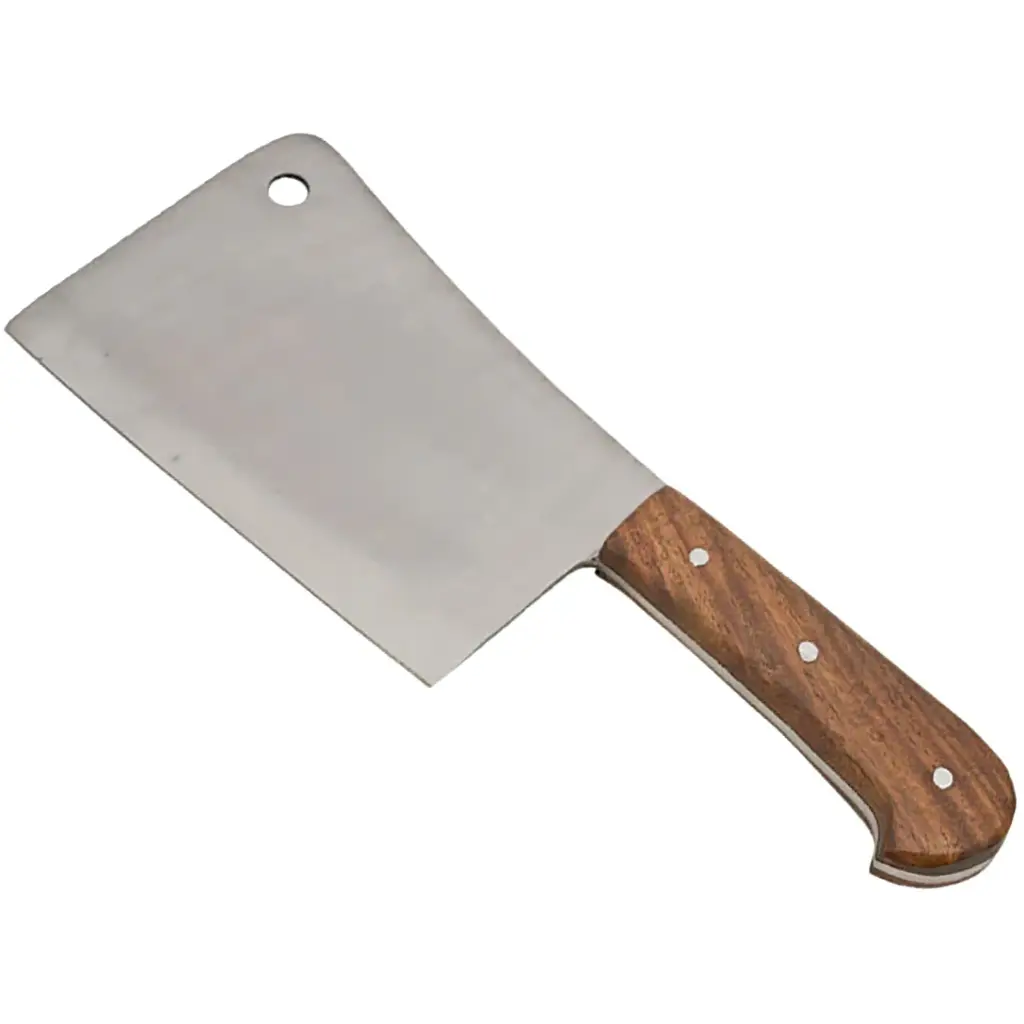
If you’ve ever fought with a dull, front-heavy block-store knife, you know the feeling of working harder than the blade does. Here, the balance sits where you actually live: over the board, between your fingers and the cutting edge. At 5.75 inches of satin-finished steel and 10.5 inches overall, this kitchen meat cleaver is compact enough to maneuver and heavy enough to let gravity help.
You drop through bone-in chicken instead of sawing. You tap through rib tips with control instead of bracing your whole body. The broad, rectangular blade gives you that butcher-shop confidence, but the shorter length keeps it from feeling like a sledgehammer in a small home kitchen. You feel the weight, but you don’t fight it.
There’s a quiet satisfaction to the sound it makes on the board—more of a solid knock than a slap. That sound tells you the edge is meeting the board cleanly, not twisting in your grip. After a few cuts, you start to trust that sound as much as the feel.
Why This Kitchen Meat Cleaver Feels So Sure in Your Hand
The details you notice first are the ones your hand can’t stop noticing. A full tang of steel runs the entire length of the handle, anchored by three bright rivets that catch the light like punctuation marks. The wood grain scales are warm brown, matte-finished, and shaped with a subtle flare at the butt so your hand knows exactly where the grip ends even when it’s slick.
That slight finger guard at the front? You don’t think about it until you’re mid-swing, knuckles close to the board, and you realize you aren’t white-knuckling to stay in place. The guard gives you just enough stop to push into a cut without creeping forward. It’s a small contour, but it changes how confidently you commit to a downward strike.
The satin blade finish matters more than you expect, too. Instead of grabbing every scrap of sinew and vegetable, the smooth face lets food release as you move. You’ll feel it when you scoop a pile of diced onions or smashed garlic with the flat—no catch, no drag, just a clean slide from board to pan.
The Hanging Hole That Tells a Story
Near the spine at the tip, there’s a round hanging hole—a nod to old butcher shops, where tools lived on hooks above heavy wooden blocks. You may hang it on a pegboard, or you may just feel that bit of heritage every time you see it on the counter. Either way, it’s a reminder: this is a working cleaver, not décor. It’s meant to be reached for with wet hands, set down hard, and grabbed again.
From Meat to Veg: Carrying One Cleaver Through Every Task
The surprise isn’t that this kitchen meat cleaver handles meat; it’s how easily it takes over everything else. You start with a pork shoulder, confident the full tang and sturdy spine can meet bone without flinching. Once it’s broken down, you’re already there at the board, so you keep going. Carrots fall into even chunks under the wide blade. Cabbage splits cleanly with a single press. Sweet potatoes—usually the nemesis of thin chef knives—give way without that nerve-jangling twist.
The broad face becomes a scraper, moving herbs and veg in wide, satisfying sweeps. You’ll find yourself slicing garlic with the tip, chopping cilantro with the front third of the edge, then turning and driving through chicken backs with the weightier rear. It goes from butcher to prep cook without ever leaving your hand.
Board-Balanced Means You Last Through the Whole Session
Board work takes stamina as much as skill. Because this cleaver is shorter than the monster blades you see in restaurant supply aisles, your wrist doesn’t pay the same tax. You still get enough mass to do real work, but you control it from a natural, close-in grip instead of reaching out to the end of a long handle. After a full round of trimming, chopping, and portioning, you’ll notice your shoulders aren’t lit up the way they used to be.
When a Kitchen Meat Cleaver Becomes Your Go-To Knife
There’s usually a moment when a tool crosses from “specialty” to “reach-for-it-first.” For many people, that moment comes the first time they realize they haven’t swapped knives in twenty minutes. You start by hacking through a rack of ribs. Without thinking, you move on to onions, then bell peppers, then a pile of chives—all with the same kitchen meat cleaver.
That’s when you understand what full-tang, wood-handled balance actually means in real use. The knife stops being the thing you’re thinking about, and the food becomes the only focus. Your motions get smaller, cleaner. You’re not babying an edge or babying your joints. You’re just cooking.
If you grill on weekends, it slips easily into that role, too. Out by the smoker, this cleaver feels right at home, turning slabs of meat, trimming fat caps, and portioning finished barky ends. Wipe it down, hang it within reach, and it’s ready to step back into the kitchen service without ceremony.
Questions People Ask Before Buying a Kitchen Meat Cleaver
Is a kitchen meat cleaver too much knife for everyday cooking?
Not when the blade is compact and board-balanced like this. A lot of people imagine a huge, unwieldy chunk of steel, but here you’re working with a 5.75-inch blade that feels more like a solid chef’s knife with a squared-off profile. You get the power for bone and hard veg without losing control on smaller prep.
Can this kitchen meat cleaver handle both bone and vegetables?
Yes, that’s exactly where it shines. The full-tang steel and cleaver-style spine give you the backbone for bone-in meats, while the plain edge and satin finish let it slide cleanly through onions, herbs, and dense roots. Most owners end up using it for both heavy butchery and daily board work.
How does the wood handle hold up in a busy kitchen?
If you treat it like any quality wooden-handled knife—hand wash, dry promptly, and avoid long soaks—it rewards you with years of solid feel. The triple-riveted scales hug the tang, and the matte finish gives you grip even when your hands are a bit damp. Over time, the wood takes on a subtle patina that feels personal.
Will a kitchen meat cleaver like this replace my chef’s knife?
For some cooks, yes. Once you get used to the straight edge and extra height, you may find yourself reaching for this cleaver more often than your traditional chef’s knife, especially for anything involving bone, hard veg, or big-batch prep. It’s less about replacing and more about discovering which blade your hands trust most.
The first time you bring this kitchen meat cleaver down on a crowded board, you’ll feel the difference immediately: the way the weight drops straight through, the way the warm wood locks into your grip, the way the satin edge meets the board with that clean, reassuring knock. A few sessions in, it won’t just be another tool in the block—it will be the one you instinctively pull when things get busy, the one that makes your station look like it belongs to someone who’s been here before. And as your rhythm settles in, you’ll realize you didn’t just buy a cleaver; you gave your hands a new way to move through the work.