Four-Ring Revival Fixed Blade Trench Knife - Black Alloy
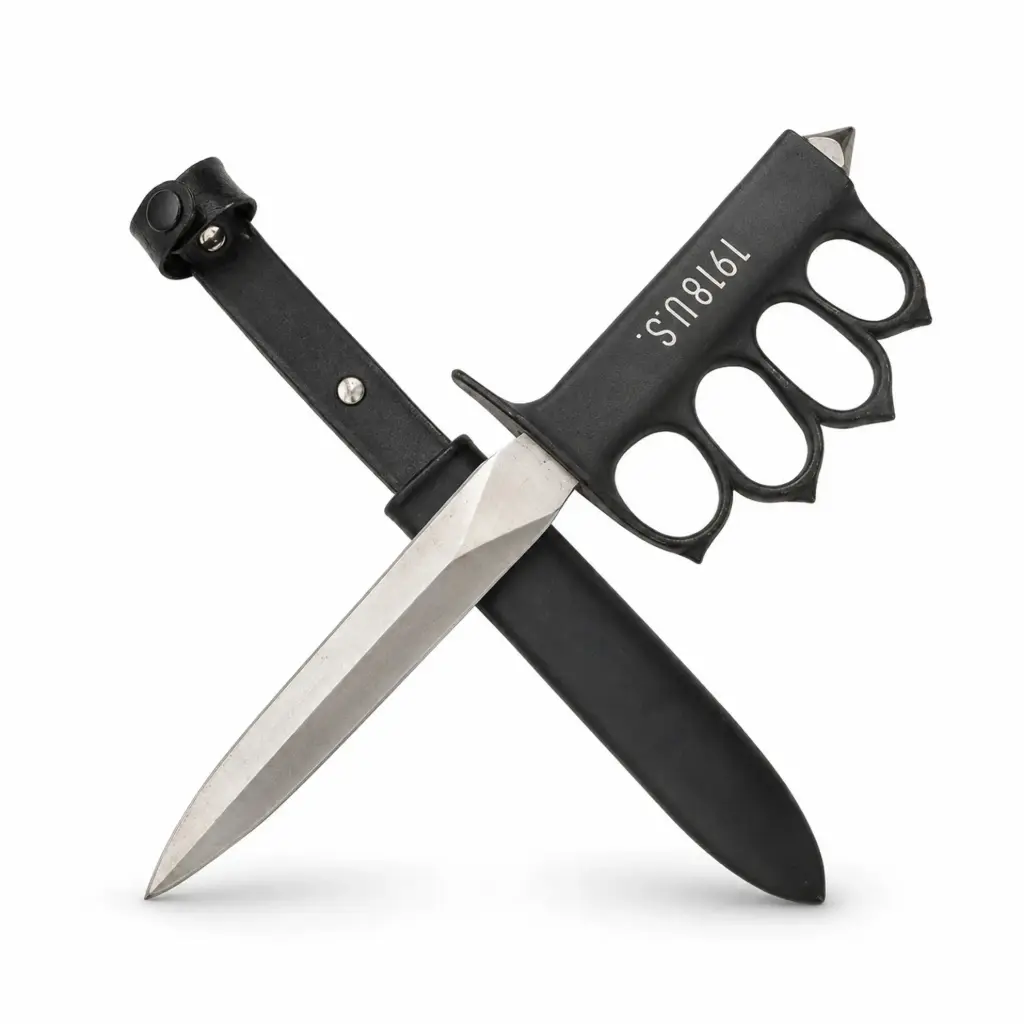
You clear a space beside the books you keep meaning to reread, and this trench knife gives that corner a different story. You notice the polished silver against matte black, then the 1918 U.S. marking tucked into the handle. With the leather sheath alongside it, you can picture the arrangement before you finish unpacking. Your collection starts feeling more deliberate: fewer objects chosen on impulse, more pieces you can explain. You haven’t acquired an antique; you’ve chosen a historical-inspired design that gives your curiosity somewhere to land.
| Blade Length (inches) | 6.375 |
| Overall Length (inches) | 11.5 |
| Blade Color | Silver |
| Blade Finish | Polished |
| Blade Style | Clip Point |
| Blade Edge | Plain |
| Blade Material | Stainless Steel |
| Handle Finish | Matte |
| Handle Material | Alloy |
| Theme | Trench Knife |
| Handle Length (inches) | 5.125 |
| Pommel/Butt Cap | Pointed Metal |
| Carry Method | Belt |
| Sheath/Holster | Leather |
You move a stack of old field guides, wipe the shelf, and leave a space beside a framed family photograph. You want something with a story, not another object that disappears into the background. A trench knife with a four-opening guard and a visible 1918 U.S. marking belongs in that conversation. You get a historical military-inspired silhouette rather than a claim of antique provenance. Before you decide where this trench knife belongs, you can already picture the polished silver catching the light against its black handle.
When a Trench Knife Gives Your Shelf a Story
You notice the guard first: four finger openings that make the shape recognizable before you read the lettering. Then your eye follows the contrast between the matte alloy handle and polished blade. That pairing explains why this trench knife makes sense as a collection piece: you can read its visual character from across the room, then discover smaller details up close.
Under the lamp, the lettering comes into view
When you look closer, the 1918 U.S. marking gives your curiosity a starting point. You might find yourself looking up period designs or comparing silhouettes in a reference book. You should treat that marking as a design detail, not proof of military issue, manufacture date, or service history. Your collector knife can invite a conversation without pretending to be an original artifact.
You do not need a whole room of military memorabilia to appreciate a trench knife. Beside a few carefully chosen objects, the black handle and silver blade give you a clear visual contrast. Your display feels considered because you know what drew you to it.
What You Can Actually Know About This Trench Knife
When you research a trench knife, you deserve more than dramatic language about toughness. Here, you can work with stated dimensions: a 6.375-inch blade, a 5.125-inch handle, and an overall length of 11.5 inches. Your fixed blade knife has no folding joint or opening mechanism to evaluate. Those measurements also help you judge shelf space before rearranging your collection.
You get a stainless steel blade with a polished finish, a clip point profile, and a plain edge. You do not get a specified steel grade, hardness rating, or documented edge-retention result. If your trench knife purchase depends on those performance details, you should have that information confirmed rather than filling the gaps with assumptions.
Your textured black alloy handle continues the restrained appearance, while the pointed silver pommel repeats the blade’s contrast. You can appreciate those details without treating them as evidence of grip security or impact resistance. For a historical-style knife, separating visible design from verified performance helps you choose with confidence.
Make Room for the Whole Piece, Not Just the Blade
Before you settle on a display, picture the included black leather sheath beside the knife. You can see its metal rivets and snap retention strap, details that make the arrangement feel complete. With this trench knife, you can build a presentation around both pieces instead of hiding the sheath in a drawer.
Before you fasten anything to your belt
If you are considering belt carry, pause at the dimensions. At 11.5 inches overall, your trench knife is a different proposition from a folding pocket knife. You need to consider clothing, movement, sheath placement, and local restrictions; the listed belt carry method does not establish comfort or legality.
You also cannot judge the fit of four finger openings from a photograph. Your hand size, gloves, and the shape of the guard all matter, so avoid assuming a universal fit. If your usual everyday carry blade disappears into a pocket, this fixed blade knife asks for a more deliberate decision.
At home, you can keep the trench knife sheathed when it is not being examined and store it securely away from children or unauthorized handling. Your collection deserves a setup that accounts for a blade and pointed pommel, not just an attractive sightline.
Trench Knife vs. Everyday Utility Knife: Choose the Right Role
You might admire this trench knife and still reach for a smaller tool when a parcel arrives. That is not a contradiction. Your collection and your daily tasks can ask for different things, and a knuckle guard adds a consideration you would not have with a conventional handle.
If you want a pocket knife for daily use, compare portability, task suitability, verified blade performance, and local carry rules first. If you want a military-inspired knife for a display, the four-ring silhouette and dated marking may matter more. Your best choice starts with the role you actually need filled.
For real-world durability, you should look for testing rather than infer it from appearance. You have stainless steel, alloy, and leather identified here, but no documented chopping tests, corrosion tests, or hard-use rating. Your trench knife should not be assigned demanding outdoor work on the strength of its historical styling alone.
That distinction helps when choosing a gift, too. You can give a collector something purposeful by recognizing their interest without assuming they want a carry knife. A brief note explaining why the design reminded you of them can make the choice feel personal.
Questions People Ask Before Buying a Trench Knife
Is a trench knife with a knuckle guard legal to carry?
You need to check the laws where you live and anywhere you plan to take it, because some jurisdictions specifically restrict knuckle knives or similar designs. Do not assume your trench knife is legal to carry simply because it is available to buy.
Is this trench knife an original military-issued antique?
You should regard this trench knife as a historical-inspired piece, not an authenticated antique. The 1918 U.S. marking does not establish age, military issue, or provenance.
Will this trench knife hold an edge with regular use?
You cannot predict edge retention reliably from the stainless steel description alone. Before choosing this trench knife for repeated cutting, ask for the steel grade, hardness, and maintenance guidance.
When you first lift the trench knife from its sheath to arrange your display, you notice the silver blade picking up the lamp’s reflection. You leave enough space around it, set the leather alongside, and step back. Your collection has not become louder; it has become more intentional. You know what caught your eye, what remains unverified, and why this piece belongs.